


How to Use a Pendulum for Beginners: Calibration, Questions, and Avoiding Bias

A pendulum is one of the simplest divination tools to begin using. It requires no elaborate spread, memorized card meanings, or formal ritual structure. At its most basic, it is a balanced weight suspended from a chain or cord, allowing small movements of the hand to become visible as swings, circles, or changes in direction.
That simplicity is also why pendulum work benefits from discipline. A pendulum can help a practitioner slow down, form precise questions, and observe an immediate physical response. It can also reflect expectation, tension, fatigue, and unconscious movement. A grounded practice makes room for both possibilities rather than treating every swing as unquestionable truth.
This guide explains how to use a pendulum for beginners, including how to establish signals, ask better questions, reduce bias, record results, and recognize when a pendulum should not be used.
What Is a Pendulum Used For?
Within modern divination and magical practice, pendulums are commonly used for yes-or-no questions, reflective decision-making, checking personal preferences, working with charts or mats, and supporting focused meditation. Some practitioners also use them in spiritual or energy-based traditions.
These uses belong to systems of belief and practice; they are not scientifically proven methods for receiving supernatural information. The visible motion of a handheld pendulum can be influenced by the ideomotor effect—small, unconscious muscular movements produced without deliberate awareness. This does not make the practice meaningless. It does mean that a pendulum is best treated as a reflective divination tool rather than an infallible authority.
Customers exploring different forms of divination can also read our guide to tarot cards versus oracle cards. Pendulum work is generally more limited in vocabulary, but its direct structure can make it approachable for beginners.
Choosing Your First Pendulum
A usable pendulum needs to hang freely, feel balanced, and move without the chain catching against your fingers. The shape, material, and decoration are secondary to basic function.
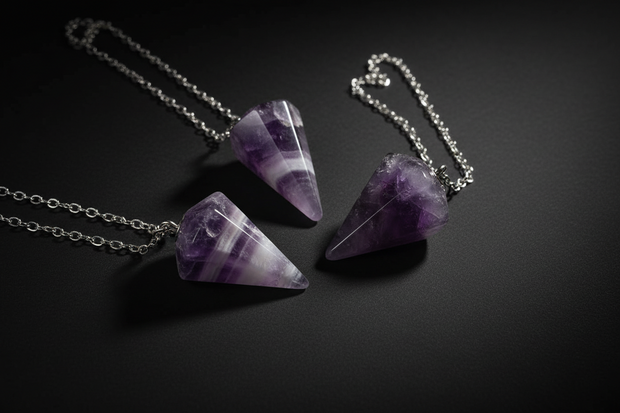
If you are deciding between stones, chain lengths and reading mats, browse pendulums and compatible reading accessories. Choose a comfortable weight and a stable place to practice.
When choosing one, consider:
- Weight: A very light pendulum can react strongly to drafts and hand tremors. A very heavy one may tire the hand. Choose a comfortable middle weight.
- Chain length: Many people begin by holding the chain several inches above the weight and adjusting until the motion is easy to observe.
- Shape: Pointed, rounded, and faceted pendulums can all work. Symmetry and balance matter more than a particular silhouette.
- Material: Crystal, metal, wood, and glass are all practical choices. Metaphysical associations may influence a practitioner's preference, but the pendulum does not need to be made from a specific stone to function.
Our gemstone pendulum selection includes several stone options for practitioners who enjoy choosing material by appearance or traditional correspondence. The broader Divination Tools collection also includes pendulums and supporting accessories.
Prepare for a Pendulum Session
A quiet, comfortable setup makes it easier to distinguish a steady response from environmental movement. You do not need a formal altar, but you should be able to sit without straining your wrist or shoulder.
- Sit at a table or desk with both feet comfortably supported.
- Rest your elbow or forearm so your hand does not tire quickly.
- Hold the chain lightly between your thumb and index finger.
- Allow the pendulum to hang without touching the table.
- Wait until it becomes relatively still before beginning.
Turn off a nearby fan and avoid working beside an open window. Strong airflow can move the pendulum independently of the hand. It is also wise to postpone a session when you are extremely tired, emotionally overwhelmed, or intensely invested in receiving one particular answer.
How to Calibrate Yes, No, and Unclear Signals
Calibration means establishing what each movement will represent during the current session. Do not assume that clockwise always means yes or that a side-to-side swing always means no. Signals can differ between people and may change with grip, position, or session.
Begin with the pendulum hanging still. Say or think, “Show me yes.” Observe the movement without trying to force it. Once a consistent direction appears, return the pendulum to stillness and ask, “Show me no.” Repeat the process for “unclear,” “unknown,” or “not ready to answer.”
Write the signals down before asking meaningful questions. For example:
- Yes: forward and backward
- No: side to side
- Unclear: clockwise circle
- Stop or reset: irregular motion or no movement
Next, test the calibration with several neutral questions whose answers you already know: “Is my name ___?” “Am I sitting indoors?” or “Is today the day of the week that it actually is?” Known-answer questions cannot prove paranormal accuracy, but they can reveal whether your grip, attention, and signal system are stable enough to continue.
Ask Questions the Pendulum Can Actually Answer
Pendulum questions should be narrow, unambiguous, and limited to one subject at a time. Confusing questions produce confusing interpretation.
Avoid questions such as, “Should I take the job and move next month?” This combines at least two decisions and does not define the standard for “should.” Break it into smaller reflective prompts instead:
- “Do I feel prepared to accept this position?”
- “Is my current hesitation mainly about relocating?”
- “Would gathering more information before Friday support a clearer decision?”
Even then, treat the response as material for reflection rather than permission to surrender judgment. A pendulum cannot evaluate a contract, predict guaranteed outcomes, or replace research and professional advice.
Good beginner questions are usually:
- Answerable with yes, no, or unclear
- About one issue only
- Specific about time when time matters
- Free from double negatives
- Not designed to invade another person's privacy
Recognize Expectation and Confirmation Bias
The most important skill in pendulum work is not producing movement. It is recognizing how easily the desired answer can shape that movement.
If you are hoping intensely for yes, your hand may begin reproducing the established yes signal before you consciously decide to move. This is one expression of ideomotor activity. Confirmation bias can then encourage you to remember the answers that felt accurate while overlooking misses, unclear sessions, or contradictions.
Several habits make the practice more honest:
- Write your question before holding the pendulum.
- Record the response immediately rather than relying on memory.
- Include incorrect and unclear results in your notes.
- Repeat important questions on another day instead of asking over and over in one sitting.
- Stop when you notice yourself rephrasing the same question until you receive the desired answer.
- Use ordinary evidence and practical research before divination when a decision has real consequences.
A Simple Beginner Pendulum Exercise
Use this short exercise to build consistency without placing pressure on the outcome.
- Calibrate yes, no, and unclear.
- Ask three known-answer questions.
- Ask one low-stakes reflective question.
- Write down the exact wording and response.
- End the session after five to ten minutes.
A low-stakes question might be, “Would I benefit from spending twenty quiet minutes reading tonight?” The point is not to obey the answer automatically. Compare it with your own reaction. Did the response surprise you, relieve you, disappoint you, or expose a preference you had not admitted?
That emotional reaction is often as useful as the pendulum's movement.
Do You Need a Pendulum Mat or Board?
A pendulum mat is optional. It provides printed answer zones that make movement easier to interpret, especially when a practitioner wants more than a basic two-direction system. Some mats include yes, no, maybe, rephrase, letters, numbers, or symbolic categories.
A mat does not automatically make the response more accurate. It gives the session a visible structure. Beginners should learn their basic signals before adding a complicated chart.
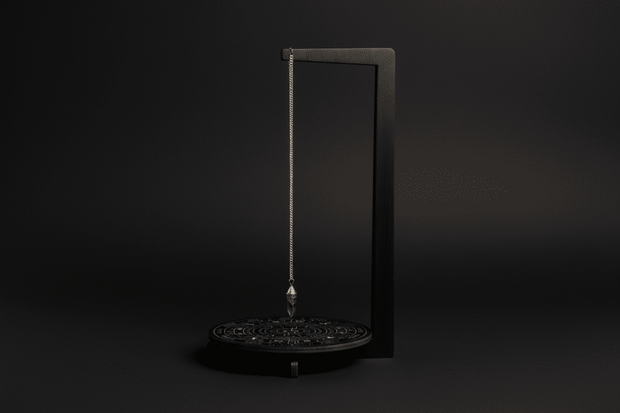
The Black Cotton Pendulum Mat with Gold Pentacle offers a simple working surface, while the Black Wooden Pendulum Stand combines storage and a structured reading display. A stand can also help prevent chains from becoming tangled between sessions.
Keep a Pendulum Journal
Consistent recordkeeping separates a thoughtful practice from selective memory. For each session, record:
- Date and time
- Your physical and emotional state
- Yes, no, and unclear signals
- The exact wording of each question
- The observed response
- Any immediate interpretation
- What later evidence showed
After several weeks, review the journal for patterns. You may discover that sessions become less stable when you are tired, that certain question structures create confusion, or that your first response is more consistent than repeated questioning.
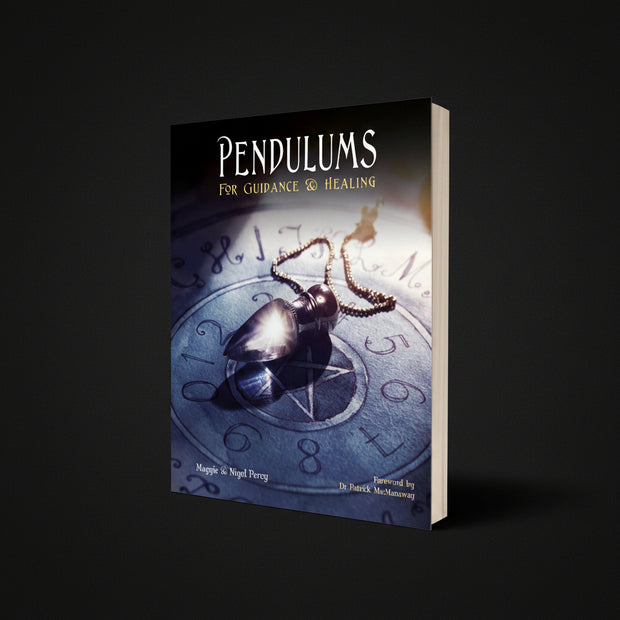
Readers seeking a dedicated introduction can explore Pendulums: For Guidance & Healing, an instructional book covering the basics and practical use of pendulums.
Cleaning and Storing a Pendulum
Physical care is straightforward. Wipe the pendulum gently with a soft cloth and store it where the chain will not knot. Before using water, salt, oils, or commercial cleaners, identify the material. Some stones, metals, finishes, and adhesives can be damaged by moisture or abrasive substances.
Practitioners who include spiritual cleansing in their tradition may use methods such as sound, visualization, prayer, or placing the tool in a designated resting space. These are ritual customs rather than requirements for the physical operation of a pendulum.
Responsible Boundaries for Pendulum Use
Do not use a pendulum as the sole basis for medical, mental-health, legal, financial, safety, or emergency decisions. It cannot diagnose illness, determine whether medication is safe, verify whether another person is dangerous, or guarantee an investment outcome.
It should also not be used to make accusations, test another person's loyalty, or claim access to private thoughts. Questions involving other people are especially vulnerable to projection and can damage relationships when a symbolic response is treated as evidence.
A responsible pendulum practice supports reflection while leaving final decisions with the practitioner.
Frequently Asked Questions
Why will my pendulum not move?
Your grip may be too rigid, the chain may be too short, or your arm may be braced in an uncomfortable position. Adjust the length, relax the hand, and begin with a small deliberate swing to observe how the pendulum travels. No movement can also be treated as an unclear response rather than a failure.
Can anyone use a pendulum?
Most people can experiment with one as long as they can comfortably hold or suspend it. No initiation or special identity is required. Different spiritual traditions may place their own meanings or rules around pendulum use.
Does the crystal type change the answer?
There is no reliable evidence that a particular crystal makes a pendulum objectively more accurate. Practitioners may choose stones according to traditional metaphysical associations, visual preference, or personal symbolism.
Should I ask the same question twice?
Repeated questioning often increases confusion and encourages answer-seeking. Record the first clear response. Revisit the issue later only when circumstances have changed or you have gathered new information.
Is a pendulum predicting the future?
Some practitioners interpret pendulum responses through spiritual frameworks, but future outcomes are not guaranteed. Choices, circumstances, and incomplete information can all change. Use pendulum work for reflection, not certainty.
Begin with Structure, Not Pressure
The best beginning pendulum practice is modest: establish clear signals, ask limited questions, record what happens, and remain willing to question your interpretation. A pendulum becomes more useful when it encourages precision and self-observation rather than dependency.
Explore our Divination Tools for pendulums, mats, stands, cards, and other tools selected for personal practice. Choose a tool that feels comfortable in the hand, then let patience and honest recordkeeping shape the work.
Tools for this practice
Explore the products selected for this guide. Review each listing for what is included and how to use it.
Shop this guide · 3 items Collapse


Keep exploring the shop
You made it to the end of the guide. Keep exploring through related products, major departments, or the full catalog.
 RELATED TO THIS GUIDE
Divination Tools
Shop this topic
RELATED TO THIS GUIDE
Divination Tools
Shop this topic


Leave a comment