


How to Use Ritual Oils in Witchcraft: Anointing, Candle Dressing, and Safety

Ritual oils are among the most versatile tools in practical witchcraft. A small amount can dress a candle, anoint a ritual object, mark the edge of a petition, or reinforce the purpose of altar work. The oil does not replace intention, judgment, or practical action. It gives the working a physical language: scent, touch, repetition, and a chosen correspondence brought together in one deliberate act.
What Is a Ritual Oil?
A ritual oil is a prepared oil associated with a particular purpose, spirit, current, or magical condition. Some formulas are built around broad intentions such as protection, prosperity, cleansing, love, clarity, or success. Others are associated with a deity, a devotional practice, a crossroads tradition, or a specific form of spellwork.
Ritual oils are not all formulated in the same way. Some are intended for candles and objects only. Others may be suitable for limited external use when the maker explicitly labels them for skin contact. Never assume that a spiritual oil is cosmetic simply because it comes in a small bottle.
Ritual Oils and Essential Oils Are Not the Same Thing
Essential oils are concentrated aromatic extracts. A finished ritual oil may contain a carrier oil, fragrance, botanicals, essential oils, or other ingredients, depending on the maker and tradition. Undiluted essential oil should not be treated like a ready-to-use anointing oil.
Read the product label before use. Do not ingest ritual oils. Avoid the eyes, mouth, broken skin, and other sensitive areas. Keep unknown blends away from children and animals, and consider allergies, medications, pregnancy, and respiratory sensitivities before working with scented products.
How to Choose a Ritual Oil
Choose the oil by the actual purpose of the working rather than by the most dramatic name. A clear intention makes it easier to select a useful correspondence.
If an oil does not suit your intended use, compare ritual oils, dry powders and prepared cleansing waters by their actual format and label. They are not interchangeable or automatically skin-safe.
- Protection and boundaries: A protection or warding oil suits work centered on shielding, reinforcement, and maintaining a boundary. The store’s Protection Ritual Oil is one example.
- Clearing and uncrossing: An uncrossing formula is commonly chosen when the work centers on removing accumulated obstacles, breaking an unwanted pattern, or resetting a condition. See the Uncrossing Ritual Oil.
- Prosperity and opportunity: Money-drawing and fast-luck oils are often paired with practical financial goals, applications, sales efforts, interviews, or opportunity work. The Money Drawing Ritual Oil is designed around this intention.
- Guidance and threshold work: Deity- or crossroads-associated oils may support an established devotional or spirit-work practice. The Hecate Ritual Oil is one example for practitioners whose work already includes Hecate or threshold symbolism.
- Introspection and integration: Shadow-work oils can accompany journaling, meditation, and self-examination. They are ritual supports, not substitutes for mental-health care or professional guidance.
Satanic and Luciferian Ritual Oils
In Satanic or Luciferian practice, ritual oils may provide a sensory cue for reflection, anoint a compatible symbolic object, or mark a devotional purpose. They remain optional and should be selected by their label, ingredients, intended use, and safety directions—not by the promise of a guaranteed result.
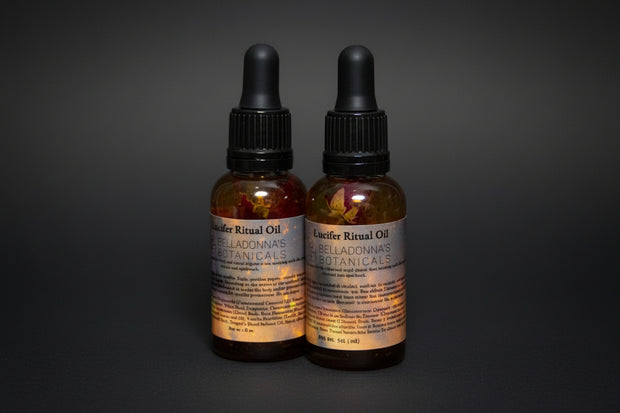
- Lucifer Ritual Oil is associated with illumination, sovereignty, and self-direction.
- Baphomet Ritual Oil is associated with balance, transformation, and embodied sovereignty.
- Demonic Praise & Offering Ritual Oil is intended for devotional and offering-focused symbolism.
Follow each product’s directions. Do not ingest ritual oil, assume it is skin-safe, pour it into melted wax, coat a wick, or apply it to porous statues, paper, fabric, or historic objects without first confirming compatibility.
How to Dress a Candle with Ritual Oil
Candle dressing is one of the most common uses for ritual oil. Begin with a clean candle and a very small amount of oil on a fingertip or cotton swab. Spread it in a thin film over the candle’s surface. The candle should never be dripping or heavily saturated.
Some traditions move oil toward the center when drawing something in and away from the center when sending something out. Others anoint from base to wick, wick to base, or according to a specific ritual pattern. These methods belong to particular systems; they are not universal laws. Consistency and meaning within your own practice matter more than copying a direction without understanding it.
Keep oil away from the wick and remove excess before lighting. Too much oil can cause sputtering, smoke, or flare-ups. Burn dressed candles in a stable, fire-resistant holder, clear the surrounding area, and never leave the flame unattended.
For a broader foundation, read Magic 101: Candle Magic and Simple Spells for Beginners and Beginner’s Guide to Prosperity Candle Spells.
Anointing Tools, Talismans, and Petition Papers
A trace of oil can be applied to the edge or back of a petition paper, the exterior of a spell jar, a candle holder, or a ritual tool made from a material that will not be damaged by oil. Use restraint. Oil can stain paper, cloud some stones, soften finishes, and damage porous wood or painted surfaces.
When anointing a talisman or tool, touch only a small point and state the purpose of the act. The goal is not to saturate the object. It is to establish a deliberate relationship between the object and the working.
For a petition paper, one tiny mark at a corner or along the reverse side is usually enough. Allow it to absorb before folding the paper or placing it near a flame.
Using Ritual Oils at the Altar or Threshold
At an altar, a drop may be placed on a dedicated dish, used on a candle, or applied to a washable ritual object. At a doorway or threshold, some practitioners mark a tiny point on a suitable surface as part of protection, road-opening, or welcoming work. Test the surface first and avoid any placement where people or animals could touch or lick the oil.
Oil, incense, and flame can be combined, but adding more materials does not automatically make a ritual stronger. Each element should have a clear job. The article How to Use Incense in Witchcraft explains how smoke can function as a separate ritual medium.
Personal Anointing and Skin Safety
Apply an oil to the body only when the product is explicitly labeled for external skin use. Even then, patch-test a small area, use the smallest practical amount, and stop if irritation occurs. Never apply ritual oil to broken skin or near the eyes, lips, or mucous membranes.
A symbolic alternative is to anoint a piece of jewelry, a cloth, or a dedicated token instead of the skin. This preserves the ritual action while reducing direct exposure.
A Simple Ritual-Oil Practice
- Write the purpose of the working in one clear sentence.
- Select one oil whose stated intention matches that purpose.
- Choose one application: candle, tool, petition, talisman, or altar object.
- Use one drop or less and apply it deliberately.
- Speak the purpose aloud or hold it silently while completing the action.
- Record what you used, how you used it, and what practical steps accompany the ritual.
Prosperity work might pair Money Drawing Ritual Oil with a dressed candle, a written financial goal, and a concrete action such as submitting an application, contacting a potential client, or listing new inventory. Protection work might pair Protection Ritual Oil with a household boundary practice and an ordinary review of locks, lighting, passwords, or personal limits.
Common Mistakes When Using Ritual Oils
- Using too much: Excess oil creates mess, staining, and unnecessary fire risk.
- Ignoring the label: Not every oil belongs on skin, candles, fabrics, or porous objects.
- Mixing formulas without a reason: Several overlapping intentions can make a working less coherent rather than more powerful.
- Expecting guaranteed results: Ritual oils support attention and symbolic action; they do not remove the need for effort, judgment, consent, or professional help.
- Skipping records: Notes help you evaluate your practice and distinguish purposeful repetition from anxious repetition.
How to Store Ritual Oils
Keep bottles tightly closed and store them upright in a cool, dark place away from direct sunlight, heat, and open flame. Wipe the neck of the bottle after use so residue does not collect around the cap. Label homemade blends with their ingredients and preparation date, especially when botanicals or perishable materials are involved.
Discard an oil that develops an unexpected rancid odor, visible mold, leaking packaging, or a major change in texture. A ritual association does not override the ordinary condition of the material.
Building a Grounded Practice
The most effective use of ritual oil is usually simple: one clear purpose, one appropriate formula, one careful application, and one practical action beyond the altar. Begin with restraint. Learn how a blend behaves on candles and materials, observe your own response to its scent, and keep safety more important than spectacle.
Handled this way, ritual oil becomes more than an aesthetic accessory. It becomes a disciplined method for giving intention a physical form.
If the purpose of the oil is obstacle work, compare Road Opener vs. Uncrossing vs. Blockbuster before choosing a formula. The categories describe different problems rather than stronger and weaker versions of the same working.
Tools for this practice
Explore the products selected for this guide. Review each listing for what is included and how to use it.
Shop this guide · 1 item Collapse
Keep exploring the shop
You made it to the end of the guide. Keep exploring through related products, major departments, or the full catalog.
 RELATED TO THIS GUIDE
Ritual Supplies & Altar Tools
Shop this topic
RELATED TO THIS GUIDE
Ritual Supplies & Altar Tools
Shop this topic


Leave a comment