


Do I Need a Pendulum Mat or Board? A Practical Guide to Yes/No, Letters, Chart, and Chakra Layouts

What a Pendulum Board/Mat Actually Is
A pendulum board or mat is a flat surface with printed response options — yes/no/maybe/rephrase, letters, numbers, and sometimes symbols. The user holds a pendulum over it and interprets swing direction as an answer. Mat and board are modern commercial terms for the same concept; cloth is a marketing synonym with no historical basis.
Do You Need One? Decision Framework
A bare pendulum works for straightforward yes/no questions. A board adds reference points but slows responses and introduces complexity. Choose a board only if you need:
- Spelling out words letter-by-letter (alphabet board)
- Categorical ranges like "strongly yes" to "strongly no" (chart/semi-circle)
- Energy-focused layouts with chakra symbols or other markers (chakra/symbol board)
If you are just starting out, a yes/no/maybe mat is the simplest entry point. Material (velvet, rubber, wood, paper) and size (commonly around 12 inches in commercial products) are preference choices, not efficacy decisions.
Four Board Types: Yes/No, Alphabet, Chart, Chakra/Symbol
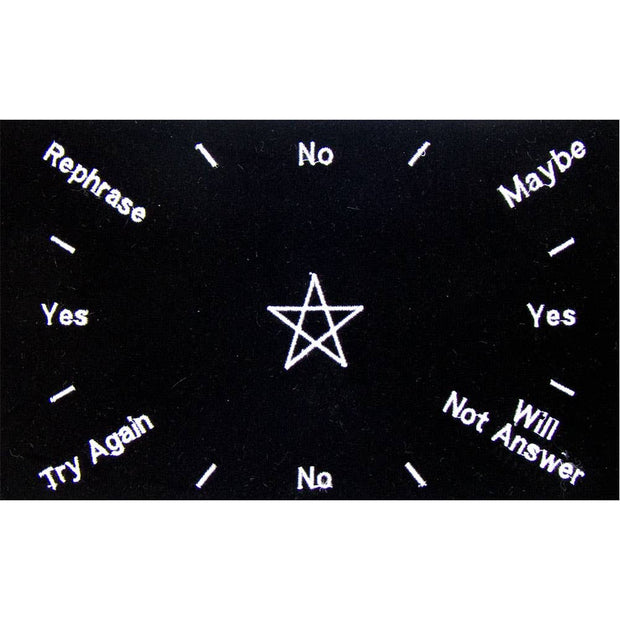
Yes/No/Maybe/Rephrase
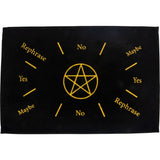
The simplest layout. Four labels acknowledge that ambiguous answers may mean the question was poorly framed, not that the pendulum is unclear. Conventions vary on which direction means yes — some boards place YES left, others right. No universal standard exists.
Alphabet Board
Letters A-Z for spelling words letter-by-letter. Slower and requires more practice. Letter order may be ABC or randomized; community reports suggest alphabet boards take longer and require more practice, but no empirical research validates one layout over another.
Chart/Semi-Circle Board
Categorical range layout for scale questions. Faster than alphabet for range-based answers but still depends on swing interpretation.
Chakra/Symbol Board
Energy-focused layout with chakra symbols or other categorical markers. Tradition-specific; not grounded in peer-reviewed research on board design.
How Pendulum Boards Work (Science)
The ideomotor effect — unconscious micro-muscular movements triggered by ideas — is the documented mechanism for pendulum motion (Carpenter 1852; Faraday 1853; Chevreul 1854/1864). This explains how the pendulum moves, but not whether the movement carries genuine external information. That question remains philosophically contested.
The largest controlled dowsing test (Munich 1987-88, >500 dowsers, 843 double-blind trials) found the group at chance. Betz claimed a positive subset; Enright 1999 reanalysis showed it is a statistical artifact. Debate continues but mainstream consensus finds no reproducible evidence.
No peer-reviewed studies exist on pendulum boards/mat/chart efficacy specifically; board design is documented only in practitioner literature.
History: What We Know and What Is Unsupported
The earliest documented proto-pendulum-board device is a 4th-century CE Roman account (Ammianus Marcellinus, Res Gestae 29.1.29-32) describing a ring on linen thread over a metal disk inscribed with Greek letters on a laurel tripod, used in 371 CE Antioch. Ammianus is hostile to paganism and likely embellishing; the device is a ring-on-thread over a lettered disk, not a modern mat.
The modern pendulum mat is entirely a contemporary product with no direct ancient lineage. The documented lineage runs: dowsing rods (15th c.), ring-on-thread divination (4th c. CE), planchette/Ouija (1840s-1890s), modern pendulum charts/mats (20th-21st c.). Many commercial sites claim "ancient Egypt" or "5000 years" — no archaeological or textual evidence supports this.
Gaspar Schott's 1662 Physica Curiosa was the first explicit European treatise on the pendulum as distinct from the divining rod, but it compiled Books 1-6 from earlier sources rather than presenting original experiment.
Setup, Care, and Safety
Physical care: keep the board clean and store it flat to avoid crease lines affecting swing. No physical safety risks from pendulum use itself.
Some traditions warn against using pendulum boards for questions about death, lost persons, or emotional distress — the ideomotor effect can amplify confirmation bias in vulnerable states. Do not use pendulum for medical diagnosis, financial decisions, or safety-critical questions; no evidence supports efficacy for these.
Cleansing methods (smoke, salt, moonlight) are tradition-specific with no measurable standard; salt water can damage some crystals.
DIY vs Commercial: What to Buy
If you decide you need a mat, the current AO inventory offers three pendulum mats and two complementary pendulum products. Mats are the direct board/mat category match; pendulums are complementary tools, not boards themselves.
- Black Cotton Pendulum Mat – Gold Pentacle Divination Tool — direct match for board/mat category; printed cotton with pentacle design.
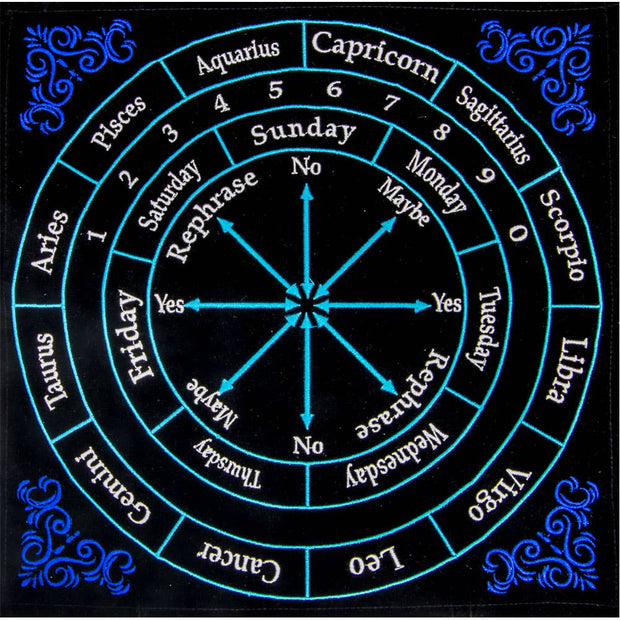
- Astrology Pendulum Mat – Color-Coded Divination Cloth — chart-style board variant.
- Black Pendulum Mat – Cotton Divination Cloth with Pentacle — yes/no/maybe layout candidate.
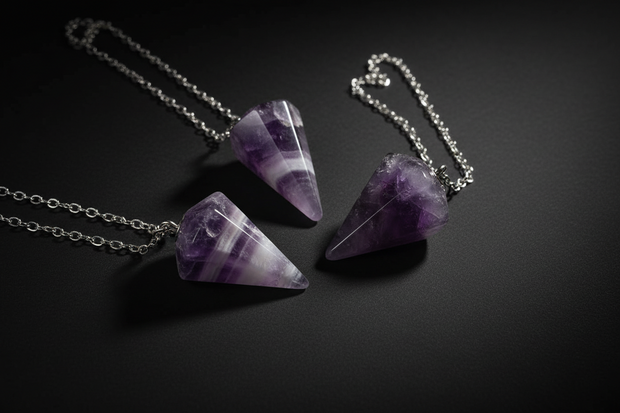
- Stone Pendulums – Assorted Natural Material Variants — complementary tool, not a board/mat itself.
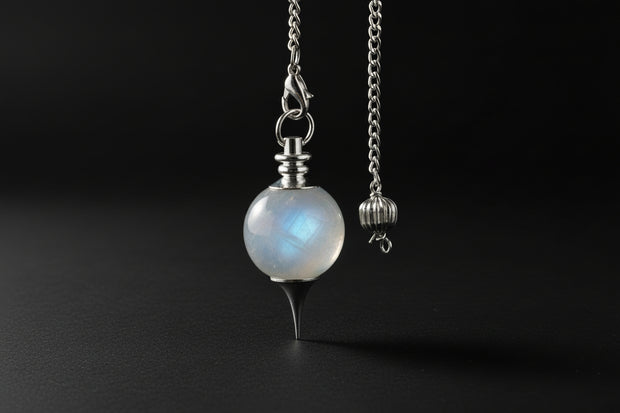
- Sephoroton Pendulum – Rainbow Moonstone Crystal — complementary tool, not a board/mat.
Exclusion criteria: do not recommend pendulum boards/mat for medical diagnosis, lost-person searches, or death-related questions. Do not claim historical ancient origins for any AO product. Do not assert efficacy beyond ideomotor reflection framework.
What This Article Does Not Prove
This article does not prove pendulum boards access external information, diagnose conditions, or locate lost persons. It does not validate "ancient Egypt" origin claims. It does not settle the debate on dowsing efficacy. Remaining uncertainty — museum artifacts, dowsing society positions, Chevreul timeline handling — is preserved in the evidence record. The article answers a practical setup question, not a metaphysical one.
Sources
- Ammianus Marcellinus, Res Gestae 29.1.29-32 (c. 390 CE) — Penelope Project, University of Chicago: penelope.uchicago.edu/ammianus/ammianus29.html
- Georgius Agricola, De Re Metallica (1556) — via Wikipedia: en.wikipedia.org/wiki/Dowsing
- Gaspar Schott, Physica Curiosa (1662) — via Wikipedia: en.wikipedia.org/wiki/Physica_Curiosa
- William B. Carpenter, "On the Influence of Suggestion in Modifying and Directing Muscular Movement" (1852) — via Wikipedia: en.wikipedia.org/wiki/Ideomotor_effect
- Michael Faraday, "Table Turning" (1853) — SPR Psi Encyclopedia: psi-encyclopedia.spr.ac.uk/articles/table-turning
- Michel Eugène Chevreul, research on the "magic pendulum" (1854/1864) — PubMed: pubmed.ncbi.nlm.nih.gov/956790
- Conjuring Credits, "Pendulum and Ouija Board" analysis: conjuringcredits.com
- Fox Taylor, Pendulum Craft (Sterling Ethos, 2025) — Hachette: hachettebookgroup.com
- Cassandra Eason, The Art of the Pendulum (Red Wheel/Weiser, 2005 ed.): archive.org
- Olson et al., "Ask the pendulum: personality predictors of ideomotor performance" (2017) — PMC: pmc.ncbi.nlm.nih.gov/articles/PMC5858027/
- Society for Psychical Research, "Dowsing" — Psi Encyclopedia: psi-encyclopedia.spr.ac.uk/articles/dowsing
- Enright (1999), "Testing Dowsing: The Failure of the Munich Experiments" — skepticalinquirer.org
Tools for this practice
Explore the products selected for this guide. Review each listing for what is included and how to use it.

Leave a comment