


Shadow Work for Beginners: Journaling, Prompts, and Healthy Boundaries

Shadow work is often presented as a dramatic confrontation with the darkest parts of the self. In practice, a grounded approach is usually quieter: noticing a reaction, recording what happened, questioning the story attached to it, and choosing a more deliberate response.
This guide introduces shadow work for beginners as a structured form of self-reflection. It can be used within a personal spiritual practice, a witchcraft practice, or a nonreligious journaling routine. It does not require you to accept every symbolic impression as fact, uncover painful memories on command, or treat discomfort as proof that a hidden truth has been revealed.
The goal is not to become perfectly healed, endlessly positive, or free from difficult emotions. The goal is to become more honest about recurring patterns while maintaining enough stability, perspective, and self-compassion to work with them responsibly.
What Does “Shadow Work” Mean?
In contemporary psychological, spiritual, and esoteric language, the shadow commonly refers to aspects of the self that are ignored, rejected, concealed, underdeveloped, or difficult to acknowledge. These may include anger, envy, fear, grief, ambition, vulnerability, desire, or even positive qualities that a person learned were unsafe to express.
Different authors and practitioners define the term differently. Some use it as a psychological metaphor. Others incorporate it into meditation, ritual, divination, ancestral reflection, or witchcraft. These frameworks may overlap, but they are not identical, and no single book or teacher owns a universal method.
A useful rule: treat an interpretation as a possibility to examine, not a verdict about who you are.
A journal entry can reveal a pattern worth exploring without proving why that pattern exists. A tarot card can provide a symbolic prompt without diagnosing a condition. A strong emotion can deserve attention without automatically confirming the first explanation that comes to mind.
What Shadow Work Is—and What It Is Not
Grounded shadow work may help you:
- Notice recurring emotional triggers and reactions.
- Examine assumptions that shape your behavior.
- Recognize protective habits that may no longer serve the same purpose.
- Explore qualities you judge harshly in yourself or others.
- Take greater responsibility for choices without collapsing into shame.
- Identify needs, values, fears, and boundaries beneath a surface reaction.
- Translate insight into a small practical change.
Shadow work is not a diagnosis, a guaranteed healing method, forced exposure to traumatic memories, a demand to forgive harmful behavior, or permission to blame yourself for everything that has happened to you. It is also not a substitute for licensed mental-health care.
You do not need to excavate your most painful experiences to begin. Everyday irritation, defensiveness, comparison, procrastination, resentment, and fear of being seen can provide more than enough material for early practice.
Set Boundaries Before You Open the Journal
Because self-reflection can become emotionally demanding, structure matters. Before beginning a session, decide what will keep the work contained.
- Choose a narrow subject. Work with one recent reaction rather than attempting to explain your entire life.
- Set a time limit. Fifteen to twenty minutes is enough for a beginner session.
- Choose an appropriate setting. Work somewhere private and stable, not while driving, working, drinking, or preparing to sleep after an already difficult day.
- Plan the ending. Decide how you will close the session: wash your hands, drink water, stretch, step outside, eat something, or complete an ordinary household task.
- Know your stop signs. If you become overwhelmed, disoriented, panicked, numb, or unable to return attention to the present, stop rather than forcing a breakthrough.
Depth is not the same as effectiveness. A short entry that leads to one honest behavioral change can be more useful than hours of emotional excavation.
What You Need for a Beginner Shadow Work Practice
A basic practice requires very little:
- A dedicated notebook or document.
- A pen or keyboard that allows you to write without interruption.
- A timer.
- Water and a simple grounding activity for afterward.
- An optional reference book or prompt guide.
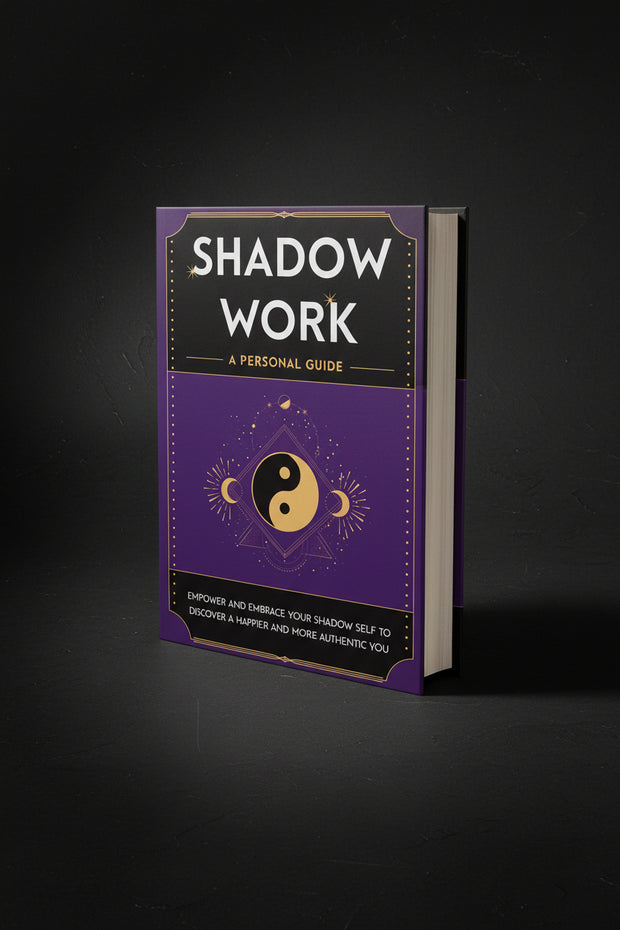
Keeping the work in one place makes patterns easier to review. A dedicated notebook from our Journals collection can help separate reflective work from daily task lists, while Shadow Work: A Personal Guide offers a compact starting point for readers who prefer a structured reference.
An Optional Shadow-Work Altar Setup
An altar is not required for shadow work, but a small temporary setup can establish time limits and keep the exercise focused. Place the journal at the center, use one symbolic object, and keep a clock or timer visible.
- A black obsidian scrying mirror may symbolize self-observation. Use it briefly in normal room lighting and do not treat visual distortions as proof of a spirit or recovered memory.
- A black chime candle may represent what has not yet been examined.
- A gray chime candle may represent ambiguity and the refusal to force a complex issue into a simple judgment.
Use an LED candle when live flame is unsuitable. Stop mirror or candle work if it causes fear, dissociation, compulsive checking, paranoia, or loss of sleep, and return the room to ordinary lighting after the session.
A Seven-Step Shadow Work Journaling Method
The following method keeps observation, interpretation, and action separate. That separation reduces the chance of turning a temporary feeling into a permanent conclusion about yourself or someone else.
1. Record the Event Without Explaining It
Begin with observable facts. Write what happened as though you were describing the scene to someone who was not present.
Example: “I shared an idea during the meeting. Another person changed the subject. I became quiet for the rest of the discussion.”
Avoid beginning with “They disrespected me” or “I always ruin everything.” Those may be interpretations, but they are not the event itself.
2. Name the Immediate Response
Record emotions, physical sensations, urges, and behavior.
- What emotion appeared first?
- Where did you feel it in the body?
- What did you want to do?
- What did you actually do?
You might write: “My face felt hot. I felt embarrassed and angry. I wanted to interrupt, but I withdrew instead.”
3. Identify the Story Attached to the Event
Ask what meaning your mind assigned to the situation.
Possible stories include:
- “Nobody values what I say.”
- “If I make a mistake, people will see that I do not belong.”
- “I have to be impressive to be accepted.”
- “Conflict always ends in rejection.”
Write the story plainly, but do not mistake it for confirmed fact.
4. Look for the Protective Function
Many difficult habits began as attempts to protect something. Withdrawal may reduce the risk of criticism. Perfectionism may try to prevent shame. Anger may create distance when vulnerability feels unsafe.
Ask:
- What is this reaction trying to prevent?
- What does it help me avoid feeling, admitting, or requesting?
- When might this response have been useful?
- What does it cost me now?
Understanding a protective function does not excuse harmful behavior. It provides enough context to change the behavior more deliberately.
5. Identify the Need or Value Beneath the Reaction
A strong response may point toward a legitimate need that is being expressed indirectly. Perhaps you need respect, clarity, rest, privacy, acknowledgment, autonomy, or a firmer boundary.
Ask what you were hoping to receive and whether you communicated that need clearly. The answer may be uncomfortable, but it should remain specific and practical.
6. Choose One Alternative Response
Shadow work becomes useful when insight changes conduct. Choose one action small enough to complete.
- Ask a clarifying question instead of assuming intent.
- State a boundary without attacking the other person.
- Return to a conversation after emotions settle.
- Apologize for a specific behavior without condemning your entire character.
- Allow yourself to be inexperienced rather than avoiding the task.
- Seek support from someone qualified to help with the issue.
The alternative does not need to feel comfortable. It needs to be more aligned with your values than the automatic reaction was.
7. Close the Session
Write one closing sentence:
“I have learned enough from this entry for today. My next step is ______.”
Then return attention to the physical present. Put the journal away, move the body, drink water, and complete the grounding action you selected before beginning.
Shadow Work Prompts for Beginners
Use one prompt per session. Answering twenty prompts at once can create volume without producing clarity.
- What behavior in other people produces a reaction that feels larger than the immediate situation?
- What quality do I criticize publicly but secretly fear or desire in myself?
- What do I believe I must hide to remain accepted?
- Where do I confuse being needed with being valued?
- What boundary do I resent others for crossing even though I have not clearly stated it?
- What do I gain by postponing this decision?
- What mistake am I unwilling to let myself be forgiven for?
- When I feel powerless, how do I attempt to regain control?
- What part of me appears only when I feel threatened?
- What positive quality have I made smaller because it once attracted criticism?
Do not assume that every answer is the deepest or final truth. Revisit important entries after several days and see whether the interpretation still fits.
Separate Observation, Belief, and Symbolism
One of the most important skills in shadow work is learning to separate what you know from what you suspect.
- Observation: “My friend did not reply for two days.”
- Interpretation: “They are deliberately rejecting me.”
- Emotion: “I feel anxious and unimportant.”
- Pattern: “Silence often leads me to expect abandonment.”
- Practical action: “I can ask whether everything is all right rather than accusing them.”
All five statements can matter, but they do not have the same evidentiary weight. This distinction is especially important when spiritual symbolism is included.
Using Shadow Work Within Witchcraft or Spiritual Practice
Some practitioners open a session with a candle, prayer, meditation, protective boundary, tarot card, or other symbolic act. These practices can help create focus and mark the beginning and end of reflective work.
However, ritual does not make an interpretation automatically factual. A card pull may suggest a question to explore; it does not prove another person’s motives. A dream may reveal emotionally meaningful imagery; it does not necessarily predict an event. A strong intuitive impression deserves discernment rather than immediate obedience.
When combining shadow work with spiritual practice, consider keeping separate journal headings:
- What happened
- What I felt and believed
- Symbolic or spiritual impressions
- Other possible explanations
- Practical action
This method respects spiritual meaning without allowing symbolism to erase evidence, consent, accountability, or ordinary problem-solving.
Common Shadow Work Mistakes
Trying to Go Too Deep Too Quickly
Beginners sometimes believe the most painful session must be the most productive. Overwhelming yourself can make reflection less accurate and harder to integrate. Work with manageable material first.
Turning Reflection Into Self-Punishment
Accountability asks, “What did I do, what effect did it have, and what will I change?” Shame declares, “This proves I am permanently bad.” The first can guide repair. The second often produces avoidance.
Assuming Every Discomfort Reveals Trauma
Some reactions connect to significant past experiences. Others result from fatigue, stress, poor communication, conflicting values, or an ordinary bad day. Avoid assigning a dramatic cause before considering simpler explanations.
Using Spiritual Explanations to Avoid Practical Action
Energetic language can be meaningful, but it should not replace direct communication, medical attention, financial planning, legal advice, or other concrete action when those are what the situation requires.
Collecting Prompts Without Changing Behavior
A journal can become another place to repeat the same story. End each useful entry with one observable next step, even when that step is simply resting, gathering more information, or asking for help.
Skipping Closure
Do not leave every session emotionally open. Use a consistent closing routine so the mind and body receive a clear signal that the work has ended for the day.
A Four-Week Beginner Practice
A simple month-long structure can help you build consistency without making shadow work an all-consuming project.
Week One: Triggers and Facts
Record one mild or moderate reaction. Focus on separating the event from the interpretation.
Week Two: Protective Patterns
Choose one repeated behavior such as withdrawal, people-pleasing, perfectionism, defensiveness, or procrastination. Ask what it attempts to protect and what it costs.
Week Three: Needs and Boundaries
Notice where resentment may be connected to an unstated need, unclear agreement, or missing boundary. Draft one respectful statement you could use.
Week Four: Integration
Review earlier entries. Look for repetition rather than isolated intensity. Select one pattern and one realistic change to practice over the next month.
Leave space between sessions. Reflection needs ordinary life, relationships, rest, and action in order to become integrated.
When to Pause and Seek Additional Support
Stop the exercise if it produces severe distress, panic, dissociation, intrusive memories, prolonged sleep disruption, worsening daily functioning, or an inability to return attention to the present. You do not need to prove your commitment by continuing alone.
A licensed mental-health professional can provide support when reflective work reaches material that feels unmanageable or unsafe. If journaling brings up thoughts of self-harm, immediate danger, or an urgent inability to stay safe, stop and contact local emergency or crisis support. Spiritual practice and self-help materials are not substitutes for emergency or professional mental-health care.
Choose Sources That Encourage Discernment
A responsible shadow-work resource should allow for uncertainty, encourage pacing, avoid promises of guaranteed transformation, and acknowledge the limits of self-guided practice. Be cautious with teachers who present every reaction as proof of trauma, demand disclosure, or portray emotional destabilization as evidence that their method is working.
For broader guidance on evaluating authors and avoiding repetitive beginner material, read Witchcraft Books for Beginners: How to Build a Reliable Study Library. You can also explore our Printed Works for additional study materials.
Begin With Curiosity, Not Condemnation
The shadow is not a monster to defeat. It is a useful name for material that may be difficult to see clearly. The work becomes more productive when curiosity replaces accusation and when insight is tested through responsible action.
Begin with one event, one honest question, and one manageable next step. Keep what helps you become more aware, accountable, and grounded. Question what encourages fear, certainty without evidence, or dependence on someone else’s interpretation.
Explore the Shadow collection, choose a dedicated notebook from our Journals, or begin with Shadow Work: A Personal Guide. The American Occultist offers practical tools and study materials for practitioners who want depth without surrendering discernment.
Tools for this practice
Explore the products selected for this guide. Review each listing for what is included and how to use it.


Shop this guide · 3 items Collapse


Keep exploring the shop
You made it to the end of the guide. Keep exploring through related products, major departments, or the full catalog.


Leave a comment