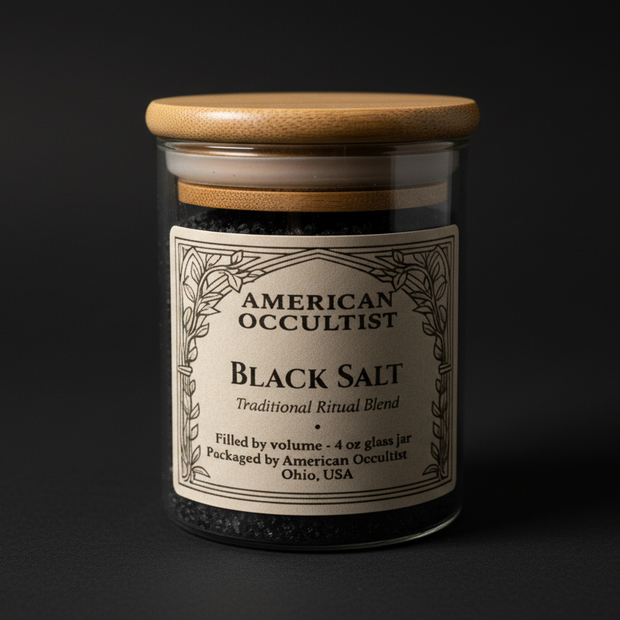
Black salt in Satanism serves as a powerful ritual protection salt and banishing tool that bridges both theistic and atheistic branches of the faith. Whether in Luciferian or traditional theistic Satanism, where practitioners believe in spiritual energies, or in LaVeyan Satanism’s symbolic psychodrama, black salt has found a place on the Satanic altar as a versatile tool for protection, boundary setting, and banishing negativity. This authoritative guide explores the historical and modern context of black salt in occult and Satanic practices, its typical uses in rituals (from protective warding to banishment spells), its psychological symbolism, and even how to make or source this Satanic altar tool. By understanding both the folklore and the practical applications of black salt, you can better appreciate how this humble mineral blend amplifies intentions and safeguards sacred space in the Left-Hand Path.

Origins and Significance of Black Salt in Occult Traditions

What is “black salt”? In occult practice, black salt (also known as Witch’s Black Salt, Sal Negra, or Drive-Away Salt) is not the same as the culinary black salt used in Indian cuisine. Instead, it’s a concoction of salt mixed with charred or black ingredients to imbue it with protective and banishing properties. Traditionally, practitioners create magical black salt by combining a base of sea salt with ashes from ritual fires or incense, powdered charcoal, and often other ingredients like iron filings or black pepper. The result is a coarse, dark mixture charged with intent – far more potent (magically speaking) than the edible “Himalayan black salt” or Hawaiian lava salt one might find at a gourmet store. The black color itself is significant: it symbolizes the absorption of negative energy, acting as a spiritual “sponge” to soak up malefic influences. Indeed, many traditions view the color black as a protective shield that absorbs negativity and provides strength during difficult times.

Historical roots: Black salt’s use in magic is rooted in folk traditions. In Hoodoo and folk magic of the American South, for example, “black salt” (sometimes called drive-away salt) has long been used for both protection and curse work. A classic Hoodoo practice is to mix salt with soot, charcoal, or iron scrapings to create a baneful powder that can either ward off evil or send someone packing. Folklore records that sprinkling black salt mixed with pepper in an enemy’s footprints will drive them away, and dissolving it into war water to splash on an adversary’s property can jinx them into leaving. At the same time, laying down black salt around your home was said to “drive away evil”, showing its dual role in folk magic. Because its ingredients (salt and ashes/charcoal) were common and accessible, versions of black salt popped up in various folk practices from New Orleans Voodoo to Appalachian granny magic.

Modern adoption: Despite these folkloric origins, black salt as a named ingredient in occult literature is relatively modern – it became popularized in Wiccan and witchcraft circles only in the late 20th century. Modern witches embraced black salt for its “extra kick” in protection spells beyond what plain white salt provides. From there, it naturally found its way into Satanic and Left-Hand Path practices, since many Satanists incorporate witchcraft and magick into their rituals. By the 21st century, black salt is a staple in metaphysical shops and online occult stores, often marketed specifically for protection and banishing. (For instance, one Luciferian apothecary sells “Black Salt for Protection & Banishing” and highlights its traditional names like Witches’ Salt and Sal Negro, underscoring its widespread use across occult paths.) In essence, black salt’s reputation as a primary protective element has transcended any one tradition – it’s now a go-to ingredient for witches, magicians, and Satanists alike when they need to ward off negativity or mark out a sacred boundary.

Theistic vs. Atheistic Satanism: How Each View Black Salt

Because Satanism itself is diverse, the way practitioners use and think about black salt can vary. Broadly, we can compare theistic Satanists (including Luciferians and other spiritual Satanists) and atheistic Satanists (such as LaVeyan Satanists of the Church of Satan) in their approach to ritual tools like black salt.

  • Theistic Satanism (Luciferian, Traditional Satanists): These practitioners believe in Satan or Lucifer as an actual entity or force and often practice magick as a real interaction with spiritual energies. In theistic Satanic rituals, black salt is typically employed very much like it is in witchcraft – as a substance with inherent spiritual power to protect, purify, or curse. For example, a Luciferian witch might consecrate black salt on their altar and then sprinkle it at the corners of their home while invoking Satan’s protection, literally believing that it wards off demons, hostile spirits, or the evil eye. Some ritual instructions in these circles speak of forming an “infernal warding circle” by walking the perimeter of one’s property with black salt, envisioning an empowered barrier against intruders and malign forces. Black salt may also be used on the Satanic altar itself: one occult source describes placing a black candle on the altar with obsidian and black salt while chanting an invocation – “Satan, lord of shadows, accept this black flame; empower my rebellion and shield my path” – blending the salt’s protective symbolism with devotion to Satan. In these contexts, black salt isn’t just symbolic; it’s considered a magickal tool charged with energy to help manifest the Satanist’s will (be it for protection, banishment, or spellwork).

  • Atheistic Satanism (LaVeyan Satanists): In contrast, LaVeyan Satanism (founded by Anton LaVey) does not believe in any literal deities or spirits. Ritual, in the LaVeyan view, is largely a form of psychodrama – a theatrical, emotional catharsis intended to focus the mind and release pent-up feelings, rather than to summon supernatural aid. This means that any tools used (candles, chalices, swords, etc.) are primarily props to engage the senses and the subconscious. LaVey’s own writings don’t specifically mention black salt in the standard Satanic ritual toolkit, but that doesn’t prevent modern atheistic Satanists from incorporating it if they find it useful. An atheistic Satanist might use black salt in a ritual purely for its psychological impact: for instance, casting a circle of black salt around themselves could help “set the stage” for the mind to enter a protected, magic-ready state. The act of sprinkling salt to symbolically keep out unwanted influences can serve as a powerful visualization aid – a way to tell one’s own psyche that “I am safe within this circle; no negativity can cross this line.” Even though the LaVeyan practitioner doesn’t believe the salt has objective power, they recognize that symbols can influence the subconscious. In the Satanic Bible, LaVey noted that rituals work by giving form to emotional needs and desires in the imaginal realm, thereby freeing the magician from those burdens. Seen in this light, using black salt as a banishing salt for Satanic rituals fits perfectly well: it becomes a dramatic prop that represents purging negativity. For example, in a destruction ritual (one of LaVey’s three basic ritual types meant to banish anger or obstacles), a LaVeyan might write down something they want to eliminate, cover the paper with black salt, and then destroy it – all as a self-guided psychodrama to feel that the obstacle is truly being cast out.

In practice, the line between these approaches can blur. Many self-described Satanists today draw from both traditional witchcraft and LaVeyan philosophy. They might genuinely enjoy the psychological aspect of ritual while also believing in a bit of energy work. Regardless of belief, the consensus in the Satanic and occult community is that black salt “does what you tell it to” – its effectiveness comes from the Satanist’s focused intent, whether that intent is seen as commanding spiritual forces or reprogramming one’s own mind (or both).

Common Ritual Uses of Black Salt: Protection, Banishing, and Beyond

Black salt’s popularity in witchcraft and Satanic practice comes from its remarkable versatility. It can be employed in any working that calls for protection, purification, banishing, or the establishment of boundaries. Here are some of the most typical uses of black salt in rituals, along with how they might appear in a Satanic context:

  • Protection & Warding: Perhaps the most widespread use of black salt is to protect a person or space from unwanted influences. Many practitioners sprinkle black salt around the perimeter of their home or ritual area to create a protective barrier that negative entities cannot cross. In a Satanic home protection spell, one might walk the property line with black salt (sometimes mixed with protective herbs or iron filings) while reciting an incantation for infernal guardianship. Laying a line of black salt across doorways and windowsills is a classic warding method to “keep unwanted people and energies out” of your home. Some even unscrew the threshold of their front door to lay black salt underneath, then replace it, creating a hidden long-lasting shield at the entrance. On a smaller scale, you can keep a packet of black salt on your person – for example, in a vial necklace or mojo bag – as a portable charm against psychic attack or the “evil eye”. Satanists who maintain altars may also keep a dish of black salt on the altar or sprinkle it in the corners of the ritual chamber, both to purify the space and to symbolically declare it protected from any forces that were not invited in.

  • Banishing Negative Energy: Black salt is an excellent banishing agent for any kind of negativity, be it an emotional cloud, a psychic hangover, or even a haunting presence. In ritual practice, one common technique is to use black salt in cleansing baths and scrubs – by adding a few tablespoons of black salt to a warm bath, practitioners immerse themselves to wash away spiritual grime and residual negativity from their aura. This is popular in Satanic self-care rituals (sometimes humorously called “demonic self-care”), where after dealing with toxic people or draining situations, a soak in a black salt bath can serve as a purification rite. Black salt is also used to cleanse objects: you might place crystals, talismans, or ritual knives in a bowl of black salt overnight to absorb any negativity they’ve accumulated. Similarly, sprinkling a pinch of black salt on mirrors, in the corners of rooms, or across thresholds is said to prevent negative energies or even malevolent spirits from entering. In formal banishing rituals, a Satanist might write down the bad habit or influence they want gone, set the paper under a candle, and ring it with black salt. As the candle burns, they visualize the salt drawing out and trapping the unwanted energy. Afterward, the salt (along with the paper’s ashes) is disposed of outside – carrying away the negativity with it. Many report that such rituals leave the space feeling noticeably “lighter” and psychologically freer; in fact, one survey found 74% of practitioners felt a significant reduction in unwanted energy after using black salt in their cleansing rituals.

  • Setting Boundaries & Circles: In both traditional witchcraft and Satanic ritual, circle-casting is a way to define sacred space. Black salt offers a dramatic alternative to chalk or white salt for this purpose. Its dark grains can be used to draw a circle on the floor around the altar or participants, visually marking the boundary of the ritual arena. Some Left-Hand Path magicians prefer black salt for circle casting during baneful workings or necromantic rites, associating its color with the chthonic (underworld) powers. Creating a circle of black salt and iron powder, for example, adds an extra layer of protection when summoning Goetic spirits or performing heavy banishing like the Lesser Banishing Ritual of the Pentagram in a Satanic context. Even outside of formal circles, boundary-setting with black salt can be practical: if you’re staying in an unfamiliar place or feel spiritually threatened, you can sprinkle black salt across door thresholds and along window panes to “seal” the room. One witch (who happened to be a Satanist) recounted keeping an unbroken ring of black salt around her old house as a protective fence, and she planned to do the same after moving to a new home. This idea of an unbroken salt line harks back to folklore about spirits being unable to cross a line of salt. In a Satanic twist, you might call this perimeter your “Infernal Ring of Defense,” dedicating it to Satan or a patron demon to empower the boundary. The black salt circle not only keeps things out but also holds your own power in – it defines the space wherein your will is law.

  • Banishing Unwanted People (Curses & Drive-Away Spells): On the more aggressive side, black salt is frequently used in spells to get rid of unwanted people or influences. Because of this, it’s sometimes nicknamed banishing salt. For instance, if someone is harassing or threatening you, some occultists will discreetly sprinkle black salt in that person’s footprints or path, with the intention that it will prevent them from returning to your home or life. This folk spell essentially “salts the earth” under their feet. Another technique is to write the person’s name on a slip of paper, put it in a jar or bag with black salt, and then either shake it vigorously (to send them away) or place it in the freezer – the idea being that you’re “freezing them out” of your life while the black salt absorbs and neutralizes the harm they cause. Author Lisa Wagoner describes a similar banishing spell in her work Positive Pagan: she adds black salt to a baggie with the target’s name (written 3, 6, or 9 times), seals it, and sticks it in the back of the freezer. “The result is usually that the inevitable happens – the person drifts out of my sphere – and the black salt in the spell provides a boost,” she notes. Importantly, the intent in such spells is often to remove the person’s influence without directly harming them (more of a banishment than a curse). However, black salt can feature in darker curse work too. Mixed with cursing herbs or graveyard dirt, it can be used to symbolize and carry the destructive aspect of the caster’s will. For example, one practitioner combined black salt with rusted iron shavings, black pepper, and ash to fill protection bottles that would “obfuscate and blind” anyone trying to cause harm. Here, black salt acted as a both a protective shield and a component in reflective hexing (sending harm back to the sender). In Satanic magic, where actively cursing an enemy is considered acceptable if justified, black salt is valued as a key ingredient in destruction rituals – it can be strewn across a poppet or used to form a sigil on a ritual altar that represents the target’s banishment or downfall. Even as a simple practical trick: a bit of black salt quietly sprinkled on an obnoxious coworker’s chair (where they won’t notice it) is a low-key way some witches attempt to make that person decide to transfer or leave.

As these examples show, black salt is truly multifaceted. It can protect and it can curse; it can bless your space with a boundary of Saturnian (protective) energy, or it can be the dirt on your enemy’s doorstep telling them to get lost. The key is intention. As one Hoodoo saying goes, “Salt does what you tell it to”, meaning that by directing your will into black salt, you effectively program it for the task at hand. This is empowering for the practitioner, Satanist or otherwise: you’re literally taking a physical substance and making it a carrier for your will. No wonder black salt is often called a “must-have” in the witch’s (or Satanist’s) arsenal.

The Psychological Symbolism of Black Salt in Ritual

Beyond its practical uses, black salt carries rich symbolism that resonates on a psychological level – a major reason it’s favored in ritual arts. Color psychology and Satanic aesthetics: The color black is deeply meaningful in Satanism. It is the color of the unknown, the forbidden, and the powerful. Psychologically, black can represent protection and boundary-setting; it’s like wearing armor. In fact, color symbolism sources note that black is often seen as a shield that absorbs negative energy, providing strength and grounding in times of trouble. When a Satanist lays down black salt, the very appearance of that dark line on the floor or that opaque grain in the water can trigger a subconscious sense of safety – it visually marks “this is protected; negativity cannot penetrate here.” Unlike bright white salt (which symbolizes purity and light), black salt’s darkness aligns with the Left-Hand Path embrace of the shadow. It says: we are not afraid of the dark; we wield it. This makes it particularly potent in rituals that involve confronting one’s inner demons or external fears.

Banishing internal negativity: Many Satanists are interested not just in external magic but in self-transformation (often termed “shadow work” in occult circles). Black salt can serve as a tool for psychological cleansing in this regard. For example, during meditation or self-reflection, a practitioner might place a small bowl of black salt nearby with the intention that it will absorb internal obstacles like self-doubt, guilt, or anxiety. As one spiritual guide suggests, you can even visualize the black salt pulling confusion or negative thoughts out of your mind, bringing clarity as you meditate. The act of symbolically transferring your unwanted feelings into a tangible substance can be very therapeutic. In line with Anton LaVey’s view of ritual as catharsis, using black salt to represent your negativity or “bad stuff” allows you to objectify it and then symbolically get rid of it – a form of psychodrama that purges psychic burden. It’s no coincidence that many feel lighter after sweeping up and tossing out the salt they used in a banishing ritual; the physical act reinforces the mental release.

Empowerment and control: Another psychological aspect of using black salt is the sense of control it can impart. Satanism often emphasizes self-empowerment and being the master of one’s own life. When you circle your space with black salt or sprinkle it into a spell, you are actively asserting your will over the situation – drawing a line, literally and figuratively. This process can build confidence and reduce fear. Instead of feeling helpless against “negative vibes” or difficult people, you perform a ritual step that concretely says “I am protected. I have made it so.” From a Jungian perspective, one could say that black salt rituals help engage the shadow self safely. By working with the symbolic darkness (black salt) in a controlled way, the practitioner is integrating their fears and aggressive energies rather than being secretly controlled by them. Even skeptics might acknowledge that there’s a placebo effect at work: if casting a circle of black salt makes you feel secure, that mindset can become a self-fulfilling prophecy where you actually project confidence and ward off bullies or energy vampires in real life. In this way, black salt serves as both a spiritual and psychological tool, perfectly aligning with the Satanic principle of using whatever works to achieve one’s desired outcome.

It’s worth noting that some contemporary Satanic and Luciferian sources even list “shadow work exploration” as one of black salt’s uses. “Shadow work” involves delving into the hidden or repressed parts of one’s psyche – confronting personal demons, so to speak. Black salt is fitting here because it symbolizes that very darkness one is delving into, yet it also acts as a protective container for it. A Luciferian practitioner might, for instance, write down traits or memories they are working to acknowledge (anger, trauma, etc.), place the paper in a dish of black salt on the altar of Lucifer, and meditate. The black salt in this context both represents the shadow material and provides a kind of grounding, absorptive presence to make the process feel safe. Spiritually and psychologically, black salt teaches a powerful lesson: that embracing and controlling the darkness (rather than fearing it) can be a path to strength, protection, and transformation. This message resonates strongly with Satanists, who often pride themselves on facing the dark truth of reality and of themselves. By incorporating black salt into rituals, they give concrete form to that ethos – turning abstract concepts of protection and self-mastery into something you can hold, sprinkle, or cast to the wind.

Crafting and Sourcing Black Salt for Your Rituals

One of the appealing things about black salt is that you can make it yourself with relative ease, imbuing it with personal energy, or you can obtain it from specialty shops if you prefer convenience. If you choose to craft your own, here is a basic guide:

  • Salt: Start with a base of salt – traditionally sea salt or rock salt. Salt itself is purifying and protective in magic, forming the foundation of the blend. Any grain size will do, but many prefer coarse salt for sprinkling around, and fine salt if it will be used in jars or sachets.

  • Charcoal or Ash: To turn the salt black, you need something carbonized. Common choices include the ashes from your incense or fire safe from prior rituals, or ground activated charcoal (such as the remnants of burnt herbs or charcoal disks). These ingredients not only color the salt but also carry the energy of whatever was burned (incense ashes from protective herbs can add their properties to the mix). Some witches burn specific herbs (like rosemary, sage, or protective resins) and use those ashes in black salt.

  • Iron Filings or Dust (Optional): If available, iron scraps – often collected from old cauldrons, cast iron pans, or a blacksmith’s anvil dust – are prized additions. Iron is traditionally a metal that repels evil and mischievous spirits, and a “pinch of metal” in the salt is said to give it extra kick against malevolent entities. For example, an experienced occultist might add filings from a forged nail or some powdered magnetite to supercharge the banishing effect.

  • Black Pepper or Chili (Optional): Some recipes include black pepper, cayenne, or other banishing spices for an extra fiery banishment quality. These ingredients are more often used when the black salt is intended for curse or enemy work, as the heat “spices up” the jinx.

  • Eggshell Powder (Optional): A less obvious ingredient, but one used by certain practitioners, is powdered eggshell (known as cascarilla in folk magic). White eggshells ground to a fine powder can be added for protection and also to help the salt form a more complex matrix. One witchy recipe suggests mixing crushed eggshells with the salt and ashes; interestingly, eggshells bring a cleansing, protective vibration and were historically used to cast circles (the combination of black salt and white eggshell creates a balance of dark and light).

  • Blend and Charge: Use a mortar and pestle if possible to grind and blend the components thoroughly. As you mix, it’s important to infuse the salt with your intent. Visualize and speak your purpose – for example, say aloud that this salt will guard against all harm and absorb all negativity that comes near you. Some like to mix during a waning moon or on a Saturday (Saturn’s day, tied to banishing) for extra correspondences, but this is up to your personal practice. The finished black salt should be stored in a tight jar and labeled. It’s essentially ready to use immediately, though many practitioners like to consecrate it on their altar (perhaps dedicating it to Satan or a patron demon to bless its protective power) before its first use.

If DIY isn’t your style, sourcing black salt is easy in today’s market. Many occult suppliers and metaphysical shops sell pre-made black salt, often under names like “Witch’s Black Salt” or “Ritual Black Salt (Sal Negra).” These products usually contain similar ingredients – for instance, one shop notes their black salt is a mix of Hawaiian lava salt and activated charcoal, sold specifically for protection and driving away unwanted energies. Prices are generally affordable (a few dollars for an ounce or two, since salt is cheap). When buying, just ensure you’re getting magical black salt meant for rituals – not the Indian Kala Namak culinary salt. Magical black salt is not intended for consumption and often has non-edible components like charcoal and ash. Reputable sellers will typically indicate that their product is for ritual use only (for example, “not for internal use” will be noted on genuine witch’s black salt).

Using and disposing: Once you have black salt on hand, store it in a dry container on your altar or with your other ritual herbs. It’s a good idea to keep it out of direct sunlight to preserve its energy (and also to prevent any charcoal in it from bleaching). As you employ it in spells or sprinkling, remember that less can be more – you don’t necessarily need to dump heaps of it; a thin line or a few pinches are symbolically sufficient. Because black salt absorbs negative energy, many occultists advise against reusing it once it’s done its job. In other words, if you lay down a line of black salt at your door for protection, you’ll periodically sweep or wash it away and replace it with fresh salt, discarding the old stuff which has “soaked up” negativity. Dispose of used black salt respectfully: throw it into running water (like a stream or at the ocean shore) to carry away the absorbed negativity, or bury it off of your property if possible. Some even like to toss it into a fire and let it burn up (taking the negativity with it in the smoke). These practices ensure that what has been banished stays gone. Always wash your hands after handling black salt, both for mundane cleanliness (charcoal can be messy) and as a final cleansing gesture.

Conclusion: Empowering Your Rituals with Black Salt

Black salt’s role in Satanic practices—whether Luciferian, LaVeyan, or eclectic—beautifully illustrates the intersection of the practical and the symbolic in ritual work. Historically a humble mixture of salt and soot used to guard against evil or sneakily jinx one’s foes, it has evolved into a must-have ritual protection salt for many on the Left-Hand Path. Its appeal lies not in flashy complexity, but in its down-to-earth power: it is earthy and elemental, a fusion of earth (salt) and fire (ash) that speaks to both our primitive instincts and our higher intentions. On a Satanic altar, a jar of black salt stands as a quiet sentinel—ready to be cast in a circle, sprinkled at thresholds, or added to potions whenever the need arises for defense or dismissal. It’s a tool that asks you to actively engage: to mark your territory, to cast out what doesn’t serve you, and to do so with the confidence that you are in command of your space and destiny.

For the spiritual Satanist, black salt strengthens the connection to the darker aspects of the natural world—honoring the protective darkness and the boundary between worlds. For the skeptical Satanist, black salt is a psychological anchor—reminding you that you have taken tangible steps to secure your psyche against unwanted influence. In both cases, it reinforces the Satanic principle of self-empowerment. By incorporating black salt into your rituals, you are effectively saying: “I take charge of the energies around me. I create my own sacred space free from harm.” This sense of agency is incredibly important in Satanism’s philosophy of being one’s own “god.”

As you experiment with black salt, you may find new creative uses for it. Perhaps you’ll devise a personal banishing ritual where you draw a sigil of Satan with black salt and candle wax to seal away negativity, or use black salt in combination with other Satanic altar tools (like placing it around a Baphomet sigil to empower a meditation). The possibilities are as open as your imagination, bounded only by the rule of respecting its purpose (protection, banishment, and absorption). And when the time comes to acquire more, you can either gather the ingredients to make a potent batch charged with your own energy, or seek out a quality product from an occult supplier – knowing that what you’re getting is part of a rich tradition of ritual protection salt spanning cultures and decades.

In summary, black salt in Satanism exemplifies how a simple blend of minerals can take on profound meaning and function. It carries the wisdom of folk magic into the modern Satanic temple, reminding us that sometimes the old ways of drawing lines and casting salt are still the most effective. Whether you view it as literally warding off demons or as a symbolic gesture that fortifies your mental resolve, black salt can enhance your rituals and spellwork in significant ways. Next time you prepare for a ritual – be it a banishing salt for a Satanic ritual to rid yourself of something burdensome, or a protective circle before invoking the infernal – consider letting black salt assist you. With reverence and clear intent, sprinkle those black crystals and feel the shift: the atmosphere a little crisper, the shadows a little safer. In that moment, you stand at the crossroads of the seen and unseen, master of your sacred space, supported by an age-old ally forged of earth and fire. Hail thyself, and let the black salt guard thy path.

Sources:

  • Catherine Yronwode, Hoodoo Herb and Root Magic – on black salt’s folk uses (as “Drive-Away Salt”).

  • Original Botanica, “Black Salt (Witches Salt)” – description of ritual uses for protection, banishing, and shielding negativity.

  • Sam “Bo” Thompson, Ravens Keep Forge Blog, “Black Salt – What Is It and How to Use It” – modern practitioners’ recipes and usage tips (warding homes, banishing people, etc.).

  • The Altar Room Blog, “Harnessing the Power of Black Salt in Witchcraft” – explains black salt’s symbolism (absorbing negative energy) and reports 74% success among users in reducing unwanted energy.

  • Anton LaVey, The Satanic Bible – philosophic context that Satanic rituals are psychodramatic, not supernatural (relevant to atheistic use of black salt).

  • SpiritualMarker, “Color Black Meaning & Symbolism” – notes that black is seen as a protective color absorbing negativity (insight into black salt’s psychological effect).

  • Luciferian Apotheca – product info on black salt’s magical uses (protection, grounding, shadow work).

Mentioned in this article

More stories

Best Incense for Satanic Ritual: Traditional Resins & Modern Blends

Best Incense for Satanic Ritual: Traditional Resins & Modern Blends

Black Accord is a structured resin blend built for ritual atmosphere rather than fragrance. Grounded in black myrrh with measured additions of dragon’s blood, copal, and cinnamon, it produces dense, deliberate smoke suited for invocation, inversion, and focused ceremonial work.

Black Salt in Folk Magic: History, Preparation, and Protection Work

Black Salt in Folk Magic: History, Preparation, and Protection Work

Black salt has long been used in folk magic for protection, boundary-setting, and spiritual cleansing. This guide explores its historical roots, practical preparation methods, and safe ritual applications without exaggeration or superstition.