


Candle Snuffer vs. Blowing Out a Candle: Practical and Ritual Differences

A candle snuffer and a breath both put out a flame, but they do it differently. A bell snuffer covers the flame and limits its oxygen. Blowing pushes air across the flame—and can also push hot wax, soot, ash, herbs, or sparks beyond the candle.
For ritual candles, a snuffer is usually the more controlled choice. That is a practical recommendation, not a universal spiritual law. Traditions disagree about whether a flame should be blown out, pinched, dipped, or snuffed, and no single rule governs all candle magic.
Snuffing vs. blowing at a glance
| Method | Advantage | Tradeoff |
|---|---|---|
| Bell snuffer | Contains the motion around the flame and reduces wax splatter | The bell becomes hot and may not fit every vessel |
| Blowing | Requires no tool | Can scatter molten wax, loose dressing material, soot, or embers |
| Wick dipper | Can reduce after-smoke by bending the wick briefly into wax | Requires practice; not suitable for every candle or wick |
| Wick trimmer | Maintains wick length before the next burn | It is not an extinguishing tool |
How a candle snuffer works
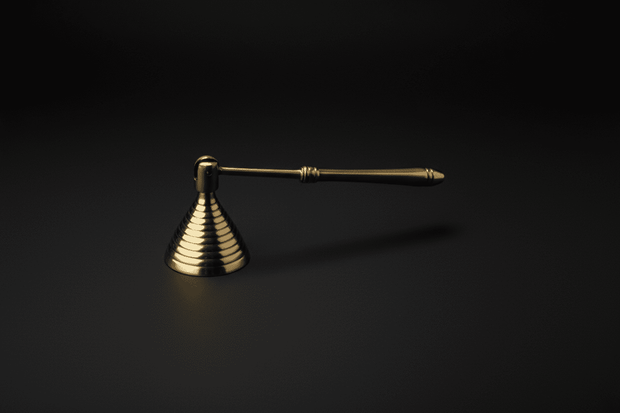
Place the bell over the flame without striking the wick or dipping the tool into molten wax. Hold it there until the flame is out, then lift it straight away. A Brass Candle Snuffer provides reach for open tapers and many altar candles, while a Mini Brass Candle Snuffer may be easier around compact setups.
To compare small brass snuffers with appropriately sized candle holders, see candle holders and flame-control tools. Check holder compatibility before lighting the candle; a snuffer does not make an unattended flame safe.
Confirm the wick has stopped glowing. Set the snuffer on a heat-safe surface because the bell may be hot. Do not touch the bell immediately, and never leave soot or wax buildup where it can fall into a future flame.
Why blowing is riskier with dressed candles
A plain candle can splatter wax when blown forcefully. A dressed ritual candle may also have loose powder, plant material, glitter, paper, or ash near the flame. Breath can launch those materials or feed a glowing ember. The safest improvement is not merely “blow more gently”; it is to keep combustible decorations away from the flame and follow the candle’s directions.
Never assume an herb, powder, oil, or crystal is safe to add to a candle. Product labels govern how a candle may be dressed, and many decorative additions increase fire risk. Review our herb safety guide before putting botanicals near heat.
Does blowing out a candle end or insult the spell?
Only if that rule belongs to the tradition or ritual structure you deliberately chose. Some practitioners associate breath with dispersing intention; others use breath as a purposeful act of release. Some prefer snuffing because it pauses the working for later. These are symbolic interpretations, not physical guarantees.
If a candle must be extinguished for safety, put it out. Leaving a flame unattended to avoid “breaking” a spell is not devotion; it is a fire hazard. You can record the interruption, restate the petition later, and relight only when the candle and its instructions permit it.
Snuffer, wick dipper, or lid?
A wick dipper bends the burning wick into the melt pool, then lifts it upright again. It can produce less after-smoke, but it is mainly useful for suitable container candles with accessible liquid wax. Do not improvise with fingers or a random tool.
A lid should be used to extinguish a candle only when the candle manufacturer explicitly says the lid is designed for that purpose. Some lids trap heat, lack a safe seal, or can be damaged. Never use a glass lid if the directions do not approve it.
Snuffers work best when the bell can reach and cover the flame without touching the container. Deep jar candles and multi-wick vessels may require a method specified by the manufacturer rather than a traditional bell snuffer.
How to clean a brass candle snuffer
- Wait until the snuffer is completely cold.
- Wipe loose soot with a soft dry cloth.
- If wax is present, gently remove it without scratching the finish.
- Use only a cleaner approved for the snuffer’s actual material and finish.
- Dry it completely before placing it near a candle again.
Antiqued, plated, lacquered, and solid-brass finishes do not all tolerate the same polish. Test any approved product in an inconspicuous place and follow the care instructions.
Frequently asked questions
Is a candle snuffer safer than blowing?
It generally offers better control and reduces the chance of blowing hot wax or loose material outward. Safe placement, supervision, wick care, and the candle’s directions still matter.
Can I pinch a candle wick with wet fingers?
Do not. You can be burned by flame, hot wax, steam, or the ember. Use a purpose-made tool or the method specified by the candle manufacturer.
How long should I hold the snuffer over the flame?
Hold it until the flame is fully extinguished, then verify there is no glowing ember. There is no need to keep the hot bell over the candle longer than required.
Can I relight a ritual candle after snuffing it?
Yes, when the candle is designed for multiple burns. Let it cool, trim or maintain the wick as directed, and relight during a supervised session.
What if the snuffer bell touches wax?
Let the tool cool before cleaning it. Avoid dragging a wax-coated bell across cloth or the candle rim, and do not scrape a hot snuffer.
Will snuffing prevent all smoke?
No. A wick may smoke briefly after extinguishing. Ventilate appropriately and maintain the wick according to the candle instructions.
The practical difference is control: a snuffer contains the extinguishing action, while breath sends air and nearby material outward. The ritual meaning is yours to define—but the fire-safety decision is not optional.
Tools for this practice
Explore the products selected for this guide. Review each listing for what is included and how to use it.

Shop this guide · 2 items Collapse


Keep exploring the shop
You made it to the end of the guide. Keep exploring through related products, major departments, or the full catalog.
 RELATED TO THIS GUIDE
Candles & Incense
Shop this topic
RELATED TO THIS GUIDE
Candles & Incense
Shop this topic


Leave a comment