


Candle Types in Witchcraft: Chimes, Tapers, Tealights, Pillars, and Figure Candles

A candle’s color can suggest a correspondence, but its shape, size, construction, and expected burn time determine how practical it will be during an actual ritual. A five-inch chime candle may suit a focused working that lasts less than an hour. A pillar can support repeated devotional use over many days. A figure candle can carry a specific symbolic role, while a flameless candle may be the safest and most responsible option in a dorm, rental, shared home, or household with pets.
There is no single candle type that is automatically more powerful than another. The best choice is the candle that fits the purpose of the working, the time available, the holder you can use safely, and the conditions of the room. This guide compares common candle types used in modern witchcraft and explains how to choose among them without turning a simple flame into an unnecessary hazard.
Why Candle Type Matters in Witchcraft
Before choosing a candle, consider four practical questions:
- How long should the working last? A short spell candle may burn during one sitting, while a pillar or container candle may be revisited over several days.
- What holder does the candle require? A candle that does not fit securely is not appropriate, regardless of its symbolism.
- How much wax, heat, and flame will it produce? Taller and wider candles need more clearance and a larger heat-safe surface.
- Does the candle need to remain intact between sessions? Some workings benefit from a reusable candle; others use a small candle once and then close the ritual.
If you are completely new to candle practice, begin with the foundational safety and preparation guidance in Candle Magic 101. For symbolism based on hue, use the separate Candle Color Meanings in Witchcraft guide.
Chime Candles and Small Spell Candles
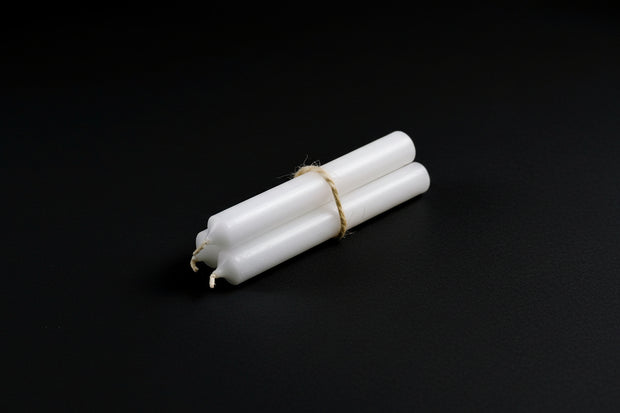
Chime candles are slim, compact candles commonly used for short rituals, small altars, candle grids, and focused spellwork. Sellers may also call similar products mini tapers, spell candles, or ritual candles. Exact dimensions and burn times vary, so the product description matters more than the label.
Their greatest advantage is scale. A chime candle usually requires less time and space than a standard taper or pillar. It is useful when you want to light a candle, complete a contained working, and close the ritual without maintaining a large flame for hours.
Chime candles are often a practical choice for:
- Short written-intention rituals
- Color-based symbolic work
- Small altars and limited surfaces
- Daily devotional moments
- Beginner candle practice
- Workings that must be completed within a defined period
They do require a properly sized holder. A narrow candle forced into an oversized holder can lean or fall, while a candle pressed into a holder that is too small may crack. A stable chime holder or other holder made for the candle’s actual diameter is essential. A simple white chime candle is versatile for practice, but versatility never replaces a stable base and supervised flame.
Taper Candles
Tapers are the familiar tall, narrow candles used in candlesticks. They create a strong vertical presence and are well suited to formal altar arrangements, paired deity candles, elemental candles, dinner-table rituals, and ceremonies where the visual rhythm of several upright flames matters.
Compared with chime candles, tapers generally burn longer and produce more wax runoff. Their height also makes them more sensitive to drafts and unstable holders. A taper should stand straight, remain firmly seated, and have generous clearance above and around the flame.
Do not assume that a taper must burn completely in one sitting. Long burn times can pressure practitioners into unsafe decisions. A ritual can be designed around safely extinguishing and relighting the candle. The meaning of the work comes from the structure and intention you establish, not from refusing to put out a flame when you need to leave the room.
Tealights
Tealights are small candles poured into shallow metal or plastic cups. They are inexpensive, widely available, and naturally contained, which makes them useful for simple altar lighting, meditation, seasonal displays, and rituals that require several small points of light.
Because the wax is contained, tealights create less loose runoff than tapers. However, the cup can become extremely hot. A tealight still requires a heat-resistant surface or holder, and it should never be placed directly on wood, fabric, paper, a resin altar tile, or another surface that can scorch or deform.
Avoid crowding many tealights together. Multiple small flames can create considerable heat, especially inside an enclosed lantern or on a crowded tray.
Votive Candles
Votives are short, compact candles that are usually wider and longer-burning than tealights. Traditional votives are designed to liquefy as they burn and therefore need a close-fitting votive holder. Without the right container, melted wax can spread beyond the candle’s original footprint.
Votives are useful for devotional practice, memorial altars, petitions, and repeated short sessions. They offer more burn time than a chime candle without requiring the height of a taper.
Do not treat a freestanding votive like a small pillar unless its manufacturer specifically identifies it as freestanding. The correct holder is part of how the candle is intended to burn.
Pillar Candles
Pillar candles are thick, freestanding candles designed to maintain their shape as they burn. They are useful when a working extends across several days or when one candle will remain part of an altar for a longer period. Their broad surface can also accommodate modest carving, inscriptions, or a small amount of appropriate candle dressing.
Pillars need a wide, heat-safe plate or tray capable of containing melted wax. They should not sit directly on an altar cloth. Large pillars also retain heat and may continue producing liquid wax after the flame is extinguished, so allow them to cool before moving or storing them.
Our pillar candles in multiple colors illustrate the difference between a reusable altar candle and a small one-session spell candle. Choose the larger format because its burn pattern serves the work—not because size alone implies greater spiritual force.
Container and Jar Candles
Container candles are poured directly into glass, ceramic, or metal vessels. They are convenient for repeated use because wax remains inside the container. They may be unscented, scented, devotional, condition-based, or made as ordinary household candles.
Container candles can be excellent for ongoing altar practice, but the vessel must be intended for candle heat. Do not improvise with ordinary drinking glasses, decorative jars, thin bottles, or containers with unknown heat resistance. Glass can crack when exposed to uneven heat, a flame burning too close to the side, or sudden temperature changes.
When using a jar candle:
- Follow the manufacturer’s instructions for wick trimming and maximum burn time.
- Stop using it if the vessel is cracked, chipped, or excessively sooty.
- Keep the wick centered and discontinue use before the flame reaches the very bottom if directed.
- Do not add loose herbs, stones, glitter, or large amounts of oil to the wax pool.
A scented container candle may add atmosphere, but fragrance can trigger headaches, asthma symptoms, or sensitivity in people and animals. Unscented candles are often the better ritual choice in shared spaces.
Novena and Devotional Candles
Novena-style candles are tall container candles often associated with extended prayer or devotional practice. In modern Pagan and witchcraft settings, practitioners may use similar candles for ancestors, deities, saints, spirits, protection, gratitude, or a sustained petition.
These candles are designed for repeated attention, not abandonment. A multi-day candle should still be extinguished whenever it cannot be supervised. “Seven-day” or “novena” describes a style or intended duration; it is not permission to leave it burning overnight or while away from home.
Figure Candles
Figure candles are shaped to resemble a person, couple, animal, deity-like form, body part, skull, symbol, or other recognizable image. Their shape gives them a specific symbolic role before color, carving, or dressing is added.
Because figure candles have uneven shapes, they may burn unpredictably. Limbs, wings, horns, narrow sections, and decorative details can create rapid wax runoff or cause the flame to shift. Place them on an oversized fireproof tray with room for the entire figure to melt. Do not rely on the original base alone.
Symbolic representation does not override another person’s consent. A figure candle can help you focus on your own boundaries, feelings, decisions, or hopes, but it does not guarantee control over another person. Responsible practice avoids claims that a shaped candle can force love, obedience, separation, or any specific outcome.
Shaped and Condition Candles
Not every symbolic candle is a human figure. Keys, dollar signs, skulls, crosses, animals, anatomical forms, houses, and other shapes may be selected because the object itself expresses the subject of the ritual.
A condition candle should support realistic action. A prosperity candle, for example, may accompany budgeting, applying for work, improving a business offer, or making a savings plan. For a structured example, see the Beginner’s Guide to Prosperity Candle Spells.
Beeswax, Paraffin, Soy, and Other Wax Types
Candle form and wax material are separate choices. Chimes, tapers, pillars, and containers can be made from different waxes, each with its own texture, scent, hardness, price, and burn behavior.
Beeswax
Beeswax is firm, naturally aromatic, and often selected for devotional or traditional-feeling candles. It may burn differently from paraffin or blended wax and is generally more expensive. People with sensitivities should not assume that “natural” automatically means irritation-free.
Flameless Candles Are a Valid Ritual Tool
Battery-operated candles can mark sacred time, represent an element symbolically, illuminate an altar, or support meditation without an open flame. They are especially appropriate in dormitories, rentals, hospitals, offices, crowded events, homes with curious pets, or anywhere fire rules prohibit candles.
They may also be necessary around supplemental oxygen or certain medical equipment. Never use open flame near oxygen. In that setting, a flameless light is not a lesser substitute; it is the responsible tool.
Ritual practice is built through attention and meaning. Fire can be symbolically represented when literal fire is unsafe.
How to Choose the Right Candle
For a Short, Focused Working
Choose a chime candle, small spell candle, or tealight. These are easier to fit into a single supervised session and require less space.
For Repeated Devotion or Meditation
Choose a pillar, votive in a proper holder, or container candle. Extinguish it between sessions and relight it as part of the repeated practice.
For Representational Work
Choose a figure or symbolic shaped candle only when the form adds something meaningful. Place it on an oversized fireproof tray and expect irregular melting.
For Limited Space or Fire Restrictions
Choose a flameless candle. Avoid trying to make an open flame work in conditions where it cannot be used safely.
Dressing and Carving Candles Without Creating a Hazard
Candle dressing may include carving words or symbols into wax and applying a very small amount of an appropriate oil. These actions are optional. More material does not create more power, and heavily dressed candles can become dangerous.
Avoid coating a candle with loose dried herbs, flowers, paper, glitter, powders, resin, crystal chips, or excessive oil. These materials can ignite, clog the wick, create sudden flare-ups, or turn melted wax into a pool containing burning debris. Stones can heat, fracture, or destabilize a candle. Pins and metal objects can become hot and fall from softened wax.
For a safer symbolic alternative, place nonflammable correspondences beside the candle at a responsible distance, write the intention on paper kept away from the flame, or place herbs in a closed container elsewhere on the altar.
Candle Burn Behavior Is Not Always a Message
Some traditions interpret flame height, wax flow, soot, tunneling, wick buildup, or the direction a candle burns. Such methods can be part of personal divination, but ordinary physical causes should be considered first.
A flickering flame may result from a draft. Tunneling may come from an insufficient first burn. Soot can result from a long wick, fragrance, poor airflow, or a flame too close to glass. A leaning candle may reflect a loose holder or uneven surface. Figure candles naturally produce irregular wax patterns because their shape is uneven.
Do not treat every manufacturing variation or combustion problem as a supernatural verdict. Address the mundane cause, especially when safety is involved.
Essential Candle Safety
- Never leave a burning candle unattended, including overnight or while briefly leaving the room.
- Keep flames away from children, pets, hair, sleeves, curtains, books, altar cloths, dried plants, paper, oils, and incense.
- Use a stable, heat-resistant holder designed for the candle’s diameter and form.
- Place the holder on a larger nonflammable tray capable of catching wax.
- Keep candles away from vents, fans, open windows, and foot traffic.
- Follow the manufacturer’s wick-trimming and maximum-burn instructions.
- Do not move a candle while wax is liquid or the container is hot.
- Keep a suitable extinguishing method nearby and know what to do in a fire emergency.
- Do not use water on hot wax or a wax fire.
- Extinguish the candle whenever the working must be interrupted. Ritual rules should never require unsafe burning.
Frequently Asked Questions
Does a spell candle have to burn all the way down?
No. Some rituals are designed for one complete burn, but many candles can be extinguished and relit. Choose a small candle when a single-session burn matters, and never continue burning solely because you believe stopping will ruin the work.
Are chime candles the same as tapers?
They are related forms, but chime candles are usually shorter and narrower than standard tapers. Terminology varies, so compare actual measurements and holder requirements.
What candle is best for beginners?
A plain chime candle or tealight in a correct holder is usually manageable because it is small and suitable for a contained session. A flameless candle is best where open flame is restricted or unsafe.
Can I put herbs or crystals directly on a candle?
It is safer not to. Loose botanical material can ignite, and stones may heat or fracture. Keep symbolic materials beside the candle at a safe distance rather than embedding them in the burn area.
Choose the Candle That Fits the Work
A useful ritual candle is not necessarily the most elaborate one. It is the candle whose burn time, stability, holder, scale, and symbolism match what you are actually prepared to do. Chime candles support short focused work. Tapers create formal altar lines. Tealights and votives offer compact light. Pillars and containers support repeated practice. Figure candles provide representational symbolism, and flameless candles make ritual possible when fire should not be present.
Build the ritual around safety first, then choose the symbolism that clarifies your intention. Explore the store’s Candles collection to compare currently available formats, or begin with what you already own and learn how it burns before adding more tools.
Tools for this practice
Explore the products selected for this guide. Review each listing for what is included and how to use it.

Shop this guide · 2 items Collapse


Keep exploring the shop
You made it to the end of the guide. Keep exploring through related products, major departments, or the full catalog.
 RELATED TO THIS GUIDE
Candles & Incense
Shop this topic
RELATED TO THIS GUIDE
Candles & Incense
Shop this topic


Leave a comment