


Crystal Hardness vs. Toughness vs. Cleavage: What Actually Determines Durability?

The Mohs hardness number is one of the most repeated facts in crystal and mineral descriptions. It is useful, but it answers only one question: how well a mineral resists scratching. It does not tell you whether the specimen will chip when dropped, split along a cleavage plane, dissolve in water, fade in sunlight, or survive ultrasonic cleaning.
To understand durability, collectors need at least four ideas: hardness, toughness, cleavage or fracture, and stability.
Hardness Means Resistance to Scratching
Mineral hardness describes resistance to abrasion or scratching. The Mohs scale runs from 1 for talc to 10 for diamond. A harder reference material can scratch a softer one.
The scale is ordinal rather than evenly spaced. The jump between two adjacent numbers is not always the same. Diamond is not merely a little harder than corundum because the numbers are 10 and 9.
Common reference points
| Mohs hardness | Reference mineral | General implication |
|---|---|---|
| 2 | Gypsum | Scratches very easily; careful handling required |
| 3 | Calcite | Vulnerable to many everyday abrasives |
| 6 | Orthoclase feldspar | Moderate scratch resistance |
| 7 | Quartz | Can scratch ordinary glass |
| 8 | Topaz | High scratch resistance but not automatically impact resistant |
| 9 | Corundum | Very strong resistance to abrasion |
| 10 | Diamond | Highest position on the Mohs scale |
Hardness is important for jewelry surfaces, polished finishes, specimen shelves, pocket stones, and cleaning methods. Dust itself can contain quartz, so wiping a softer polished mineral with a dusty cloth may create fine scratches.
Toughness Means Resistance to Breaking
Toughness describes how well a material resists chipping, cracking, or breaking under impact and stress. A mineral can be hard but not especially tough.
Topaz is a classic example. It ranks 8 on the Mohs scale, yet its pronounced basal cleavage makes it vulnerable to a well-placed blow. Diamond is extremely hard, but it can chip or split along directions of structural weakness. Jade materials, by contrast, are valued partly because their interlocking structures can make them unusually tough even though they are not near diamond on the hardness scale.
For handling, toughness often matters more than hardness. A hard stone can still be damaged by a drop onto tile.
Cleavage Is Directional Weakness
Cleavage is the tendency of a mineral to split along planes determined by its crystal structure. These planes are not random surface cracks. They reflect directions where atomic bonding is weaker.
Cleavage may be described as perfect, good, distinct, poor, or absent, and by the number and orientation of cleavage directions. A specimen may tolerate pressure from one direction and fail from another.
Examples include:
- Topaz: perfect cleavage in one principal direction;
- feldspars, including moonstone varieties: two prominent cleavage directions;
- gypsum and selenite: very soft, with pronounced cleavage and easy splitting;
- calcite: perfect rhombohedral cleavage in three directions;
- mica: perfect basal cleavage that allows thin sheets.
A polished surface can hide cleavage risk. A beautifully finished tower or sphere may still contain the same structural directions as the original mineral.
Fracture Describes Breakage Outside Cleavage Planes
When a mineral breaks without following cleavage, the resulting surface is described as fracture. Common terms include conchoidal, uneven, splintery, fibrous, and hackly.
Quartz has no cleavage and commonly shows conchoidal fracture, producing curved, shell-like break surfaces and potentially sharp edges. Obsidian, a volcanic glass rather than a mineral species, also fractures conchoidally and can become razor sharp.
No cleavage does not mean unbreakable. It means breakage is not controlled by cleavage planes.
Stability Covers Heat, Light, and Chemicals
Durability also includes stability: resistance to heat, sudden temperature change, light, moisture, acids, alkalis, household chemicals, and cleaning equipment.
A mineral may be hard and tough enough for handling but still react badly to:
- prolonged sunlight;
- rapid heating or cooling;
- water or humidity;
- acidic cleaners;
- salt;
- bleach or ammonia;
- ultrasonic vibration;
- steam;
- oils, dyes, resins, or surface coatings.
Treatments can change care requirements. Read Natural vs. Synthetic vs. Treated vs. Imitation Crystals before assuming every specimen of the same mineral should be cleaned identically.
Why the Mohs Scale Is Not a Care Guide
A Mohs number cannot answer these questions:
- Will the stone chip if dropped?
- Does it have perfect cleavage?
- Can it tolerate water?
- Will sunlight change its color?
- Is it dyed, coated, fracture filled, or stabilized?
- Can it handle ultrasonic vibration?
- Will it scratch another specimen in the same box?
Use hardness as one part of a full care profile.
Examples From Common Shop Forms
Quartz and amethyst
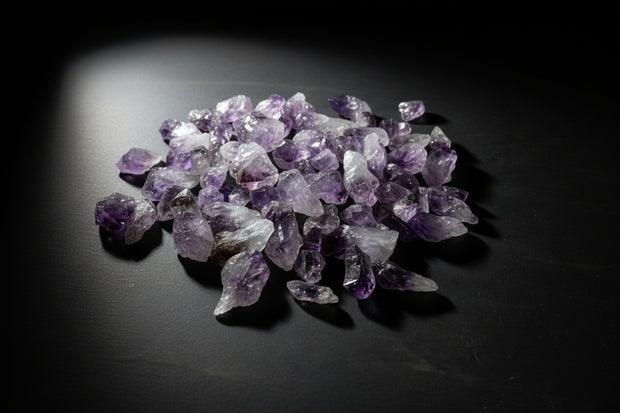
Quartz is Mohs 7 with no cleavage, giving it good scratch resistance for many display and handling uses. It can still fracture, chip at points, or break when dropped. Natural terminations deserve protection from contact with harder or equally hard objects.
Moonstone and other feldspars
Feldspars are moderately hard but have cleavage that can make them vulnerable to impact. Moonstone’s optical effect does not protect it from structural weakness. Avoid careless drops, steam, and ultrasonic cleaning.
Selenite and gypsum
Gypsum is only Mohs 2. Selenite forms scratch easily, split along cleavage, and can be damaged by prolonged water exposure. Handle long sticks and carved plates with support under the entire piece.
Topaz
Topaz demonstrates why hardness and toughness must be separated. Its Mohs 8 surface resists scratching better than quartz, but cleavage can make impact dangerous.
Obsidian
Obsidian is glass and can fracture into sharp edges. A polished obsidian sphere may look sturdy but should still be protected from falls and edge impacts.
How Form Changes Risk
Carving does not change the mineral’s basic hardness or cleavage, but it changes where stress concentrates.
- Natural points: terminations and thin edges chip easily.
- Towers and obelisks: narrow tips are vulnerable, and tall forms can topple.
- Spheres: lack corners but can roll and fall.
- Palm stones: comfortable to handle but may be dropped more often.
- Clusters: contain many exposed crystals and fragile attachment points.
- Thin plates and bowls: can flex or split along cleavage.
See Which Crystal Form Should You Choose? for form-specific use.
A Practical Durability Checklist
Before cleaning, carrying, or displaying a specimen, record:
- confirmed mineral or material identity;
- Mohs hardness;
- toughness or impact sensitivity;
- cleavage directions;
- typical fracture;
- water and chemical stability;
- light and heat sensitivity;
- known treatments;
- fragile points, inclusions, repairs, or existing cracks;
- the form: natural, tumbled, carved, mounted, or composite.
Do Not Perform Scratch Tests on Finished Pieces
Scratch testing can permanently damage the item, reduce value, and produce misleading results when the surface is coated, weathered, altered, or contaminated. Do not test a polished product, jewelry piece, collector specimen, or unknown stone against glass as a casual identification method.
Identification should combine provenance, observation, physical properties, and professional testing when value or safety matters.
Storage Rules Based on Durability
- Store hard stones away from softer polished surfaces.
- Wrap specimens individually rather than allowing them to rub together.
- Support cleavable or elongated pieces from underneath.
- Keep spheres in secure stands.
- Place heavy pieces low in a cabinet.
- Protect points and clusters from shelf edges.
- Do not stack specimens unless the support is designed for it.
- Label care restrictions with the specimen.
Compare Natural and Carved Examples
Browse Crystals & Stones, Tumbled Stones, and Carved Crystals while comparing how mineral properties interact with form. The Amethyst Raw Point, Clear Quartz Sphere, Black Moonstone Palm Stone, and Selenite Sticks illustrate very different handling needs.
Frequently Asked Questions
Does a higher Mohs number mean a stone will not break?
No. Mohs hardness measures scratch resistance, not resistance to impact or cleavage.
What is the difference between cleavage and a crack?
Cleavage is a structural tendency to split along specific crystallographic planes. A crack is an actual break that may or may not follow cleavage.
Can quartz scratch quartz?
Materials of equal hardness can abrade one another, especially when grit is trapped between surfaces. Store polished quartz pieces separately.
Why can a soft mineral survive while a hard one chips?
Survival depends on the direction and force of impact, toughness, cleavage, shape, existing damage, and support—not hardness alone.
Is water safe for every hard stone?
No. Water stability is separate from hardness. Treatments, inclusions, porosity, soluble components, matrix, and mounting materials can all affect care.
Durability Is a Combination of Properties
Hardness tells you about scratches. Toughness tells you about breaking. Cleavage tells you where a mineral is structurally likely to split. Stability tells you how it responds to heat, light, moisture, and chemicals. Use all four before choosing how to wear, clean, carry, store, or display a crystal.
Tools for this practice
Explore the products selected for this guide. Review each listing for what is included and how to use it.

Shop this guide · 2 items Collapse


Keep exploring the shop
You made it to the end of the guide. Keep exploring through related products, major departments, or the full catalog.
 RELATED TO THIS GUIDE
Crystals & Stones
Shop this topic
RELATED TO THIS GUIDE
Crystals & Stones
Shop this topic


Leave a comment