


Crystal Inclusions: What They Are and Why Collectors Value Them

An inclusion is material or a structural feature enclosed within a crystal or gemstone as it grows or changes. Inclusions may be tiny mineral crystals, needles, fluid-filled cavities, gas bubbles, healed fractures, growth layers, or several phases trapped together.
They are not automatically defects. Some lower clarity, some weaken a stone, some reveal treatment, and some create the exact optical effect or visual landscape that makes a specimen desirable.
How Inclusions Form
Crystals grow within changing geological environments. Temperature, pressure, fluid chemistry, available elements, space, and interruptions can vary during growth. A growing crystal may surround another mineral, trap a pocket of fluid, pause and restart, or partially heal after cracking.
Because inclusions record events, they can provide information about formation conditions and growth history. Interpretation requires training; one attractive feature does not by itself prove a locality, age, or treatment status.
Major Types of Inclusions
Solid mineral inclusions
A host crystal can enclose another mineral. These may appear as distinct crystals, grains, plates, fibers, needles, or clouds. Identification depends on shape, optical properties, chemistry, and context rather than color alone.
Examples familiar to collectors include rutile needles in quartz, chlorite in quartz, mica plates, hematite flakes, and tourmaline needles. Similar appearances can have different identities.
Fluid inclusions
Small cavities can trap liquid present during crystal growth or later healing. Some contain more than one liquid phase or dissolved solids. Under magnification, a fluid inclusion may show a moving bubble.
Do not heat a specimen to make a bubble move. Temperature change can expand fluids, damage the host, or destroy scientific information.
Gas inclusions
Gas may occupy part or all of a cavity. A bubble inside liquid is one common visual expression. A rounded bubble alone does not prove a stone is glass; interpretation depends on the complete inclusion scene and material.
Multiphase inclusions
A single cavity can contain liquid, gas, and one or more solid crystals. These multiphase inclusions can be particularly useful to gemologists and geologists studying the environment in which the host formed.
Needle and fiber inclusions
Fine needles or fibers can form parallel groups, sprays, networks, or random patterns. When oriented correctly and cut appropriately, some create chatoyancy—the cat’s-eye effect—or asterism, the star seen in some gems.
Veils and feathers
Networks of tiny inclusions or partially healed fractures can appear as wispy veils, feathers, frost, or fingerprints. The terms are descriptive, not exact mineral identifications.
Some are beautiful under directional light; others reach the surface and reduce durability.
Fingerprint inclusions
A fracture that partially heals can leave a pattern of small fluid or solid inclusions resembling a fingerprint. This records a break-and-heal event during the material’s history.
Phantoms
A phantom is a visible outline of an earlier growth stage inside a later layer. It may be defined by mineral coatings, color zoning, or a change in clarity. Phantom quartz is a familiar example.
Growth zoning and internal color structure
Changes in chemistry or growth conditions can create bands, sectors, or zones of color. Not every zone is technically an inclusion, but collectors often discuss these features together because they create internal pattern and reveal growth history.
Inclusion, Fracture, or Surface Mark?
Not every line is an inclusion.
- Inclusion: material or a feature enclosed within the host.
- Fracture: a break that may be internal, surface reaching, healed, or open.
- Cleavage: breakage following structural planes.
- Growth feature: zoning, striation, or internal boundary created during growth.
- Surface mark: scratch, chip, polish line, residue, adhesive, or weathering on the exterior.
Use magnification and changing light angles. A surface scratch often becomes clearer when reflected light moves across it.
Why Inclusions Matter for Identification
Inclusion scenes can help trained observers distinguish:
- natural from synthetic material;
- one gem species or variety from another;
- untreated from heated, filled, diffused, or otherwise treated stones;
- glass or assembled products from single natural crystals;
- possible geological environments;
- sometimes, probable geographic origin when multiple forms of evidence agree.
No single inclusion should carry more certainty than it deserves. Origin determination can require advanced microscopy, spectroscopy, chemistry, and comparison data.
Natural Does Not Mean Untreated
A natural stone can contain natural inclusions and still have been heated, dyed, filled, irradiated, coated, stabilized, or assembled. Treatment may alter existing inclusions or produce diagnostic features.
Read Natural vs. Synthetic vs. Treated vs. Imitation Crystals for the terminology.
How Inclusions Affect Value
Value depends on species, market, rarity, visibility, beauty, durability, provenance, size, treatment, and intended use. “More inclusions” is neither always better nor always worse.
In faceted transparent gems
Eye-visible inclusions often reduce clarity and value when the market expects transparency, especially if they darken the stone or threaten durability. Some species are normally more included than others, so standards differ.
In collector crystals
A sharp, aesthetically placed inclusion can increase interest. A phantom, moving bubble, rutile spray, chlorite landscape, or unusual mineral association may become the specimen’s main feature.
In phenomenal gems
Oriented inclusions can create stars, cat’s eyes, aventurescence, or other optical effects. Removing the inclusions would remove the phenomenon.
In carved and ornamental material
Internal patterns may be intentionally positioned within spheres, towers, hearts, and freeforms. Value depends on design, polish, stability, and whether the description accurately names the material.
Inclusions and Durability
Some inclusions are harmless. Others create stress concentrations or connect with fractures that reach the surface.
Look for:
- open fractures;
- large inclusions near edges or points;
- feathers reaching the surface;
- cavities with weak surrounding material;
- inclusions that expand or react differently under heat;
- filled fractures or resin stabilization;
- existing chips aligned with internal features.
Read Crystal Hardness vs. Toughness vs. Cleavage before deciding how to clean or carry an included specimen.
How to Observe Inclusions Safely
You do not need laboratory equipment to begin observing, but you do need restraint.
- Clean only with a method already known to be safe for the material.
- Use diffuse daylight or a cool LED light.
- Rotate the specimen rather than forcing one viewing angle.
- Observe against light and dark backgrounds.
- Use a 10× loupe or low-power microscope.
- Record whether the feature is internal or surface reaching.
- Photograph from several angles with a scale.
- Do not heat, freeze, scratch, soak, or apply chemicals to “test” an inclusion.
Common Misidentifications
- Calling every golden needle rutile.
- Calling every green inclusion chlorite.
- Calling every internal crack a rainbow inclusion.
- Calling every stepped growth feature a record keeper.
- Calling every outline a phantom.
- Assuming a bubble proves glass.
- Assuming an inclusion proves a specific mine or country.
- Confusing glue, polish residue, or dust with internal material.
- Using metaphysical names as mineral identifications.
Inclusions, Enhancement, and Disclosure
Fractures and cavities may be filled with oil, resin, glass, dye, or other substances to improve appearance or stability. Proper disclosure matters because treatments affect care, value, durability, and future repair.
Ask sellers:
- Is the material natural, synthetic, imitation, or assembled?
- Are fractures filled?
- Is the color natural or treated?
- Has the specimen been stabilized or repaired?
- Is the stated inclusion professionally identified or visually inferred?
- Is the locality documented?
Keep an Inclusion Record
For collector pieces, record:
- host material;
- proposed inclusion identity;
- who identified it and by what method;
- orientation and location inside the host;
- surface-reaching fractures;
- photographs and magnification;
- treatments or repairs;
- supplier and locality information;
- care restrictions;
- date acquired.
Use What Makes a Mineral Specimen Collectible? to preserve provenance alongside appearance.
Explore Internal and External Crystal Features
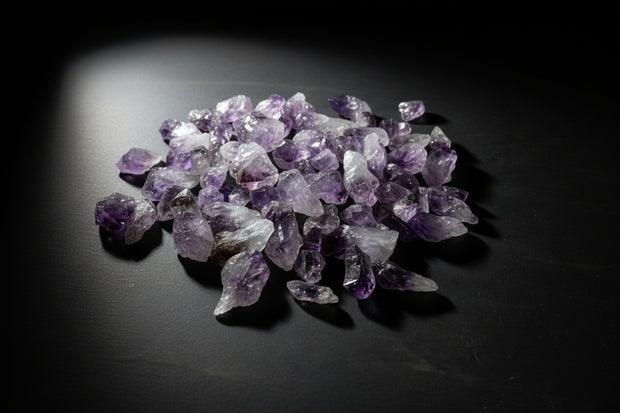
Browse Crystals & Stones to compare transparent, translucent, rough, clustered, tumbled, and carved materials. The Amethyst Cluster Druzy, Amethyst Raw Point, Clear Quartz Sphere, and Smoky Quartz Rainbow Mini Sphere provide different opportunities to observe growth, internal features, fractures, polish, and form.
Frequently Asked Questions
Are inclusions always natural?
No. Synthetic materials can contain inclusions, and treatments can alter or add internal features. Interpretation depends on the complete evidence.
Does a bubble mean a stone is fake?
Not automatically. Natural fluid inclusions can contain bubbles. Bubble shape, context, host material, and other features matter.
Are rainbows inside crystals inclusions?
Many internal rainbows are interference colors produced by fractures rather than separate included minerals. They can be natural or related to stress and treatment.
Do inclusions make a crystal more valuable?
Sometimes. Aesthetic, rare, diagnostic, or phenomenon-producing inclusions may add value, while distracting or durability-threatening features may reduce it.
Can inclusions prove locality?
They can contribute evidence, but a confident origin often requires multiple observations, chemistry, reference data, and documented provenance.
Should I clean inside a crystal cavity?
Only after confirming the mineral species, matrix, coatings, and safe method. Aggressive cleaning can remove delicate secondary minerals or destroy evidence.
Internal Features Tell Part of the Story
Inclusions can record growth, interruption, healing, chemistry, and geological association. Observe them carefully, describe them modestly, protect surface-reaching features, and allow identification to remain uncertain when the available evidence is incomplete.
Tools for this practice
Explore the products selected for this guide. Review each listing for what is included and how to use it.

Shop this guide · 2 items Collapse


Keep exploring the shop
You made it to the end of the guide. Keep exploring through related products, major departments, or the full catalog.
 RELATED TO THIS GUIDE
Crystals & Stones
Shop this topic
RELATED TO THIS GUIDE
Crystals & Stones
Shop this topic


Leave a comment