


What Does the Evil Eye Mean? History, Nazar Amulets, Khamsas, and Modern Use

The “evil eye” is not simply a blue eye-shaped charm. It is a widespread belief that envy, admiration, hostility, or an intense gaze can bring misfortune to a person, animal, household, or possession. Protective objects associated with that belief developed across many cultures, especially around the Mediterranean, Middle East, North Africa, South Asia, and neighboring regions.
Because the belief spans languages, religions, and centuries, there is no single universal ritual or meaning. A Turkish nazar bead, a khamsa hand, an Italian cornicello, and other protective forms belong to related but distinct cultural histories.
The evil eye belief
In many traditions, the danger is connected to envy or excessive praise. Customs may include modest speech, blessings, protective phrases, gestures, amulets, prayer, smoke, water, or other local practices. Some communities understand the eye as deliberate harm; others believe it can be cast unintentionally.
These are cultural and religious beliefs, not scientifically established mechanisms. A protective symbol can still carry personal, familial, artistic, or devotional meaning without being presented as measurable proof of supernatural danger.
What is a nazar?
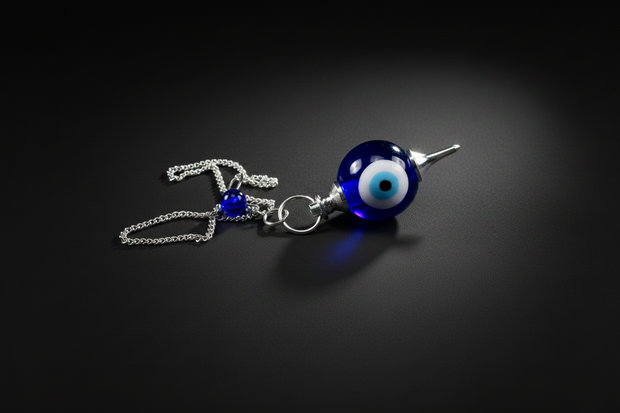
The nazar is the familiar concentric eye-shaped bead, often blue, white, black, and light blue. In Turkey and surrounding regions, it is used as an apotropaic object—something intended to avert or turn away harm. It may be worn as jewelry or displayed in homes, vehicles, businesses, and on gifts.
Blue is common, but color variations in modern retail are not a single ancient code shared by every tradition. Be cautious with charts that assign fixed meanings to every commercial color without identifying a cultural source.
The British Museum holds examples described as amulets intended to deter the evil eye or eye of envy.
What is a khamsa?
The khamsa is a hand-shaped protective form found across North Africa and the Middle East. It is also known in different contexts as the Hand of Fatima or Hand of Miriam. Muslim, Jewish, and Christian communities have all used hand-shaped amulets, though meanings, inscriptions, and devotional associations vary.
An eye may appear in the palm, but the khamsa and nazar are not the same object. Modern jewelry often combines them.
Museum collections document khamsa forms across multiple communities, including a hand-shaped amulet from North Africa.
The evil eye is not the Eye of Horus
The Egyptian Wedjat or Eye of Horus has its own history connected with restoration, protection, healing, kingship, and rebirth. It is not merely an ancient Egyptian version of the nazar. Both are eye symbols with protective associations, but combining them into one origin story erases important differences.
How protective symbols are used today
- Worn as bracelets, necklaces, earrings, or pins.
- Placed near entrances, registers, cribs, vehicles, or workspaces according to personal or family custom.
- Included in prayer, blessing, warding, or folk-magic practices.
- Used as a reminder to resist envy, gossip, comparison, or unwanted attention.
- Displayed decoratively without a religious claim.
At American Occultist, the symbol appears on items such as a protection bracelet. Product symbolism should be described accurately rather than guaranteeing immunity from harm.
What does it mean when an evil-eye charm breaks?
Some people interpret a broken charm as having absorbed or deflected harm. A material explanation may be simpler: glass chips, elastic stretches, metal fatigues, and jewelry catches on objects. You may retire the item respectfully if that fits your practice, but breakage is not proof that an attack occurred.
Replace damaged jewelry for physical safety, especially if it has sharp glass, exposed wire, or weakened cord.
Respectful use
- Learn the specific name and origin of the object you are using.
- Do not claim that every culture shares one evil-eye system.
- Distinguish family or religious practice from modern eclectic witchcraft.
- Avoid fear-based sales claims that tell customers they are cursed and must buy a remedy.
- Do not diagnose conflict, illness, or bad luck as supernatural attack without evidence.
- Credit living communities rather than describing the symbol as ownerless “ancient magic.”
Evil-eye symbolism in a broader protection practice
A charm can serve as one layer of intentional practice, but practical boundaries still matter: locks, medical care, financial safeguards, privacy settings, documentation, and direct communication solve problems symbols cannot.
See Spiritual Protection for Beginners for a framework that combines grounding, boundaries, cleansing, and wards. Our protection-oil comparison also explains how “evil eye” is used in modern product naming.
Frequently asked questions
Is the evil eye symbol evil?
No. The eye-shaped amulet is generally protective; the phrase “evil eye” refers to the harmful gaze or influence it is meant to avert.
Do all evil-eye charms have to be blue?
No. Blue is strongly associated with the nazar, but materials and colors vary by region, period, maker, and modern fashion.
Can anyone wear a nazar or khamsa?
These objects circulate widely, but wear them with accurate naming and respect for the living cultures and religions connected to them.
Does breaking prove the charm worked?
No. That is a spiritual interpretation, not verifiable evidence. Inspect ordinary wear and damage first.
Is a khamsa the same as the evil eye?
No. A khamsa is a hand-shaped amulet that may include an eye motif and may be used for protection against the evil eye.
Tools for this practice
Explore the products selected for this guide. Review each listing for what is included and how to use it.
Shop this guide · 4 items Collapse


Keep exploring the shop
You made it to the end of the guide. Keep exploring through related products, major departments, or the full catalog.
 RELATED TO THIS GUIDE
Ritual Supplies & Altar Tools
Shop this topic
RELATED TO THIS GUIDE
Ritual Supplies & Altar Tools
Shop this topic


Leave a comment