


Protection Oils Compared: Protection vs. Fiery Wall vs. Evil Eye vs. Astral Defense

“Protection oil” can describe several different kinds of work. One formula may be suited to everyday boundary maintenance, while another is framed for a specific concern such as the evil eye or feeling exposed during astral practice. The useful question is not which oil is strongest. It is what kind of protection are you trying to name?
This guide compares four oils by scope and intent. If you need application methods first, start with our guide to using ritual oils.
Protection oils at a glance
| Oil | Best fit | Key distinction |
|---|---|---|
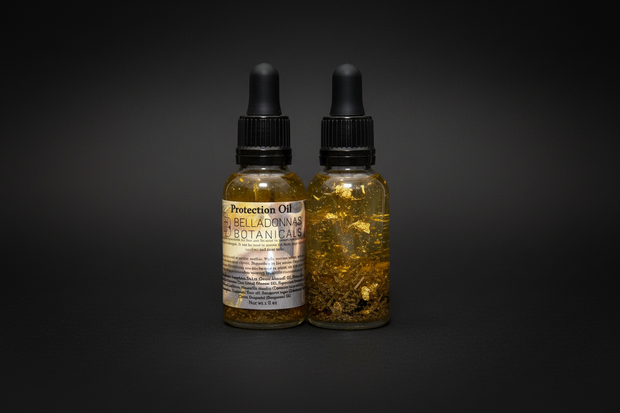
| Protection Ritual Oil | General-purpose protection | Broad rather than threat-specific |
| Fiery Wall of Protection | Firm, reinforced boundaries | Emphasizes a strong perimeter |
| Evil Eye Protection | Work specifically framed around envy, malice, or the evil eye | Names a particular folk concern |
| Astral Defense | Grounding and boundaries around dream, trance, or astral practice | Tied to altered-state spiritual work |
Choose general Protection when the concern is broad
A general Protection Ritual Oil makes sense when you cannot—or do not need to—name a narrow source. Think of ordinary boundary work for a home altar, personal ritual tools, travel, or the beginning and end of a working. Its advantage is flexibility. It does not require you to decide that another person, a psychic attack, or a specific spiritual force is responsible for an uncomfortable situation.
That makes general protection a sensible first choice for beginners. It can support a clear ritual intention without escalating an uncertain feeling into a dramatic story.
Choose Fiery Wall for an emphatic perimeter
Fiery Wall of Protection Ritual Oil is the more forceful boundary option in this comparison. The “wall” language points to a perimeter: a firm line around a person, space, threshold, or working. It is a better thematic fit when your petition is about keeping disruption outside a defined boundary rather than maintaining general spiritual hygiene.
More forceful symbolism does not make an oil objectively more powerful. Specificity is what matters. If the image of a fiery wall does not match your practice, the general formula may produce a clearer, less cluttered working.
Choose Evil Eye Protection when that is the tradition you mean
The evil eye is a particular idea found in many cultures, not a synonym for every setback or hostile interaction. Evil Eye Protection Ritual Oil is relevant when your practice already uses evil-eye symbolism or when your petition explicitly concerns harmful attention, envy, or malice.
Avoid using the label to accuse a specific person without evidence. A self-contained petition—“may harmful attention fail to take hold”—keeps the work centered on your boundary rather than on guessing another person’s motives.
Choose Astral Defense for dream, trance, and journey work
Astral Defense Crystal Healing Oil has the narrowest context here. Its language of shielding, grounding, and energetic integrity suits meditation, dreamwork, trance, or astral practices in which opening and closing the session deliberately matters.
It is not a substitute for sleep, mental-health care, or ordinary safety. If vivid dreams, fear, or dissociation are distressing or persistent, pause the spiritual practice and seek appropriate support. Ritual language should help you feel oriented, not make a health concern harder to recognize.
Can you combine protection oils?
You can, but combining is not automatically better. One well-matched formula and one plain petition are usually easier to interpret than several oils assigned overlapping jobs. If two concerns are genuinely distinct, separate them: general protection at the opening of a working, for example, and astral-defense symbolism only around the trance portion.
Frequently asked questions
Which protection oil should a beginner buy?
Choose general Protection unless you can clearly explain why a narrower formula fits. A specific name should clarify your intention, not pressure you into inventing a threat.
Is Fiery Wall “stronger” than Protection oil?
It is more emphatic and more specific, not measurably stronger. Choose it when a hard perimeter is the image you intend to work with.
Is evil-eye protection the same as return-to-sender work?
No. Evil-eye protection is defensive warding around a named traditional concern. Return-to-sender work is framed around redirecting what is believed to have been sent. Our removal and redirection comparison explains that distinction.
Can I put ritual oil directly on my skin?
Only if the exact product label explicitly permits topical use and you follow its directions. Otherwise, keep it on suitable ritual objects and surfaces. Never ingest ritual oil, and keep it away from children, pets, eyes, and flame.
The best protection formula is the one whose scope matches your actual petition. Start broad when the concern is broad; choose a specialized oil only when its tradition and purpose genuinely belong in the work.
Tools for this practice
Explore the products selected for this guide. Review each listing for what is included and how to use it.
Shop this guide · 1 item Collapse

Keep exploring the shop
You made it to the end of the guide. Keep exploring through related products, major departments, or the full catalog.
 RELATED TO THIS GUIDE
Ritual Supplies & Altar Tools
Shop this topic
RELATED TO THIS GUIDE
Ritual Supplies & Altar Tools
Shop this topic


Leave a comment