


How to Use Dowsing Rods: Holding, Asking Questions, Interpreting Movement, and Practicing Responsibly

Dowsing rods are simple tools whose movement can feel dramatic. Two L-shaped rods are held loosely in front of the body, where they may cross, separate, turn, or swing as the user walks or asks questions. They have been used in traditions of water finding, object searching, divination, and modern energy work.
The simplicity of the tool is also why responsible practice matters. Dowsing rods are highly responsive to small movements in the hands. That sensitivity can make them useful for reflection and structured divination, but it also makes them vulnerable to expectation, posture, wind, uneven ground, and unconscious muscle movement.
What Are Dowsing Rods?
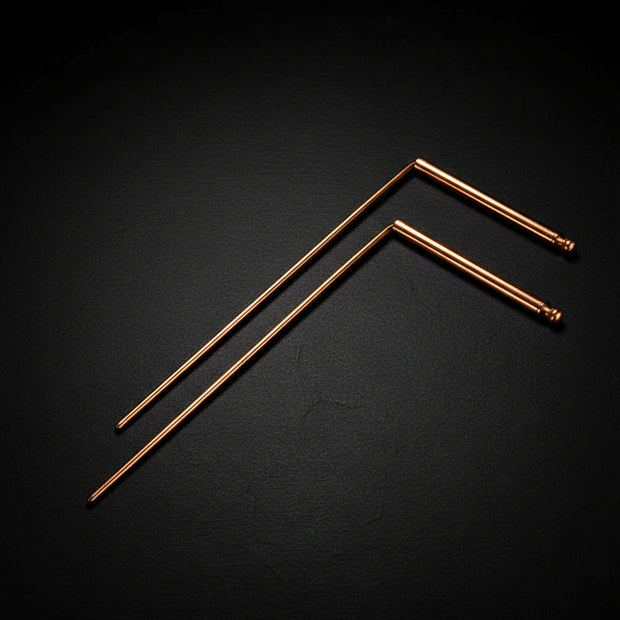
The most familiar modern form is a pair of L-shaped metal rods. The short ends are held in the hands while the longer ends extend forward. Some sets, including copper dowsing rods with rotating handles, allow the rods to turn with very little friction.
Older dowsing methods often used a forked branch held under tension. Pendulums are also used for dowsing, but they translate small movement into swinging patterns rather than the crossing or opening motion of rods.
What Makes the Rods Move?
Dowsing rods are not motionless measuring instruments. They magnify subtle movement. A slight rotation of the wrists, shift in grip pressure, change in stride, or expectation about where a response should occur can produce a visible turn.
Psychology commonly describes this through the ideomotor effect: thoughts, expectations, and attention can produce small muscular movements without the person consciously intending to move. This does not necessarily mean the user is pretending. A sincere practitioner may be unaware of the motion that begins the response.
Controlled scientific testing has not established dowsing as a reliable method for locating water, buried utilities, human remains, medical problems, or other hidden targets. For that reason, rods should never replace professional surveying, utility location services, geological assessment, medical care, emergency services, or evidence-based investigation.
A thoughtful spiritual approach can acknowledge both realities: the rods may be meaningful as a divination or self-reflection tool, while their movement is still physically influenced by the person holding them.
How to Hold L-Shaped Dowsing Rods
- Stand comfortably. Keep your shoulders relaxed and your feet about shoulder-width apart.
- Hold one rod in each hand. The long sections should point forward and remain roughly parallel to the ground.
- Use a light grip. Do not squeeze the handles or deliberately restrain the rods.
- Keep your elbows near your sides. This reduces exaggerated arm movement.
- Pause before interpreting. Let the rods settle instead of treating every twitch as a message.
If the rods have free-spinning handles, make sure the metal can rotate without rubbing against the inside of the handle. Practice in a room without fans before moving outdoors.
Establishing a Personal Response System
Many users begin by asking the rods to demonstrate “yes,” “no,” and “neutral.” One person may see crossing as yes; another may see opening as yes. The pattern is not universal.
A more disciplined method is to test the response with known facts:
- Ask a question whose answer is clearly yes.
- Return the rods to neutral and allow them to settle.
- Ask a question whose answer is clearly no.
- Repeat several times on different days.
- Record inconsistencies rather than redefining the response after the fact.
Do not force a response by rotating the wrists. Also do not assume that a dramatic movement is more accurate than a subtle one.
How to Ask Better Questions
Dowsing questions work best when they are specific, limited, and answerable. “Will everything work out?” is too broad. “Would it be useful for me to spend twenty minutes reviewing this decision tonight?” creates a clearer focus.
Avoid questions that surrender responsibility: whether to stop medication, accuse another person, enter danger, make a major financial commitment, or ignore professional advice. Divination is better used to reveal priorities, emotions, hesitation, and possible next steps than to claim certainty about high-stakes facts.
Walking a Search Pattern
Some practitioners use rods while walking through a space. Establish a start point and move slowly in straight lines. Keep your pace consistent. Mark responses without immediately deciding what caused them, then repeat the route from a different direction.
Repetition is essential because many environmental factors can affect the rods:
- Wind or moving air
- Uneven ground
- Changes in walking speed
- Nearby people
- Tension in the hands and shoulders
- Seeing a feature you expect to matter
- Remembering where a previous response occurred
For locating underground utilities, always contact the appropriate utility-marking service. Dowsing is not a safe substitute.
Using Rods for Reflective Divination
As a spiritual tool, rods can help externalize an internal process. The visible movement creates a pause between the question and the answer. That pause can reveal where you feel resistance, anticipation, fear, or preference.
Try asking a question, observing the response, and then writing down your immediate reaction. Relief, disappointment, irritation, or excitement may tell you more than the rod position itself. This approach uses the tool as a mirror rather than presenting it as infallible detection equipment.
You can also compare rods with tarot, runes, pendulums, and scrying in Divination for Beginners.
How to Reduce Bias
- Use questions with clearly defined wording.
- Write the question before beginning.
- Test known answers and record failures.
- Have another person conceal the target location.
- Repeat the test rather than counting one success.
- Avoid changing the meaning of signals after seeing the result.
- Stop when tired, emotionally overwhelmed, or determined to receive one particular answer.
Blind testing can be especially instructive. If you believe the rods can locate an object, have someone place it under one of several identical containers while you are out of the room. Run enough trials to distinguish a pattern from chance.
Cleaning and Storage
Wipe copper rods with a dry cloth after handling. Copper naturally develops a patina; whether you polish it is an aesthetic choice. Keep rods dry, avoid harsh cleaners on coated handles, and store them where the long arms will not bend.
Practice With Curiosity and Limits
Dowsing rods can be approached as historical tools, divination instruments, sensitivity exercises, or demonstrations of ideomotor movement. Responsible use does not require dismissing the experience, but it does require honesty about what the tool can and cannot prove.
Explore the Divination Tools collection for rods, pendulums, and other methods. Use them to ask better questions—not to replace evidence, expertise, or personal responsibility.
Tools for this practice
Explore the products selected for this guide. Review each listing for what is included and how to use it.
Shop this guide · 1 item Collapse

Keep exploring the shop
You made it to the end of the guide. Keep exploring through related products, major departments, or the full catalog.
 RELATED TO THIS GUIDE
Divination Tools
Shop this topic
RELATED TO THIS GUIDE
Divination Tools
Shop this topic


Leave a comment