


What Do the Symbols on a Lilith Statue Mean—and Which Are Modern?

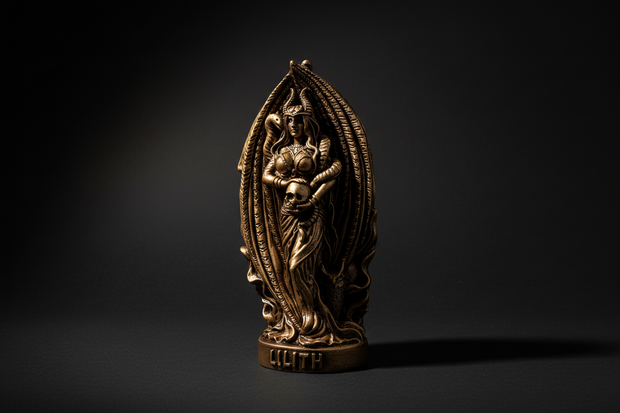
Wings, owls, serpents, horns, moons, crowns, and sigils often appear on modern Lilith statues. They do not all come from one ancient image or one continuous, universally agreed tradition. A statue can be meaningful devotional art without being an archaeological reconstruction.
The first step in reading a Lilith statue is to separate three layers: ancient Near Eastern spirit traditions, later Jewish stories about Lilith, and modern occult or artistic interpretations. The symbols on a particular sculpture may combine all three.
What is historically connected to Lilith?
Ancient Mesopotamian texts refer to classes of spirits whose names include forms such as lilû and lilītu. Later Jewish texts develop Lilith as a dangerous night figure. A difficult word in Isaiah 34:14 is translated in different ways, and late-antique incantation bowls and protective texts provide clearer evidence for Jewish traditions about liliths.
The famous story in which Lilith is Adam’s first wife who refuses subordination comes from the medieval Alphabet of Ben Sira, not from Genesis. The Jewish Women’s Archive overview of Lilith traces that development and her much later reinterpretation as a figure of independence.
That history matters because a popular modern sentence—“Lilith was always an ancient goddess of feminine rebellion”—compresses different cultures, centuries, and sources into a claim the evidence does not support.
Is the Queen of the Night relief definitely Lilith?
No. The Old Babylonian clay plaque often called the Burney Relief or Queen of the Night has wings, bird talons, owls, lions, and symbols of divine authority. Older popular occult writing frequently labels the figure Lilith. The identification is disputed, and the British Museum currently presents the figure as widely considered to be the Mesopotamian goddess Ishtar, while scholarly proposals have also included Ereshkigal.
Therefore wings and owls on a modern Lilith statue may quote the visual language of the Queen of the Night, but they do not prove that the ancient plaque depicts Lilith. The British Museum’s discussion of the relief is a useful corrective to confident social-media captions.
How to read common symbols on a modern Lilith statue
| Symbol | Common modern reading | Historical caution |
|---|---|---|
| Wings | Freedom, night flight, refusal of confinement | Medieval stories describe Lilith flying away, while winged ancient imagery is not uniquely hers |
| Owls or bird talons | Night, hidden knowledge, liminal sight | Often borrowed from the disputed Queen of the Night identification |
| Serpent | Sexuality, forbidden knowledge, transformation, adversarial wisdom | Later art and occult synthesis matter here; no single serpent symbol defines all Lilith traditions |
| Crescent or dark moon | Night, cycles, shadow work, independence | Popular modern occult correspondence rather than a universal ancient Lilith emblem |
| Crown or horns | Sovereignty, infernal queenship, untamed authority | Meaning depends heavily on the sculptor’s visual vocabulary |
| Sigil | A focal mark for contemporary devotion or ritual | Most “Lilith sigils” circulating today are not ancient Mesopotamian inscriptions |
Why do modern statues mix these symbols?
Contemporary occult art communicates through compression. A sculptor may use wings for flight, an owl for night, a serpent for transformation, and a crown for sovereignty so the viewer can read the desired character at once. This is iconography—an artistic system of signs—not necessarily a claim that every object appeared together in an ancient ritual.
Modern practitioners also approach Lilith differently. Some understand her as a demon or spirit within a historical religious framework. Some honor her as a goddess. Some work with her as an archetype of autonomy, sexuality, shadow integration, or resistance. Others regard modern worship as a creative reinterpretation rather than continuation. A product description cannot settle that theological question for everyone.
Is Lilith a goddess?
There is no single answer across traditions. Historical Jewish sources generally do not present Lilith as a benevolent goddess; modern occultists and some Satanic or Pagan practitioners may venerate her as one. State which tradition and period you mean instead of turning one community’s theology into a universal fact.
How to choose and place a Lilith statue
Read the product’s own description and inspect the exact symbols on that sculpture. Decide whether your purpose is devotional, symbolic, educational, or decorative. If it is devotional, learn from the sources and living tradition you are actually engaging rather than relying only on an image search.
A Lilith Ritual Oil may complement modern work centered on sovereignty or shadow integration, but it does not turn modern correspondences into ancient facts. Keep devotional claims and historical claims clearly labeled.
For altar placement, stable setup, offerings, and respectful care, use our guide to building a deity altar. Do not place oil, flame, or incense against a statue unless its material and the product instructions make that use safe.
Frequently asked questions
Why does Lilith have wings?
Wings can refer to the medieval story of her flight from Eden or to modern themes of freedom. They may also echo ancient winged figures that are not securely identified as Lilith.
Why is Lilith shown with an owl?
The owl usually symbolizes night and hidden sight, and it often quotes the Queen of the Night plaque. That plaque’s identity remains debated, so the owl should not be called an uncontested ancient Lilith attribute.
Is the serpent Lilith’s original symbol?
No single original symbol can be established across all sources. Serpents enter Lilith imagery through later texts, art, and modern occult associations, where meanings vary.
Which Lilith sigil is authentic?
Ask “authentic to what source?” A modern occult sigil can be authentic to a named system or practitioner without being ancient. Look for a traceable publication and date rather than a context-free graphic.
Is a modern Lilith statue disrespectful?
Not inherently. Respect comes from honest labeling, careful sourcing, and awareness that Jewish folklore, modern feminist interpretation, Pagan devotion, and Satanic practice do not make identical claims.
A symbol can be spiritually useful and historically modern at the same time. Reading Lilith imagery responsibly means allowing both truths to stand.
Tools for this practice
Explore the products selected for this guide. Review each listing for what is included and how to use it.

Shop this guide · 2 items Collapse


Keep exploring the shop
You made it to the end of the guide. Keep exploring through related products, major departments, or the full catalog.


Leave a comment