


Liminal Time Explained: Dawn, Dusk, Midnight & Seasonal Turning Points

Liminal time is time understood as a transition: dawn between night and day, dusk between day and night, midnight between calendar dates, or a festival between seasonal phases. These moments can carry ritual meaning, but no clock hour or astronomical event is universally magical.
The useful question is not “Which time is most powerful?” It is “What change does this time actually mark, and does that change belong to my source, place, purpose, and schedule?”
Are dawn and dusk the same as sunrise and sunset?
No. Dawn is the period when morning twilight begins; sunrise is the calculated moment when the Sun’s upper edge appears at the horizon. Sunset is the corresponding evening event; dusk occurs as evening twilight ends.
The United States Naval Observatory explains that twilight is scattered sunlight before sunrise and after sunset. Civil, nautical, and astronomical twilight use different solar angles, so there is no single scientific instant called “twilight.” Location, season, horizon, elevation, and weather also affect what an observer experiences.
Ritually, dawn can represent emergence, disclosure, beginning, or return; dusk can represent closure, descent, concealment, or transition into night. Those are symbolic readings, not physical forces guaranteed to produce an outcome.
Is midnight inherently liminal?
Midnight is the conventional boundary between civil calendar dates. Its symbolic strength comes partly from that clean numerical change: one day has ended and another begins. Clock time, however, is a human system shaped by time zones, daylight-saving rules, and local convention. Solar midnight—the point when the Sun is lowest relative to a location—usually does not occur at exactly 12:00 a.m.
Folklore and occult texts sometimes privilege midnight, but a ritual does not become more authentic simply because it is inconvenient or isolating. A well-defined closing rite at 9:00 p.m. is better than a fatigued, unsafe visit to a remote place at midnight.
Is 3 a.m. a special liminal hour?
There is no universal historical rule making 3 a.m. the “witching hour,” “devil’s hour,” or most active paranormal time. Different stories place supernatural danger at midnight, the hours after midnight, or other local boundaries. Modern horror media and repetition online have made 3 a.m. sound far more standardized than the evidence supports.
Waking at 3 a.m. can have ordinary explanations including sleep cycles, stress, noise, temperature, substances, medication, illness, caregiving, or schedule. Persistent sleep problems deserve practical attention rather than automatic supernatural interpretation.
Are Moon phases liminal times?
Every lunar phase is part of a continuous cycle. The primary phases—new, first quarter, full, and third quarter—are calculated configurations rather than nights with identical local visibility. NASA’s Moon overview explains that the phases result from our changing view of the Moon’s sunlit half.
Practitioners often call the new moon liminal because one visible cycle appears to end before the crescent returns. “New moon” and “dark moon” do not have one universal occult definition, however. Some people use them interchangeably; others reserve dark moon for the waning interval before astronomical new moon. State the convention instead of treating it as ancient consensus.
What makes a seasonal turning point liminal?
Solstices and equinoxes are astronomical reference points. Seasonal festivals are cultural observances. They can coincide, but their meanings come from particular calendars, climates, religious histories, and communities.
The modern eight-festival Wheel of the Year combines several sources into a widely used Pagan calendar. Our Wheel of the Year guide explains the individual sabbats. A liminality lens asks a different question: what is visibly changing where you live, and how does the rite move participants from one seasonal condition into another?
Southern Hemisphere practitioners, tropical climates, agricultural communities, and urban households may observe seasonal change differently. Copying Northern Hemisphere imagery without looking outside can turn a living transition into decoration.
How do I choose a liminal time for ritual?
- Name the transition. Beginning, ending, release, decision, return, or seasonal change are different purposes.
- Check the source. Determine whether the timing comes from a religion, local folklore, a modern author, or your own symbolism.
- Use local facts. Look up actual twilight, lunar phase, or seasonal conditions for your location.
- Choose a safe window. Fatigue, weather, traffic, fire restrictions, pets, and household obligations matter.
- Mark the boundary clearly. Open and close at defined points instead of letting “liminal” mean indefinite.
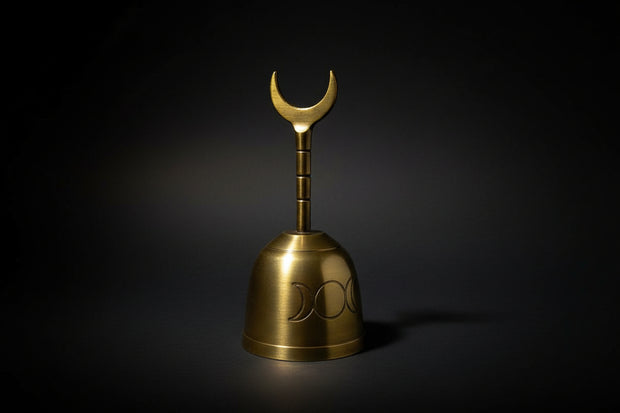
A Moon Altar Bell can audibly mark the beginning and ending of a timed observance. Its function is procedural: the sound creates a clear boundary for attention. A ritual journal is useful for recording the actual time, sky conditions, intention, observations, and later interpretation rather than relying on memory.
Frequently asked questions
Is twilight more powerful than midnight?
There is no objective ranking. Twilight is a visible environmental transition; midnight is a calendrical and clock boundary. Choose the one that fits the ritual’s symbolism and source.
How long does a liminal time last?
It depends on the boundary. Twilight has calculable stages; a new year changes by convention; a life transition can last months. Define the working interval before beginning.
Do I need exact astronomical timing?
Only if the practice or experiment requires it. A symbolic dusk observance may use the period of fading light, while an astrological election depends on more precise calculations.
Is an eclipse a good time for beginner ritual?
An eclipse is a dramatic astronomical alignment, but traditions disagree about whether it is auspicious, disruptive, dangerous, or simply observable. Beginners can watch safely using appropriate eye protection for solar eclipses and postpone ritual claims until they understand the source being followed.
Can I create a personal liminal time?
Yes. The hour before moving house, the final evening at a job, or the first quiet morning after graduation may be more relevant to a personal transition than a generic occult timetable. Our life-transition ritual shows how to give that interval a clear beginning and return.
Tools for this practice
Explore the products selected for this guide. Review each listing for what is included and how to use it.

Shop this guide · 2 items Collapse


Keep exploring the shop
You made it to the end of the guide. Keep exploring through related products, major departments, or the full catalog.
 RELATED TO THIS GUIDE
Ritual Supplies & Altar Tools
Shop this topic
RELATED TO THIS GUIDE
Ritual Supplies & Altar Tools
Shop this topic


Leave a comment