


Natural Crystal Habit vs. Carved Crystal Shape: How to Tell the Difference

A crystal can be natural material and still have a completely human-made shape. Quartz carved into a tower remains natural quartz, but the tower is not its natural crystal habit. A polished point may be cut to resemble a natural termination. A sphere reveals the stone’s color and internal features while removing nearly all evidence of its original external growth form.
Understanding the difference helps buyers compare specimens accurately, care for fragile forms, and avoid product descriptions that confuse mineral identity with manufacturing.
What Is Crystal Habit?
Crystal habit is the characteristic external shape or growth appearance a mineral tends to develop under particular conditions. Habit reflects crystal structure, available space, growth rate, temperature, chemistry, and competition with nearby minerals.
A mineral species can display several habits. Quartz may form recognizable prismatic crystals with pointed terminations, small drusy coatings, massive material without visible faces, or unusual skeletal and scepter forms. The species is the same, but the growth expression differs.
Crystal Form and Habit Are Related but Not Identical
In mineralogy, crystal form can refer to a set of equivalent crystal faces related by symmetry. Habit describes the overall appearance created by one or more forms and their relative development.
Collectors and retailers often use “form” more broadly to mean sphere, tower, heart, palm stone, tumble, cluster, or raw piece. That retail usage is understandable, but it should not be confused with crystallographic form.
Euhedral, Subhedral, and Anhedral Crystals
Euhedral
A euhedral crystal developed recognizable external faces because it had enough space to grow.
Subhedral
A subhedral crystal shows some developed faces while other areas were restricted by neighboring minerals or matrix.
Anhedral
An anhedral grain lacks its own well-developed external faces, often because it grew tightly against surrounding material.
These terms describe face development, not quality. An anhedral mineral can be rare, colorful, scientifically important, or excellent carving material.
Common Natural Crystal Habits
Habit names are descriptive, and a specimen may fit more than one.
- Prismatic: elongated crystals with parallel side faces, as seen in many quartz specimens.
- Tabular: broad and relatively thin, like a tablet.
- Bladed: flattened and elongated like a blade.
- Acicular: slender, needle-like crystals.
- Fibrous: fine parallel or radiating fibers.
- Cubic: cube-shaped growth, familiar in minerals such as pyrite and fluorite.
- Octahedral: eight triangular faces in the idealized form.
- Botryoidal: rounded, grape-like surfaces.
- Reniform: rounded kidney-like masses.
- Dendritic: branching, tree-like patterns.
- Drusy or druzy: a surface covered by many small crystals.
- Massive: material without visible individual crystal faces.
- Stalactitic: cylindrical or icicle-like growth from deposition.
- Radiating: crystals growing outward from a common center.
A habit name should be based on actual morphology, not solely on metaphysical symbolism.
Natural Point, Broken Point, and Polished Point
The word “point” creates frequent confusion.
Natural point
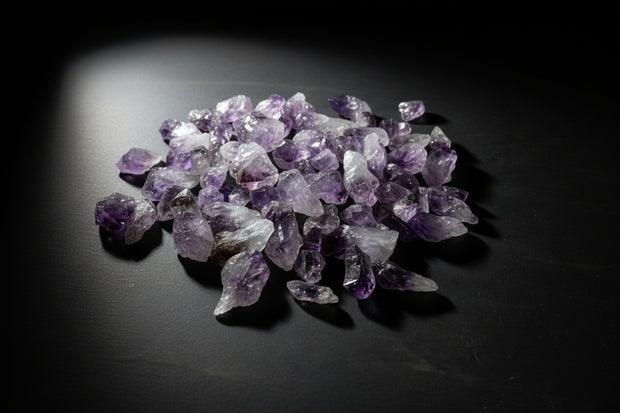
A natural point retains a crystal termination formed during growth. It may still have been cleaned, separated from matrix, repaired, or lightly polished elsewhere.
Broken or incomplete point
The crystal grew with a termination, but part has chipped or broken. This is not the same as a carved point.
Polished natural point
The original crystal shape may remain recognizable while surfaces, base, or damaged areas have been polished.
Cut and polished point
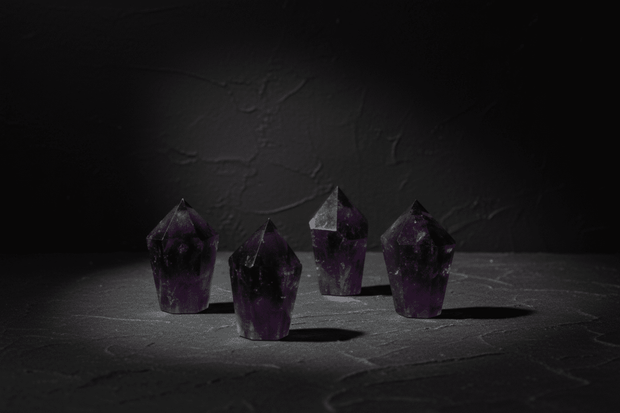
Massive or irregular material is sawn and ground into a pointed shape. Retailers may call this a tower, generator, obelisk, or polished point.
All four can be useful and attractive. The important issue is accurate description.
How Carved Crystal Shapes Are Made
Lapidary workers cut, grind, sand, polish, drill, and sometimes stabilize mineral or rock material. The process can reveal pattern, optical effects, color zones, and inclusions that were difficult to see in rough material.
Common carved forms include:
- spheres;
- towers and generators;
- obelisks;
- palm stones;
- worry stones;
- hearts;
- eggs;
- bowls and plates;
- wands;
- skulls, animals, deities, and symbolic figures;
- freeforms shaped around the original material.
The carving is human-made even when the material is natural.
Spheres
A sphere is cut and polished from a larger piece. Its curved surface can display color, chatoyancy, aventurescence, banding, internal fractures, and inclusions from many angles. It can also roll, so it requires a stable stand.
A “crystal sphere” describes the product category; it does not mean the mineral grew naturally as a perfect ball.
Towers, Generators, and Obelisks
These trade terms often overlap.
- Tower: a broad retail term for an upright polished shape with a pointed top.
- Generator: often a six-sided polished point intended to direct attention or energy in modern metaphysical use; definitions vary.
- Obelisk: generally a tapered four-sided monument-like shape with a pyramidal top, though retail products do not always follow that geometry exactly.
These names describe carving style and marketed use, not natural habit.
Palm Stones, Worry Stones, and Tumbles
A palm stone is shaped and polished to rest comfortably in the hand. A worry stone usually includes a thumb-sized depression or an oval tactile form. A tumbled stone is rounded in a rotating or vibratory tumbler with abrasives.
These processes remove sharp edges and much of the original surface. They may make material easier to carry while obscuring natural faces, coatings, matrix, and locality clues.
Clusters and Druzy Pieces
A cluster contains multiple crystals attached to one another or to matrix. A druzy surface carries many small crystals. These are natural growth arrangements, although specimens may be trimmed, repaired, dyed, coated, mounted, or cut flat for display.
A flat base does not necessarily mean the entire specimen is carved. It may have been sawn so the natural cluster stands securely. Good descriptions separate the natural growth from the preparation.
Freeforms
“Freeform” usually describes a polished shape that follows the color, pattern, cavity, or outline of the rough rather than imposing a strict sphere or tower geometry. It is still a shaped product.
The term does not establish mineral identity, treatment status, or natural surface.
Natural Material Does Not Mean Unaltered
A natural mineral or rock may be:
- cut or carved;
- polished;
- heated;
- dyed;
- coated;
- irradiated;
- stabilized with resin;
- fracture filled;
- repaired with adhesive;
- assembled from several pieces;
- mounted on a base.
None of these automatically makes the product worthless. Disclosure allows buyers to compare honestly and choose appropriate care.
Read Natural vs. Synthetic vs. Treated vs. Imitation Crystals.
How to Examine a Supposed Natural Point
Look for a combination of features rather than one shortcut:
- consistent crystal faces and symmetry appropriate to the mineral;
- natural growth striations or texture;
- small irregularities rather than perfectly uniform machine polish;
- a transition between faces and termination;
- evidence of sawing or grinding at the base;
- polish lines, rounded edges, or identical angles on all sides;
- color concentration in cracks that may indicate dye;
- adhesive near repaired tips or matrix;
- whether the mineral commonly forms the claimed habit.
A skilled lapidary can produce convincing points, and natural crystals can be heavily polished. Photographs alone may not settle the question.
Why Habit Matters to Collectors
Natural habit can help show:
- how the mineral grew;
- available space and competition;
- associations with matrix and other minerals;
- crystal symmetry;
- locality characteristics;
- damage, regrowth, dissolution, or secondary coatings.
Carving emphasizes different qualities: color, internal pattern, tactile use, symmetry, polish, design, and display.
Why Shape Matters to Care
Carved shape changes handling risk even when the material stays the same.
- Spheres roll and fall.
- Tower tips chip.
- Thin bowls split or flex.
- Natural clusters shed fragile crystals.
- Palm stones are handled and dropped frequently.
- Drilled carvings may be weak around holes.
- Flat-cut bases can expose fractures.
Use Crystal Hardness vs. Toughness vs. Cleavage to match care with material and form.
A Buyer’s Description Checklist
- What is the mineral, rock, glass, or synthetic material?
- Is the external shape natural, cut, polished, carved, or mixed?
- Are any natural faces preserved?
- Has the base been cut?
- Are tips repaired?
- Is the color natural or treated?
- Is the item solid material, stabilized, filled, coated, or assembled?
- Is the pictured item the exact piece?
- Are dimensions and weight provided?
- Is locality documented?
Compare Natural, Tumbled, and Carved Forms
Explore Crystals & Stones, Tumbled Stones, and Carved Crystals. Compare the natural termination of the Amethyst Raw Point with the shaped geometry of the Amethyst Diamond Obelisk. The Clear Quartz Point, Clear Quartz Sphere, Carnelian Sphere, and Rose Quartz Heart show how shape changes presentation and use.
Frequently Asked Questions
Are crystal towers natural?
The material may be natural, but the uniform tower shape is usually cut and polished unless the listing clearly describes a naturally terminated crystal.
Can a natural point have a cut base?
Yes. A natural crystal may be cut flat at the base for stability while preserving its natural faces and termination.
Are spheres made from one solid piece?
Many are, but some products can be assembled, reconstituted, resin bound, or glass. The seller should identify the material accurately.
Does polishing remove metaphysical properties?
That is a belief-based question with no universal answer. From a mineralogical perspective, polishing changes the surface and shape, not the mineral species, unless treatment or composite material is involved.
Is a carved crystal less collectible?
Not automatically. Natural specimens and lapidary art are collected for different reasons. Quality, rarity, design, craftsmanship, material, disclosure, and provenance all matter.
What does “raw” mean?
Retail use varies. It may mean unpolished, naturally surfaced, broken rough, mine-run material, or only minimally processed. Ask whether the item has been cut, cleaned, coated, repaired, or treated.
Describe the Material and the Shape Separately
A clear listing should tell you what the material is and how the visible shape was produced. Natural habit preserves growth evidence. Carving creates intentional geometry and tactile form. Neither category is automatically superior, but they should never be confused.
Tools for this practice
Explore the products selected for this guide. Review each listing for what is included and how to use it.
Shop this guide · 2 items Collapse


Keep exploring the shop
You made it to the end of the guide. Keep exploring through related products, major departments, or the full catalog.
 RELATED TO THIS GUIDE
Crystals & Stones
Shop this topic
RELATED TO THIS GUIDE
Crystals & Stones
Shop this topic


Leave a comment