


Pentacle vs. Pentagram: History, Orientation, Meaning, and Common Myths

The words pentacle and pentagram are often used as though they mean exactly the same thing. In casual conversation, that usually causes little trouble. In historical study, ritual practice, jewelry, and religious symbolism, however, the distinction can be useful.
A pentagram is a five-pointed star drawn with five straight lines. A pentacle is usually a disk, seal, or talisman bearing a pentagram or another magical figure. Modern usage is not perfectly consistent, so context matters more than policing vocabulary.
The simplest difference
- Pentagram: the five-pointed star itself.
- Pentacle: an object or inscribed figure used as a talisman, ritual tool, seal, or emblem.
Many modern people use pentacle specifically for a pentagram enclosed in a circle. That is a practical modern convention, but it is not the only historical use of the word. Older magical texts sometimes apply pentacle to complex seals that contain letters, divine names, geometric figures, or planetary symbols rather than a five-pointed star.
A symbol with many histories
The pentagram is much older than modern Witchcraft. Five-pointed stars appear in ancient writing, geometry, religious art, protective markings, and learned magic. Their meanings changed with time and place. A symbol used to represent order in one setting could represent health, the human form, the wounds of Christ, the elements, or magical protection in another.
That variety is important. There is no single uninterrupted meaning that travels unchanged from antiquity to the present. Modern practitioners inherit a long visual form and then interpret it through their own religious, magical, cultural, or personal framework.
The pentagram in modern Witchcraft and Wicca
In many modern Witchcraft and Wiccan contexts, the five points are associated with earth, air, fire, water, and spirit. The surrounding circle may be interpreted as unity, wholeness, containment, or the relationship among those forces.
This interpretation is meaningful within those traditions, but it should not be presented as the only meaning the symbol has ever carried. Different Wiccan traditions, solitary practitioners, ceremonial magicians, Pagans, and occultists may explain the points and orientation differently.
For a broader discussion of choosing symbols by informed context rather than internet stereotypes, read Wearing Occult Symbols: Meaning, Personal Expression, and Context.
Does an upright pentagram mean good?
An upright pentagram has one point at the top and two points at the bottom. It is often interpreted in modern Western occultism as spirit directing or harmonizing the material elements. Some Wiccans and Pagans use it as a religious emblem, protective sign, or representation of elemental balance.
That does not make it a universal symbol of “good.” Symbols do not carry one moral definition independent of culture and intention. An upright pentagram can be decorative, religious, magical, mathematical, historical, or simply personal.
Does an inverted pentagram mean evil?
An inverted pentagram has two points at the top and one at the bottom. It has acquired strong associations with Satanism, the occult, horror media, and rebellion in modern popular culture. The Sigil of Baphomet, for example, uses an inverted pentagram with a goat’s head and Hebrew lettering. That specific emblem has a defined modern Satanic history that should not be projected onto every inverted five-pointed star.
Some occult systems interpret inversion as matter over spirit, descent into material experience, initiation, reversal, or a particular degree of training. Other users choose it specifically as a Satanic or antinomian symbol. Still others use it aesthetically. Orientation alone cannot tell you a person’s beliefs.
To understand the distinct emblem often confused with any inverted star, see Sigil of Baphomet Meaning.
Pentacles as ritual tools
In ceremonial magic, Tarot symbolism, and some Wiccan systems, a pentacle may be a physical altar tool connected with earth, material stability, embodiment, protection, or manifestation. It may be made from wood, metal, clay, stone, or another durable material and marked with a star, seal, divine name, or tradition-specific design.
A ritual pentacle is not automatically required. It has meaning because a system assigns it a function and the practitioner uses it consistently. Buying a symbol does not obligate someone to accept every interpretation attached to it.
How to choose which symbol to wear or display
- Identify the exact design. Is it a plain star, a circled star, a Sigil of Baphomet, or a more complex seal?
- Learn its relevant context. A symbol may have different meanings in Wicca, ceremonial magic, Satanism, Christianity, folk protection, and modern fashion.
- Decide what it means in your practice. Personal meaning matters, but it should not erase documented religious or cultural meanings.
- Consider where it will be seen. Public interpretation may differ from your intention.
- Choose accurately described items. Look closely at orientation, surrounding lettering, and added figures rather than relying on a product title alone.
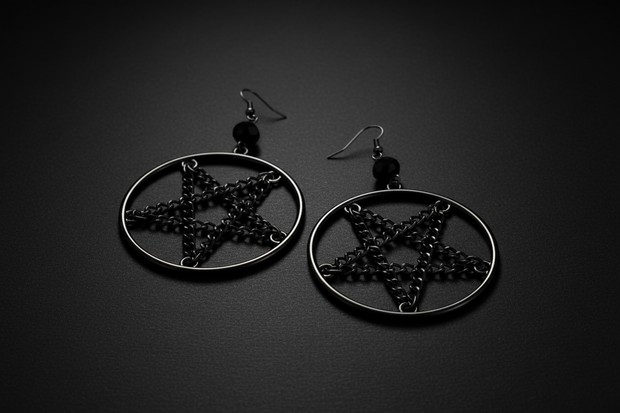
Our pentacle earrings and black chain pentagram earrings illustrate how the same basic five-pointed form can be presented through different designs and personal styles.
Common myths
“The pentagram is always Satanic”
False. The pentagram has appeared in many non-Satanic religious, magical, mathematical, and decorative contexts.
“The pentacle is ancient Wiccan symbolism”
Misleading. The five-pointed star is ancient, but Wicca is a modern religion. Modern Wiccan meanings are part of the symbol’s continuing history, not proof of one unchanged ancient system.
“A circle automatically makes it protective”
Not automatically. A surrounding circle may be interpreted as protection or containment, but symbolism gains function through a tradition, ritual, or intentional use.
“You must earn the right to wear one”
There is no universal authority governing every pentagram or pentacle. Particular initiatory traditions may have their own rules, while many Pagans, Witches, occultists, Satanists, and secular wearers use the symbol independently.
Frequently asked questions
Is a pentacle always a pentagram inside a circle?
No. That is a common modern definition, but historically a pentacle can be a broader category of magical seal or talisman.
Can Christians use a pentagram?
Historically, five-pointed stars have appeared in Christian symbolism. Modern reactions vary, so contemporary viewers may not recognize that history.
Is an inverted pentagram the same as the Sigil of Baphomet?
No. The Sigil of Baphomet is a specific composite emblem. A plain inverted pentagram lacks several defining elements of that design.
Which direction should a pentagram face on an altar?
Use the orientation required by your tradition or the meaning you intend. There is no single rule shared by all occult or Pagan systems.
A symbol should be understood, not feared by default
The most accurate question is not “Is this symbol good or evil?” but “What design is this, who is using it, and in what context?” The pentagram and pentacle have accumulated many meanings because people have used them for centuries. Learning those distinctions makes the symbol more interesting—and prevents modern stereotypes from replacing history.
Tools for this practice
Explore the products selected for this guide. Review each listing for what is included and how to use it.
Shop this guide · 1 item Collapse

Keep exploring the shop
You made it to the end of the guide. Keep exploring through related products, major departments, or the full catalog.
 RELATED TO THIS GUIDE
Occult Jewelry & Symbolic Adornments
Shop this topic
RELATED TO THIS GUIDE
Occult Jewelry & Symbolic Adornments
Shop this topic


Leave a comment