


Sigil of Baphomet: Meaning, History & Symbolism

The Sigil of Baphomet is a goat-headed inverted pentagram enclosed by circles and Hebrew lettering spelling Leviathan. It is the official insignia of the Church of Satan and one of the most recognizable symbols of modern Satanism.
The underlying goat-pentagram design predates Anton LaVey. The Church of Satan selected, refined, named, and popularized its own version during the 1960s.
What Is the Sigil of Baphomet?
The complete emblem combines a goat’s head, an inverted pentagram, enclosing circles, and Hebrew characters for Leviathan. An inverted pentagram by itself is therefore not automatically the Sigil of Baphomet.
Origins of the Sigil of Baphomet
Éliphas Lévi and the Goat-Pentagram Association
French occultist Éliphas Lévi helped establish the later association between an inverted pentagram and a goat. In Dogme et Rituel de la Haute Magie (1855–1856), he described a pentagram with two points upward as evoking the horns, ears, and beard of a goat. His nineteenth-century Baphomet imagery also became influential in later occult art.
Stanislas de Guaita’s Goat Pentagram
In 1897, Stanislas de Guaita’s La Clef de la Magie Noire printed a goat face inside an inverted pentagram surrounded by lettering that included the Hebrew spelling of Leviathan. This design became a major visual predecessor of the modern sigil.
Anton LaVey and the Church of Satan
The goat-pentagram image later appeared in Maurice Bessy’s A Pictorial History of Magic and the Supernatural. Anton LaVey encountered that rendering and selected it when forming the Church of Satan. The organization then developed its own geometrically refined version, used it on The Satanic Mass and The Satanic Bible, and standardized the name “Sigil of Baphomet.”
For its 60th anniversary in 2026, the Church of Satan announced the first official update to its version of the Sigil since 1969 while retaining the emblem’s core goat, inverted-pentagram, circle, and Leviathan framework.
Elements of the Symbol
The Inverted Pentagram
Within LaVeyan Satanic contexts, the downward-pointing pentagram is commonly associated with material existence, carnality, opposition, and an adversarial stance toward conventional spiritual hierarchy. Interpretations outside that context vary.
The Goat’s Head
The goat makes the emblem visually distinct and connects it with Baphomet and with older occult goat imagery. The meaning of goat symbolism varies by source and tradition rather than carrying one universal interpretation.
The Hebrew Letters
The Hebrew characters around the pentagram spell Leviathan. Leviathan is a biblical sea creature that also appears in later occult and Satanic symbolism.
The Circle
The enclosing circles bind the goat, pentagram, and Hebrew lettering into one complete emblem. They are part of the recognizable Sigil of Baphomet design rather than a feature of every inverted pentagram.
What the Sigil Means in Modern Satanism
There is no single interpretation shared by every Satanist. In Church of Satan and LaVeyan contexts, the Sigil functions explicitly as an identifying Satanic emblem; individual users may also associate it with broader philosophical or ritual themes.
- Material existence: Emphasis on life in the present world
- Individualism: The self as a central source of authority
- Opposition: The adversarial questioning of religious dogma
- Carnality: Acceptance of human beings as embodied animals
- Identity: A visible emblem of Satanic philosophy or affiliation
- Psychological focus: A ritual image used for concentration and atmosphere
Want the Sigil as a Physical Altar Piece?
If the symbol itself is what brought you here, the Baphomet Engraved Slate Altar Tile is the most direct match: a compact rendering of the complete emblem for display, altar layout, or use as a stable ritual surface.
View the Baphomet Engraved Slate Altar Tile →
It is an optional symbolic object; owning or using one is not required for Satanic practice.
Baphomet and Satan
Baphomet has a complex history and is not automatically identical with Satan in every occult system. In modern Satanic use, the goat image within the sigil functions as an emblem rather than proof of one universal theology.
Common Misconceptions
“The sigil automatically represents criminal activity.”
No. It is a religious, philosophical, artistic, and cultural symbol used by many lawful individuals and organizations.
“Every person displaying it worships a literal Satan.”
No. Many Satanists are non-theistic and use the image symbolically.
“The symbol originated with the Church of Satan.”
No. The Church of Satan adapted and popularized an earlier occult design.
Frequently Asked Questions
What do the Hebrew letters spell?
They spell Leviathan when read in the intended sequence around the pentagram.
Did Anton LaVey create the Sigil of Baphomet?
No. The goat-headed inverted pentagram predates LaVey. He selected an existing rendering, and the Church of Satan later developed and standardized its own version.
Is the Sigil of Baphomet evil?
There is no universal moral interpretation of a symbol. In the Church of Satan it is explicitly a Satanic emblem; other viewers may interpret it through religious, historical, artistic, or oppositional frameworks.
Is the Sigil of Baphomet the same as every inverted pentagram?
No. The complete sigil includes the goat’s head, Hebrew letters, and enclosing circles.
Is Baphomet a historical pagan god?
The familiar goat-headed Baphomet image is primarily a modern occult construction rather than a straightforward surviving ancient deity image.
Other Ways to Use Baphomet Imagery in an Altar Setup
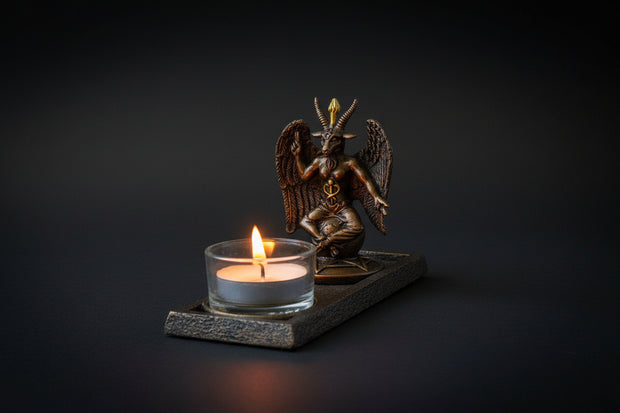
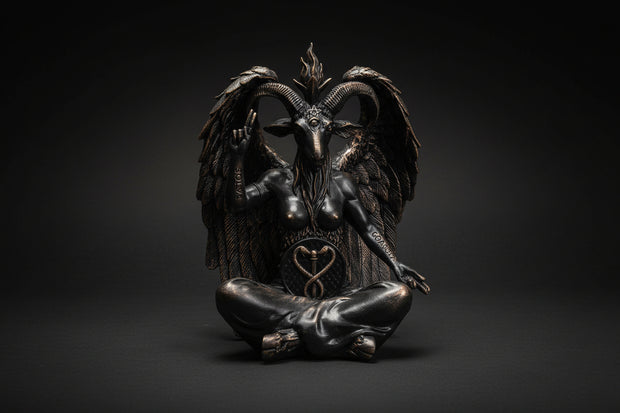
If you specifically want the complete emblem, start with the slate altar tile above. For a compact sculptural option, the Mini Baphomet Statue fits smaller altars and shelves. If you prefer Baphomet imagery integrated with candlelight, the Baphomet votive holder is an alternate format; for a larger focal point, the 8-inch Baphomet statue is another option. These are optional display or ritual objects, not requirements of Satanic practice.
Related Reading
Tools for this practice
Explore the products selected for this guide. Review each listing for what is included and how to use it.
Shop this guide · 2 items Collapse

Keep exploring the shop
You made it to the end of the guide. Keep exploring through related products, major departments, or the full catalog.
 RELATED TO THIS GUIDE
Candles & Incense
Shop this topic
RELATED TO THIS GUIDE
Candles & Incense
Shop this topic


Leave a comment