


Ritual Powder vs. Incense Powder: Burning, Sprinkling & Safety

“Ritual powder” describes a product category, not one standardized formula. One jar may contain finely ground botanicals, another may include resins or minerals, and another may be a maker’s proprietary blend. That variability matters because a powder intended to remain in a closed packet is not automatically safe to burn, inhale, apply to skin, add to bathwater, or scatter where animals can reach it.
The safest rule is simple: use the exact product only in ways its label or manufacturer explicitly permits. Spiritual intention does not change the physical behavior of dust, fragrance, herbs, minerals, dyes, or unknown additives.
Ritual Powder, Incense Powder, and Body Powder Are Different
| Product type | What the name tells you | What it does not tell you |
|---|---|---|
| Ritual or spell powder | It was prepared for a symbolic or magical intention | Whether it is burnable, cosmetic, edible, pet-safe, or suitable for water |
| Powdered or loose incense | It is sold for burning by a stated method | Whether it is safe on skin, in baths, or around respiratory sensitivities |
| Bath or body powder | It is marketed for a particular cosmetic use | Whether it can be burned or used on household surfaces |
| Culinary powder | It is sold as food for a stated use | Whether it belongs in ritual products or is safe when burned |
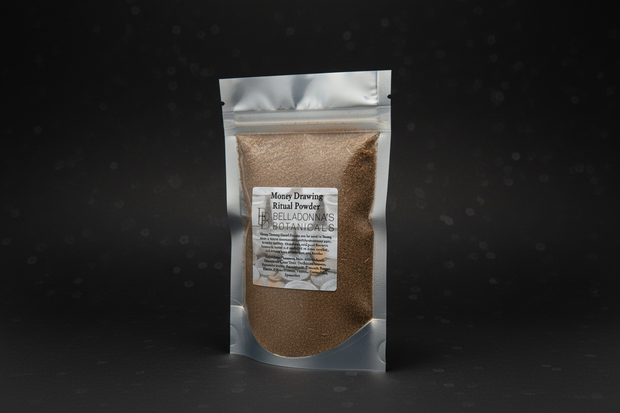
Do not transfer directions between categories. A jar called Money Drawing Ritual Powder should be handled according to that product’s directions, not according to instructions found for loose incense, bath salts, cosmetic dusting powder, or a homemade herb recipe.
Can Ritual Powder Be Burned?
Not unless the manufacturer clearly says it is intended for burning and explains the method. A spiritual correspondence is not a combustion-safety test. When heated, unknown material can smolder, flare, damage a burner, produce irritating smoke, or release substances that were not meant to be inhaled.
Keep ordinary ritual powder away from candle flames, charcoal, incense cones, heated resins, wax pools, and hot metal. If a product is labeled as incense, match it to the correct burner and ventilation. Our incense-burner guide explains the differences among stick, cone, resin, and charcoal setups.
Why Blowing and Scattering Powder Deserve Caution
Fine particles do not stay where a ritual places them. They can enter eyes and lungs, settle on food-contact surfaces, move through fans or ventilation, cling to animal fur, stain fabric, or create residue on floors. “Natural” does not mean non-irritating, and an ingredient that is familiar in whole form can behave differently when finely ground and airborne.
Avoid blowing ritual powder toward a person, animal, doorway, fan, flame, public walkway, shared hallway, vehicle, or workplace. Do not secretly apply it to someone’s clothes, bed, shoes, desk, property, or belongings. Consent and ordinary property rules still apply.
Contained Alternatives
- Keep a small amount in a closed, labeled jar beside a petition.
- Place a sealed packet beneath an altar object.
- Set the closed jar near—but not against—a candle holder.
- Use a written word, color, symbol, or photograph instead of loose material.
- Choose an oil, water, candle, or incense product specifically labeled for the method you want to use.
Containment does not weaken symbolism. It makes the working easier to reverse, clean, store, and evaluate.
Can Ritual Powder Go on Skin or in a Bath?
Do not assume it can. A product must be specifically labeled for cosmetic or bath use, with ingredients and directions appropriate to that route of exposure. A spiritual seller’s suggestion is not a substitute for a complete label. Unknown botanicals, fragrance, essential oils, resins, pigments, or minerals may irritate skin, eyes, mucous membranes, or existing medical conditions.
Never use ritual powder internally. Do not add it to food, drinks, medicine, a diffuser, a humidifier, or a pet’s water. If you want a symbolic bath but the product is not bath-approved, keep the closed container outside the tub or place a written intention nearby.
Ritual Powder Around Pets and Children
Loose powder is easy to inhale, lick, track, or spill. Keep it in a child-resistant storage area away from pet access and food supplies. Do not draw powder lines across floors, thresholds, bedding, litter areas, enclosures, feeding stations, or outdoor routes used by animals.
If a person or animal is exposed and develops symptoms, stop the ritual, move to fresh air when appropriate, and contact a qualified medical professional, veterinarian, poison-control service, or emergency service. Bring the packaging or ingredient information if available.
Surfaces, Fabrics, and Documents
Powder can abrade, discolor, absorb moisture, or become embedded in porous material. Oils or pigments in a blend may stain paper, upholstery, unfinished wood, stone, carpet, grout, or clothing. Test nothing on an irreplaceable object.
For document-centered intentions, keep the product closed beside the document or place a separate written copy under the jar. Do not apply powder to legal papers, identification, financial documents, electronics, library books, borrowed objects, merchandise, or workplace materials.
Choosing a Powder by Intention
Once the handling method is safe, choose by the narrowest relevant intention:
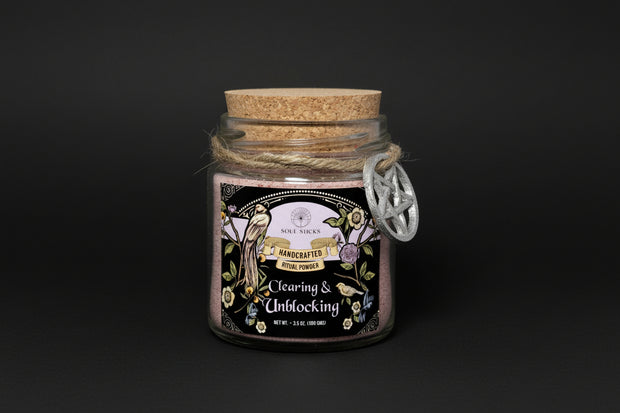
- Clearing & Unblocking Ritual Powder suits a general reset or release of stagnation.
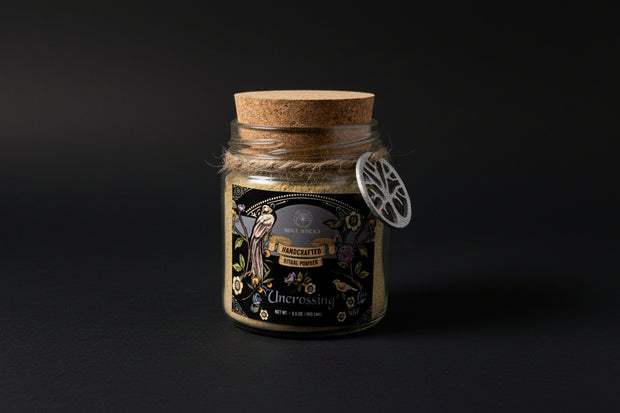
- Uncrossing Ritual Powder belongs to the more specific folk-magic idea of a crossed condition.
- House Blessing Ritual Powder aligns with welcome, gratitude, and household intention.
- Protection Ritual Powder fits symbolic boundaries and maintenance.
- Success & Prosperity Ritual Powder is broader than a narrowly financial formula.
Do not link every product into one working. One relevant formula with a clear purpose is more coherent than a pile of overlapping names.
Storage and Disposal
Keep the original label. If you transfer powder to another container, copy the product name, maker, date, warnings, and ingredients. Use a stable jar with a secure lid, and store it away from culinary spices, supplements, cosmetics, incense, children, animals, moisture, and heat.
Do not scatter leftovers outdoors by default. Salt, concentrated botanicals, dyes, fragrance, minerals, and non-native plant material can affect soil or wildlife. Follow manufacturer directions; when composition is unknown, closed household disposal may be more responsible than placing it in land or water. Our broader guide to ritual-remnant disposal provides additional options.
Frequently Asked Questions
Can all ritual powders be burned as incense?
No. Burn only a product explicitly labeled and instructed for that purpose. “Ritual powder” and “powdered incense” are not interchangeable terms.
Is it safe to blow ritual powder?
Blowing makes fine material airborne and increases eye, lung, surface, and pet exposure. A contained symbolic use is safer.
Can ritual powder be added to candle wax?
Do not add unknown powders to a wick or wax pool. Loose material can affect flame behavior and create smoke. Use only a product and candle method specifically approved by their manufacturers.
Can I put ritual powder in bathwater?
Only if the exact product is labeled for bath or cosmetic use. Otherwise keep it outside the bath as a visual symbol.
Can ritual powder be used on tarot cards or jewelry?
Loose powder can scratch, stain, lodge in card edges, or react with finishes and metals. Keep the product closed beside the object instead.
How much ritual powder is needed?
Follow the label. Symbolic work does not require a visible mess, and using more material does not guarantee a stronger result.
Is ritual powder safe if every ingredient is natural?
“Natural” does not establish respiratory, skin, pet, fire, or environmental safety. Dose, particle size, allergies, contamination, and method of use all matter.
Use the Label, Not the Assumption
Choose ritual powder for its stated intention, then keep its physical use within the manufacturer’s instructions. If the label does not say burn, bathe, apply, diffuse, or scatter, do not invent that permission. A closed jar, sealed packet, or nearby symbol can hold the same intention with far less risk.
Tools for this practice
Explore the products selected for this guide. Review each listing for what is included and how to use it.

Shop this guide · 4 items Collapse


Keep exploring the shop
You made it to the end of the guide. Keep exploring through related products, major departments, or the full catalog.
 RELATED TO THIS GUIDE
Ritual Supplies & Altar Tools
Shop this topic
RELATED TO THIS GUIDE
Ritual Supplies & Altar Tools
Shop this topic


Leave a comment