


What Is a Shew-Stone? John Dee, Scrying & the Obsidian Mirror

A shew-stone—also spelled show-stone—is a reflective or transparent object used for scrying. In John Dee’s angelic sessions, the scryer Edward Kelley reported figures, letters, places, and speech perceived through such an object while Dee recorded and questioned what Kelley described.
The term describes a function, not one required mineral. A crystal sphere, polished stone, dark mirror, or other dedicated viewing object can be called a shew-stone in historical or modern writing. That does not make every scrying mirror Enochian.
What did a shew-stone do?
The object provided a visual focus for the scryer. Kelley looked; Dee kept the record, asked questions, prayed, and organized the reported communications. This division of labor is important. Popular images often show Dee personally staring into a black mirror, but the best-known sessions depended on Kelley’s role as seer.
Dee’s records describe a religious and investigative process rather than passive fortune-telling. The conversations concerned spiritual hierarchies, language, tables, political and theological questions, and claims about divine knowledge.
Did John Dee use an obsidian mirror?
An obsidian mirror long associated with Dee is held by the British Museum. Scientific analysis traced its obsidian to the Pachuca region of Mexico, and the object itself was made within an Aztec cultural context before entering Europe. The Museum lists it as Dr Dee’s Magical Mirror or Speculum.
The association is historically significant, but a careful article should not turn it into more evidence than it is. Ownership traditions and later labels do not prove that this exact mirror produced every Enochian communication. Dee’s papers refer to multiple scrying objects and sessions over time.
Did Dee also use a crystal ball?
The British Museum also holds a small rock-crystal ball associated with Dee. Its catalogue gives a tentative seventeenth-century date and notes that the connection was assigned later. It is better described as associated with Dee than as an unquestionable surviving instrument from a named session.
Both objects show why “Dee used only a black mirror” and “Enochian magic requires a crystal ball” are too rigid. The practice centered on scrying and reported communication, not a single commercially standardized object.
Where did the shew-stone sit?
In the ritual apparatus described in Dee’s material, a central scrying object could be placed over a large wax seal on the Holy Table. Four smaller inscribed wax discs supported the table’s legs. Surviving British Museum discs closely resemble the manuscript instructions; one catalogue entry explains the central-and-four-support arrangement in connection with the wax magical discs.
A modern mirror placed on an ordinary altar is therefore a scrying tool, but not a full reconstruction of Dee’s Holy Table setup.
Obsidian mirror vs. crystal sphere
| Feature | Obsidian mirror | Crystal sphere |
|---|---|---|
| Viewing field | Dark, reflective surface with low visual detail | Transparent or translucent field with reflections and internal features |
| Lighting | Usually benefits from soft indirect light and controlled reflections | Needs stable placement without concentrated sunlight |
| Historical connection | A Mexican obsidian mirror is associated with Dee | A small rock-crystal ball is also associated with him, with uncertain provenance |
| Uniquely Enochian? | No | No |
Can a modern black mirror be used for Dee-style study?
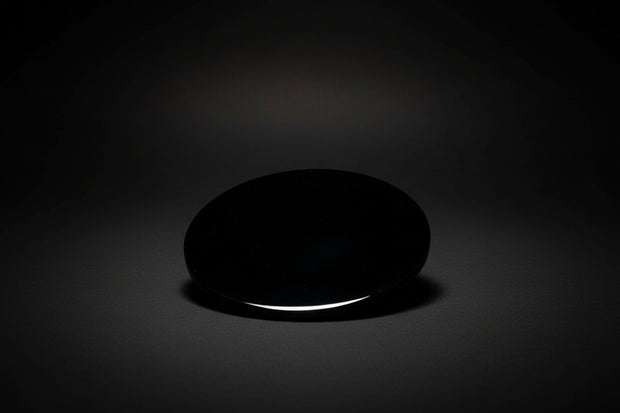
A Black Obsidian Scrying Mirror is relevant to studying the visual method and the famous Dee-associated object. It should not be advertised as an authentic Enochian artifact or as a guaranteed communication device. It is a contemporary divination tool made from a historically relevant material.
For basic placement, lighting, cleaning, recording, and bias controls, use our existing guide to using a scrying mirror. That guide deliberately treats perceived imagery as ambiguous rather than proof of an external being.
A grounded observation method
- Place the mirror securely where it cannot fall or reflect a flame into your eyes.
- Use soft ambient light; do not light candles close to hair, paper, curtains, or the mirror’s edge.
- Set a short observation period and a clear stopping time.
- Describe shapes, color changes, thoughts, and associations before interpreting them.
- Record multiple explanations, including ordinary visual adaptation, expectation, and imagination.
- End the session if it produces panic, fixation, sleep loss, or difficulty separating impressions from daily evidence.
This is an observation exercise, not an Enochian invocation. Do not present a general mirror practice as Dee’s ritual merely because his name appears in the introduction.
Frequently asked questions
Is “shew-stone” another word for crystal ball?
Sometimes, but it can refer more broadly to an object used for scrying. The function matters more than one material or shape.
Was Dee’s black mirror European?
No. Material analysis identifies the famous mirror as Mexican obsidian, probably made within an Aztec context before it reached Europe.
Do I need a black mirror to study Enochian magic?
No. Historical study begins with records and diagrams. Practical schools also differ on whether scrying and a separate scryer are required.
Is every vision a message?
No conclusion follows automatically. Low-detail gazing can produce visual adaptation and imaginative imagery. Record first and interpret cautiously.
Can sunlight damage a crystal ball?
A transparent sphere can concentrate sunlight and create a fire hazard. Store it covered and away from direct sun, regardless of ritual beliefs.
Further reading
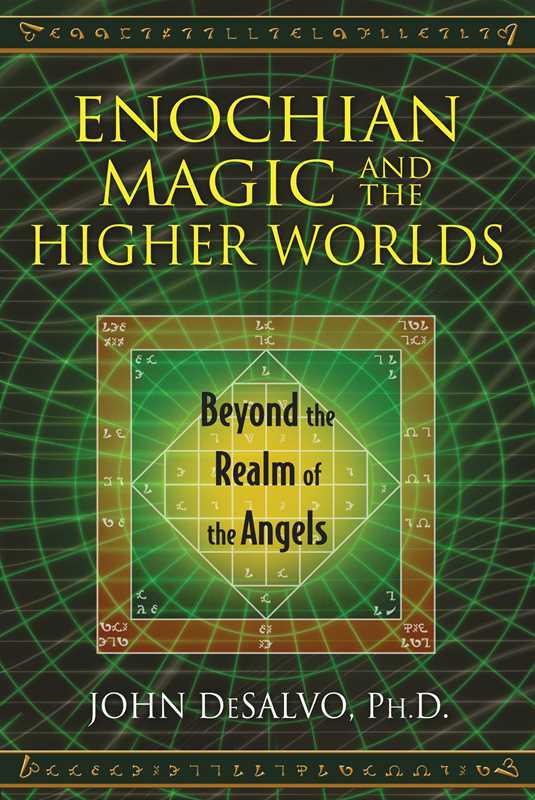
Enochian Magic and the Higher Worlds offers John DeSalvo’s modern account of Enochian meditation and higher-world practice. Compare any practical instructions with the historical object record rather than assuming a modern method exactly recreates the Dee–Kelley sessions.
The most accurate product language is also the simplest: an obsidian mirror is a relevant scrying tool with a remarkable historical connection to Dee, but Enochian specificity comes from the system in which the tool is used.
Tools for this practice
Explore the products selected for this guide. Review each listing for what is included and how to use it.
Shop this guide · 2 items Collapse

Keep exploring the shop
You made it to the end of the guide. Keep exploring through related products, major departments, or the full catalog.
 RELATED TO THIS GUIDE
Divination Tools
Shop this topic
RELATED TO THIS GUIDE
Divination Tools
Shop this topic


Leave a comment