


What Is Enochian Magic? Dee, Kelley, the Calls, Tables & Aethyrs

Enochian magic is not simply “speaking the language of angels.” The name now covers several connected but distinct things: the angelic conversations recorded by John Dee and Edward Kelley in the 1580s, the letters and Calls that emerged from those sessions, complex letter tables and spirit hierarchies, and later ritual systems built by the Hermetic Order of the Golden Dawn, Aleister Crowley, Anton LaVey, and modern authors.
The easiest way to understand Enochian magic is to ask which historical layer a writer means. A statement may be accurate for a Golden Dawn temple and completely absent from Dee’s surviving record.
Who were John Dee and Edward Kelley?
John Dee was an English mathematician, astrologer, scholar, and adviser associated with the court of Elizabeth I. Edward Kelley served as his best-known scryer: the person who reported sights and speech perceived in a crystal or reflective object. The Royal College of Physicians describes their sessions as “spirit actions” or angelic conversations, carefully recorded by Dee between 1582 and 1589. Its John Dee collection article provides useful historical context without asking the reader to accept the reported angels as proven beings.
Dee understood the communications through a Christian worldview. He believed the intelligences could disclose knowledge about nature, divine order, and a primordial sacred language. Kelley described the visions; Dee questioned, organized, copied, and interpreted them. Calling the system purely Dee’s invention or purely Kelley’s work erases that partnership.
Did Dee call it “Enochian”?
Dee more often used terms such as Angelical, Adamical, or the language of angels. “Enochian” became the standard label later, connecting the material to the biblical patriarch Enoch, whom the communications presented as a previous human possessor of the language.
This is why “Enochian” can refer to both a body of recorded language and an entire modern magical tradition. The two meanings overlap, but they are not identical.
The main parts of the Enochian material
| Component | What it is | Common confusion |
|---|---|---|
| Angelical letters and words | A script and limited body of vocabulary recorded in Dee’s papers | An alphabet chart is not a complete translation system |
| Calls or Keys | Invocatory texts with English renderings and pronunciation notes in the manuscript tradition | The Calls are only one part of the wider material |
| Liber Loagaeth | Large, difficult letter tables associated with the angelic sessions | Most of its material does not have an accepted word-for-word translation |
| Great Table | A composite system of lettered tablets from which names and hierarchies were derived | Later colored Watchtower arrangements are not identical to Dee’s presentation |
| Aethyrs | Thirty named regions or levels approached through variations of the final Call in later practice | There are not thirty entirely separate Calls |
| Ritual apparatus | The Holy Table, wax seals, lamen, ring, and scrying object described or associated with the workings | A generic crystal ball is relevant, but not uniquely Enochian |
What survived from Dee’s actual practice?
The surviving papers preserve conversations, diagrams, letter tables, translations, corrections, and instructions—but not one tidy beginner manual. Physical objects associated with Dee complicate the picture further. The British Museum holds wax discs resembling the seals described in his manuscripts, a crystal ball, a gold disc linked to Kelley’s Four Castles vision, and an Aztec obsidian mirror traditionally associated with Dee.
These artifacts are valuable evidence, but provenance is not equally certain for every object. The Museum notes that the surviving Four Castles gold disc differs from Dee’s manuscript drawing. Historical honesty sometimes means saying that an attractive surviving object is associated with a practice rather than unquestionably used in every session.
What did later occult orders add?
The Golden Dawn reorganized portions of the material into a teachable ceremonial system, connecting elemental tablets with its temple structure, color correspondences, grades, and broader Hermetic framework. Crowley published and practiced his own Enochian material, especially work with the thirty Aethyrs. LaVey later placed adapted Keys inside a Satanic ritual context.
These later systems kept Enochian material alive, but they also changed how it was interpreted and performed. “Traditional Enochian” therefore needs a date and source: Dee–Kelley, Golden Dawn, Crowleyan, Satanic, or a particular modern author.
Is Enochian magic a religion?
No single religion owns it today. Dee’s record is thoroughly Christian and angelic, while later users have included Hermetic magicians, Thelemites, Satanists, Pagans, and non-theistic occultists. Their theological explanations can conflict sharply. Learning the historical origin does not require adopting Dee’s beliefs, but rewriting those beliefs out of the source material produces bad history.
Frequently asked questions
Is Enochian an ancient language?
The documented corpus comes from Dee and Kelley’s late-sixteenth-century sessions. Claims that it can be traced as a complete spoken language to biblical antiquity are matters of religious or occult belief, not established linguistic history.
Is Enochian the same as angel magic?
It is one form of angelic ceremonial magic. Many Jewish, Christian, Islamic, grimoire, and modern angel traditions are not Enochian.
Do you need to believe in literal angels?
Practitioners answer differently. Some treat the beings as independent intelligences; others use psychological, visionary, artistic, or historical frameworks. State the framework rather than presenting one interpretation as proven.
Is it connected to the Book of Enoch?
The name and mythology invoke Enoch, but Dee’s Liber Loagaeth is not the same text as the ancient Jewish writings commonly called 1 Enoch.
Where should a beginner start?
Begin with history and vocabulary before attempting a Call. Our forthcoming source-first Enochian study path separates original records, later ritual systems, and modern reconstructions.
Further reading
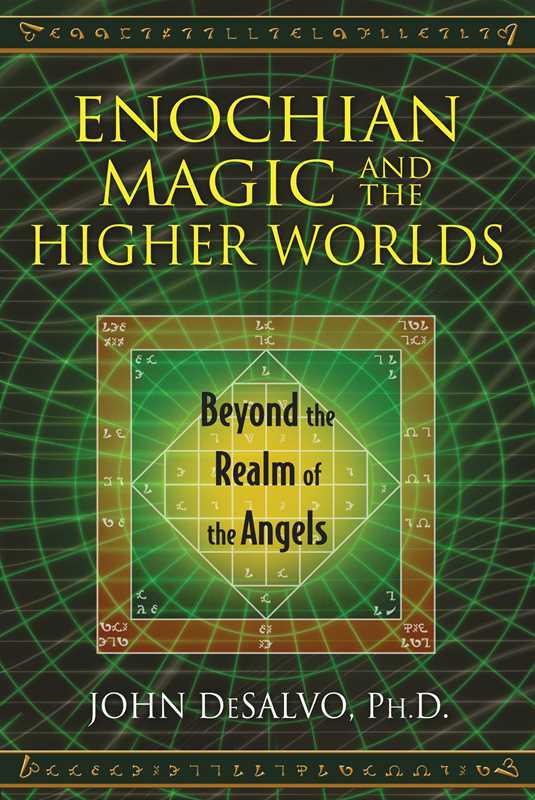
Enochian Magic and the Higher Worlds by John DeSalvo presents a modern practical reconstruction called Power Magic. Its claim that the original system was incomplete is the author’s position, not a universal historical consensus; read it as a named modern interpretation.
Enochian magic becomes far easier to understand once it stops being treated as one unchanged secret tradition. It is a documented Renaissance record with multiple later lives—and each layer deserves to be identified on its own terms.
Tools for this practice
Explore the products selected for this guide. Review each listing for what is included and how to use it.
Shop this guide · 1 item Collapse
Keep exploring the shop
You made it to the end of the guide. Keep exploring through related products, major departments, or the full catalog.


Leave a comment