


Enochian Alphabet FAQ: Is It a Language and How Is It Pronounced?

Most “Enochian translators” on the internet do not translate a language. They substitute stylized Enochian characters for Latin letters. That can produce an attractive inscription, but changing the alphabet does not change an English sentence into Angelical vocabulary or grammar.
The recorded Enochian corpus includes a distinctive script, English-letter transliterations, words, short grammatical patterns, and the longer texts known as the Calls. It is large enough to study and too limited to support effortless translation of anything a modern user wants to say.
Alphabet, transliteration, and translation
| Process | What it does | What it does not do |
|---|---|---|
| Font substitution | Displays English letters in Enochian-looking glyphs | Create Enochian words |
| Transliteration | Represents one writing system in another script | Supply meaning automatically |
| Dictionary lookup | Matches an attested word with a proposed English meaning | Guarantee a grammatical new sentence |
| Translation | Transfers meaning between languages using vocabulary, grammar, and context | Remain reliable when the source corpus lacks needed evidence |
How many letters are in the Enochian alphabet?
The script conventionally contains twenty-one distinct letter forms, though transliteration tables may appear to cover twenty-two Latin values because U and V can be treated as positional variants. J, K, and W are not separate values in the usual Dee-derived chart. Letter forms also vary between manuscript contexts and modern fonts.
Those details are why a product should identify its source chart. An “Enochian alphabet” plaque that adds modern English letters without explanation may be a decorative cipher rather than a faithful reference.
Which direction is Enochian written?
Dee’s alphabet table and some manuscript examples support right-to-left presentation, but much of the practical corpus is preserved in Latin-letter transcription and later occult publications often print it left to right. Modern practitioners therefore encounter both directions.
Do not reverse a modern English phrase, swap its font, and call the result a historically translated angelic sentence. Direction, script, vocabulary, and meaning are separate questions.
Is Enochian a real language?
It is unquestionably a documented body of language-like material recorded in Dee and Kelley’s papers. The disputed question is its origin and linguistic status. Dee understood it as a sacred primordial language communicated by angels. Skeptical and linguistic interpretations have described parts of it as constructed language, English-shaped material, or glossolalia.
The surviving corpus is too restricted to resolve every grammatical question. Its syntax often resembles English, and different parts of the manuscript material do not behave identically. Responsible writing separates the fact of the recorded corpus from belief about supernatural authorship.
Why are there competing pronunciations?
Dee wrote pronunciation notes beside portions of the Calls, but he wrote for readers of Early Modern English, not for a modern audio course. Later schools made different choices:
- Manuscript-oriented pronunciation tries to reconstruct Dee’s clues and Elizabethan English sounds.
- Golden Dawn-style pronunciation often vocalizes difficult consonant clusters to create speakable ceremonial words.
- Crowleyan conventions developed through Thelemic publication and practice.
- LaVeyan pronunciation emphasizes hard consonants and dramatic delivery within Satanic ritual.
The Church of Satan publishes its own Enochian pronunciation guide. It is evidence for the LaVeyan method, not proof that every earlier school pronounced the Calls that way. Our comparison of Enochian and Satanic Enochian explains why the religious translation and the pronunciation convention must be evaluated separately.
Is there one correct pronunciation?
There is no universally accepted modern standard. A careful teacher should name the convention being used and avoid saying that every alternative is dangerous or fraudulent. Historical reconstruction can be better supported in some places than others, and no recording can reproduce an allegedly angelic original independently of human sources.
Can Google or an online tool translate English into Enochian?
It can transliterate letters or replace words from a glossary. It cannot reliably create unlimited new Enochian prose because the attested corpus does not provide complete modern vocabulary and grammar. Treat instant translators as visual tools unless they document their lexical source and clearly label unattested constructions.
How to evaluate an Enochian inscription
- Ask whether the claim is transliteration or translation.
- Request the source manuscript, edition, or dictionary.
- Check whether the words are attested or newly invented.
- Confirm the reading direction and U/V treatment.
- Identify whether the design follows Dee, Golden Dawn, Crowley, LaVey, or a modern artist.
- Do not copy a modern artist’s chart or font commercially without permission.
Frequently asked questions
Can I write my name in Enochian?
You can transliterate the available sounds or letters, but that produces an Enochian-script rendering of your name—not an ancient angelic name with a discovered meaning.
Are Enochian tattoos automatically accurate?
No. Verify the source, direction, spelling, and whether the design is only a font substitution before making a permanent inscription.
Does mispronouncing a word cause spiritual danger?
Traditions hold different beliefs, but historical uncertainty makes absolute claims irresponsible. Beginners can study silently and compare conventions without reciting Calls.
Why do some charts have twenty-two letters?
They may be counting Latin transliteration values rather than distinct Enochian glyphs, especially the U/V distinction. The chart should explain its method.
Did Dee invent the letter shapes?
Dee recorded them as part of the angelic communications. Whether their ultimate source was supernatural, Kelley, Dee, earlier scripts, or creative synthesis is debated.
Readers confused by references to nineteen, thirty, or forty-eight texts can continue with The 19 Enochian Calls and 30 Aethyrs, which explains the counting without reproducing the invocations.
Further reading
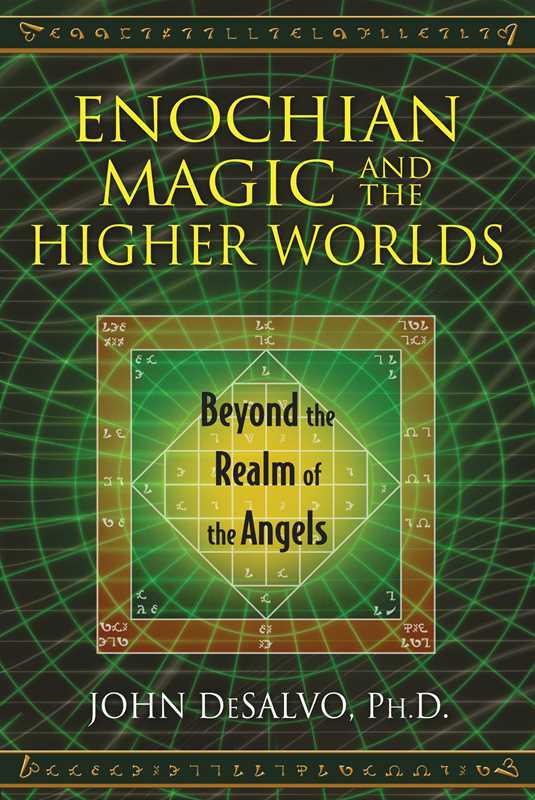
Enochian Magic and the Higher Worlds includes DeSalvo’s practical approach. Because pronunciation is one of the field’s most disputed subjects, compare the book’s stated method with manuscript-oriented and lineage-specific conventions instead of silently merging them.
An alphabet is not a translator, a font is not a grammar, and dramatic certainty is not a source. Those three distinctions answer most poorly explained Enochian-language questions.
Tools for this practice
Explore the products selected for this guide. Review each listing for what is included and how to use it.
Shop this guide · 1 item Collapse
Keep exploring the shop
You made it to the end of the guide. Keep exploring through related products, major departments, or the full catalog.


Leave a comment