


How to Catalog a Personal Crystal and Mineral Collection

A mineral collection becomes harder to understand as soon as labels separate from specimens, purchase details are forgotten, or several similar pieces enter the same drawer. Cataloging solves this by connecting each object to a stable record.
Your system does not need museum software. A notebook, spreadsheet, database, or combination can work when it is consistent, backed up, and simple enough that you will actually maintain it.
Give Every Specimen a Unique Catalog Number
Use a number that belongs only to one object or clearly defined set. Examples include:
- AO-0001, AO-0002, AO-0003;
- 2026-001, 2026-002, 2026-003;
- QZ-001 for a quartz-focused collection, when category codes will remain stable.
Simple sequential numbers are often safest because identifications can change. If a specimen first cataloged as one mineral is later corrected, the catalog number should remain the same.
Connect the Number to the Object Safely
Place the number on an archival label stored with the specimen, on the outside of a box, or on a reversible base label. Avoid permanent marker, adhesive tape, or glue directly on delicate, porous, soluble, historic, or valuable material.
For tiny specimens, keep the numbered piece in a matching vial or box. Never rely on memory to reconnect a loose label later.
Record the Core Identification Fields
A useful catalog entry includes:
- catalog number;
- mineral species or current identification;
- variety or trade name, clearly separated from species;
- associated minerals and matrix;
- locality as specifically as documentation allows;
- dimensions and weight;
- natural, polished, carved, mounted, or jewelry form;
- condition notes;
- repair, stabilization, dye, coating, heat, irradiation, or other treatment when known;
- date acquired and source;
- purchase price or gift information;
- current storage or display location.
Read How to Read a Mineral Label before transferring old label information.
Preserve the Original Label
Do not discard an old dealer, mine, museum, auction, or collection label merely because you created a cleaner one. Original labels may contain locality history, prior catalog numbers, dealer names, or ownership information that cannot be reconstructed.
Photograph both sides of every original label and store it with the specimen in an archival sleeve when appropriate. Enter the wording exactly before adding your corrected or expanded interpretation.
Separate Facts From Later Identification
A strong record distinguishes:
- Original label: the wording that arrived with the specimen.
- Current identification: what you or another source presently believes it to be.
- Confidence: confirmed, probable, tentative, or unknown.
- Basis: seller statement, visual identification, field record, laboratory test, or expert review.
Do not silently rewrite provenance when an identification changes. Preserve the history of the record.
Photograph the Specimen Systematically
For each item, capture:
- a full front view;
- back and side views;
- the base;
- close-ups of significant crystals, damage, repairs, or labels;
- a scale reference when useful;
- the catalog number in at least one record photograph.
Name the files with the catalog number, such as AO-0042-front.jpg. Accurate color and consistent lighting make later comparison easier. Review How to Photograph Crystals and Mineral Specimens Accurately.
Record Dimensions Consistently
Choose one order—such as width × depth × height—and use it throughout the catalog. Record the unit every time. For irregular specimens, note the maximum measurements. Weigh small pieces in grams and large pieces in grams, kilograms, ounces, or pounds according to your system, but avoid switching unpredictably.
Describe Condition Without Hiding Natural Features
Condition notes may include:
- natural contact or incomplete termination;
- fresh chip or older weathered break;
- loose crystal or unstable matrix;
- repaired point or filled fracture;
- adhesive on base;
- surface coating, oxidation, or dust;
- fading or color change observed over time.
Date condition photographs for valuable or fragile pieces. This helps distinguish new damage from an earlier feature.
Track Where Every Item Is Stored
A catalog is most useful when it tells you where the object is. Use location codes such as:
- Display Case A, Shelf 2;
- Drawer C-04;
- Box 12;
- Loaned to exhibition, date;
- Stored off-site.
Update the location when the object moves. A detailed record is not useful when the specimen itself cannot be found.
Use a Spreadsheet or Database
Suggested columns include:
| Identification | Provenance | Physical Record | Management |
|---|---|---|---|
| Catalog number | Source or seller | Dimensions | Storage location |
| Species | Acquisition date | Weight | Purchase price |
| Variety or trade name | Original label text | Condition | Estimated replacement value |
| Associated minerals | Locality | Treatments or repairs | Photo filenames |
Use controlled terms where possible. For example, choose one spelling for “unknown,” one date format, and one set of condition terms.
Purchase Price Is Not the Same as Current Value
Record what you paid because it is factual. Keep any later estimate in a separate field with the date, source, and purpose of the estimate. Retail asking prices, insurance replacement values, auction results, and expected resale prices are different numbers.
Back Up the Catalog
Keep at least two copies in different places. A practical approach is:
- one working digital catalog;
- one automatic cloud or external-drive backup;
- one periodic export in a common format such as CSV or PDF;
- photographs stored separately from the only computer containing the catalog.
Paper labels remain important because digital records can fail, while paper records benefit from digital photographs and searchable data.
Review the Collection Periodically
Once or twice a year:
- reconcile every specimen with its catalog entry;
- reattach separated labels;
- update storage locations;
- photograph new damage or changes;
- review tentative identifications;
- check mounts, boxes, and stands;
- update insurance records when relevant;
- confirm backups open correctly.
For preservation guidance, read How to Clean, Store, and Display Mineral Specimens Without Damaging Them.
Build the Physical and Written System Together
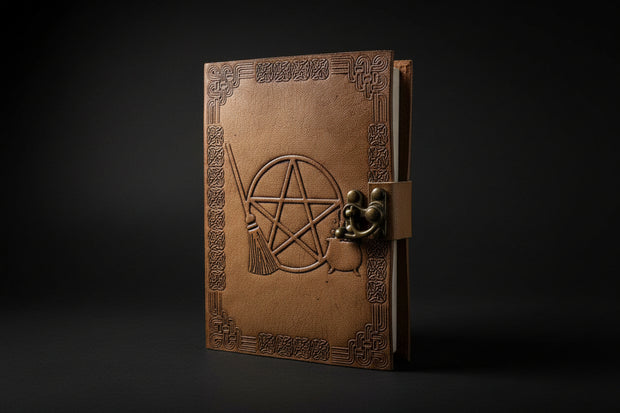
Use the Storage & Chests collection for suitable organizational containers and the Journals collection for handwritten field notes or acquisition records. Continue developing the collection through Crystals & Stones.
Frequently Asked Questions
Do I need special catalog software?
No. A spreadsheet is sufficient for many collections. The best system is one you can search, update, export, and back up.
Should I put a sticker directly on the crystal?
Usually avoid direct adhesive unless you understand the material and use a reversible archival method. A numbered box or label stored beside the specimen is safer.
What if the identification changes?
Keep the same catalog number. Update the current identification while preserving the original label text and earlier determination.
Should gifts receive a purchase value?
Record that the item was a gift and, when necessary for insurance, keep a separate dated replacement-value estimate.
How should I catalog a set of tumbled stones?
Catalog the set as one lot when the pieces share a source and are not individually important, or assign separate numbers when identity, value, or provenance differs.
What information matters most?
Catalog number, identification, locality, source, original label, dimensions, condition, treatments, photographs, and current location form the essential core.
A Catalog Preserves More Than a Name
The record protects the connection between an object and its identity, locality, ownership history, condition, and place in your collection. Begin with a simple numbering system, preserve original labels, photograph consistently, and improve the catalog as your knowledge grows.
Tools for this practice
Explore the products selected for this guide. Review each listing for what is included and how to use it.

Shop this guide · 4 items Collapse


Keep exploring the shop
You made it to the end of the guide. Keep exploring through related products, major departments, or the full catalog.
 RELATED TO THIS GUIDE
Ritual Supplies & Altar Tools
Shop this topic
RELATED TO THIS GUIDE
Ritual Supplies & Altar Tools
Shop this topic


Leave a comment