


How to Prepare for Your First Palm Reading

A first palm reading can feel unusually personal because the reader studies a part of your body rather than a separate deck or tool. Good preparation is simple: arrive with comfortable hands, decide what you hope to learn, and know that you may set limits on touch, questions, and interpretation.
Palmistry is a traditional interpretive practice that examines features such as hand shape, fingers, mounts, texture, flexibility, and lines. It should not be presented as an infallible map of fixed fate, medical diagnosis, or guaranteed prediction.
Know What a Palm Reading May Examine
Methods differ, but a reader may compare:
- overall hand shape and proportion;
- finger length, spacing, flexibility, and tips;
- the major and minor lines;
- raised areas traditionally called mounts;
- skin texture and visible markings;
- differences between the right and left hands.
Different schools assign different meanings to the dominant and nondominant hands. Let the reader explain the method being used rather than assuming one hand represents an unchangeable destiny.
Prepare Your Hands Without Altering Them
- Wash your hands normally before the appointment.
- Dry them thoroughly.
- Avoid applying heavy lotion or oil immediately beforehand.
- Remove rings or bracelets only when comfortable and when they obstruct the area being examined.
- Do not scrub, trace, darken, or photographically enhance the lines.
Ordinary scars, calluses, work wear, mobility differences, and age-related changes are part of the hands as they are. You do not need a manicure.
Tell the Reader About Accessibility Needs
Let the reader know when you have pain, arthritis, tremor, limited range of motion, neuropathy, an injury, skin sensitivity, or a condition that makes prolonged hand positioning uncomfortable. A reading can be adapted with shorter viewing periods, visual inspection without touch, photographs when appropriate, or one hand at a time.
You never have to allow touch. The reader can ask before moving a finger, turning the hand, or tracing a line.
Choose a Useful Focus
Palm readings are often broader than a single tarot spread, but you can still choose a focus:
- personal strengths and habits;
- communication and relationship patterns;
- work style and decision-making;
- changes you have noticed over time;
- the traditional meaning assigned to a particular line or mount;
- how the reader compares both hands.
For help developing grounded questions, read How to Ask Better Divination Questions.
Set Privacy Boundaries
A reader should not pressure you to discuss trauma, medical history, pregnancy, death, sexuality, finances, or relationships merely because a marking is interpreted in a certain way. You may redirect the conversation or decline a topic.
Ask before photographing the reading table or recording the session. The reader should ask before taking or retaining photographs of your hands. Review Privacy and Confidentiality in Spiritual Practice.
What to Bring
- A short list of questions
- A notebook
- Reading glasses if you want to see fine details
- Accessibility supports you normally use
- Previous hand photographs only when you want to discuss visible change
You do not need your birth chart, a crystal, or knowledge of palmistry terminology.
During the Reading
Ask the reader to identify the physical feature being discussed. This keeps the interpretation connected to something you can see rather than a stream of unsupported claims.
Useful clarifying questions include:
- Which line or feature are you referring to?
- Is that interpretation shared across palmistry systems?
- How do the two hands differ?
- Is this read as a tendency, a current pattern, or a fixed event?
- What practical reflection could I take from this?
A line is not a medical test. Changes in skin, nails, swelling, color, sensation, or pain belong with an appropriate healthcare professional, not a fortune-telling conclusion.
After the Reading
- Record the major themes and the features connected to them.
- Note which interpretations felt accurate, uncertain, or irrelevant.
- Choose one reflection or action rather than trying to monitor every line.
- Avoid repeatedly inspecting your hands for frightening changes.
- Keep any hand photographs private unless you have a reason to share them.
Explore Palm Readings in Store
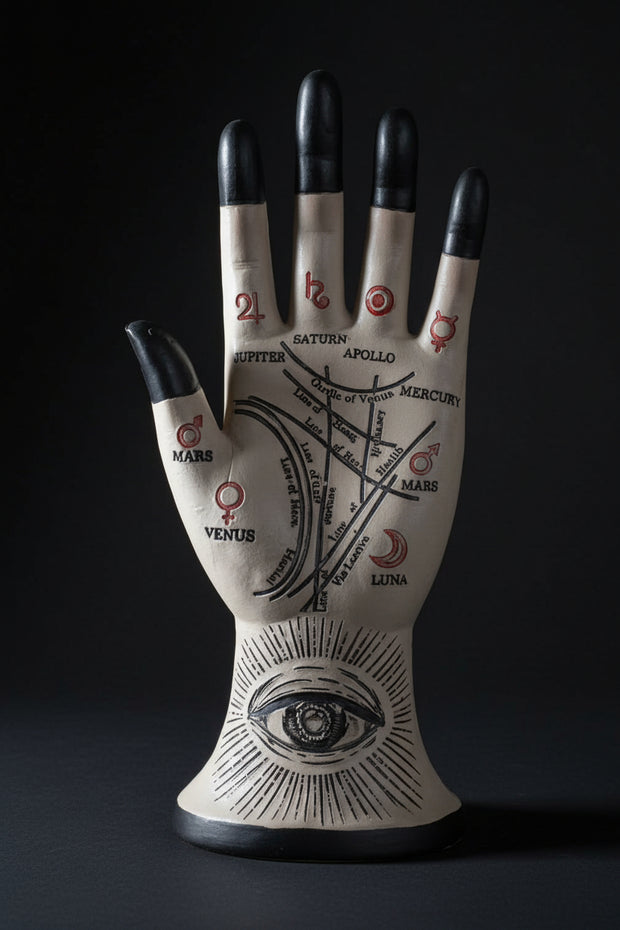
View current details and availability on our Palm Readings page or explore all In-Store Services. Customers interested in palmistry symbolism can also explore the Palmistry Hand Statue and Palmistry Hands Tray.
Frequently Asked Questions
Which hand will be read?
Many readers examine both. Traditions disagree about how dominant and nondominant hands should be interpreted, so ask which system is being used.
Should I avoid lotion?
Heavy lotion or oil immediately beforehand can obscure texture and make handling uncomfortable. Normal skincare earlier in the day is not a problem.
Can palm lines change?
Minor appearance can change with movement, skin condition, age, work, injury, lighting, and photography. Palmistry traditions may interpret change symbolically, but it should not be treated as proof of a predicted event.
Does the reader need to touch my hands?
No. You may request a visual reading without touch or ask the reader to explain before repositioning your hand.
Can palmistry diagnose illness?
No. A palm reading is not a medical examination or diagnostic service.
Do short lines predict a short life?
No responsible conclusion about lifespan should be drawn from one line. Traditional line names are symbolic categories, not reliable measurements of death or longevity.
Your Hands Are Not a Sentence
Arrive comfortable, establish consent around touch and photographs, ask which features support each interpretation, and treat the reading as a reflective tradition rather than an unchangeable verdict.
Tools for this practice
Explore the products selected for this guide. Review each listing for what is included and how to use it.


Shop this guide · 3 items Collapse



Keep exploring the shop
You made it to the end of the guide. Keep exploring through related products, major departments, or the full catalog.


Leave a comment