


Mugwort vs. Wormwood: Identification, Ritual Differences & Safety

Part 8 of the Ritual Botanical Field Guide.
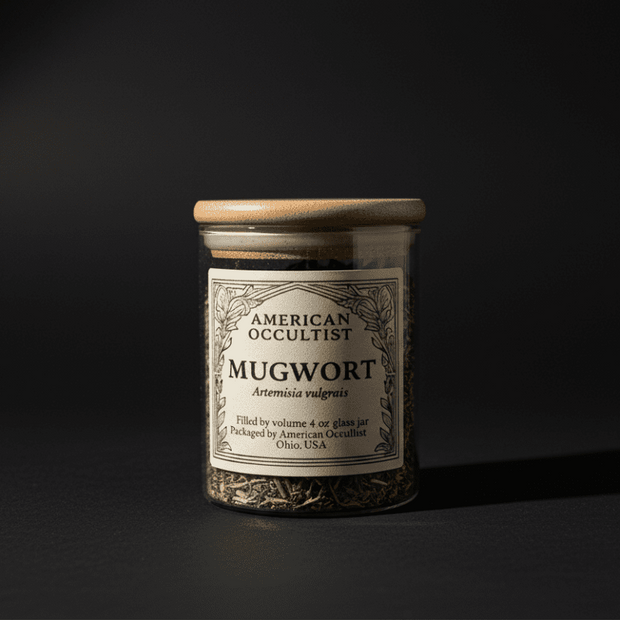
Mugwort and wormwood are related, visually similar dried herbs that are often confused in occult shops and correspondence lists. They belong to the same genus, Artemisia, but they are not the same species. Mugwort is commonly identified as Artemisia vulgaris; common wormwood is Artemisia absinthium.
That one-word difference on a label changes the plant’s identity, material history, and the body of sources relevant to it. Shared lunar or protective themes do not make the jars interchangeable.
Mugwort vs. Wormwood at a Glance
| Question | Mugwort | Wormwood |
|---|---|---|
| Common botanical identity | Artemisia vulgaris | Artemisia absinthium |
| Common modern ritual frame | Dream symbolism, divination, thresholds, lunar attention | Boundaries, banishing, severance, ancestor or underworld imagery |
| Frequent confusion | Treated as any silvery Artemisia | Reduced entirely to its association with absinthe |
| Safe default method | Closed jar, sealed packet, written botanical name | Closed jar, sealed packet, written botanical name |
| Interchangeable? | No—not unless a specific source explicitly treats the symbolic role as substitutable | |
These ritual frames describe common patterns in contemporary sources. Neither set of associations is universal, and neither plant scientifically causes dreams, visions, protection, or spirit contact.
How to Identify the Correct Jar
Start with the botanical name. Mugwort — Artemisia vulgaris and Wormwood — Artemisia absinthium should be labeled as separate products.
Do not rely on a dried herb’s color alone. Harvest timing, which aerial parts are included, particle size, age, storage, and photography can make gray-green leaves look similar. Aroma is also an unreliable home identification test and requires handling an unknown material.
If a jar says only “Artemisia,” “dream herb,” or “witch herb,” the identity is incomplete. Keep it sealed and do not guess. The principles in How to Read a Ritual Herb Label apply especially strongly to plants with several related common names.
Mugwort in Modern Ritual Practice
Mugwort is widely associated in modern European-derived occult practice with dreaming, divination, liminal awareness, moon symbolism, and crossing thresholds. Its genus name connects it to Artemis in later interpretive traditions, while regional folk uses and common names add other layers.
A coherent mugwort working might place the closed jar beside a dream journal, tarot deck, scrying mirror, or written question. The plant acts as a symbolic marker of attention; it does not need to be placed under a pillow, consumed, or burned.
Our separate Mugwort Smoke Wand is a different product form from the herb jar. A product intended for smoke still requires ventilation, fireproof equipment, attention to people and animals in the space, and compliance with the label. It is not the default method for everyone.
Wormwood in Modern Ritual Practice
Wormwood is often framed in contemporary occult sources around strong boundaries, banishing, severance, difficult truth, ancestor symbolism, or underworld imagery. Its bitter reputation and historical association with absinthe shape much of the modern mythology.
That history can make wormwood a more coherent symbol for an ending, refusal, or guarded threshold than for a gentle dream practice. A closed jar beside a written boundary is sufficient. There is no need to ingest it, breathe its smoke, or add it to a drink in order to express that symbolism.
Why the Two Are Not Automatic Substitutes
Both plants belong to Artemisia, and both may appear in correspondence systems involving protection, the moon, spirits, or altered boundaries. But a shared genus is not sameness. Their species, folklore, sensory profiles, chemical composition, and modern ritual emphasis differ.
When a source names mugwort, first determine what role it serves. If the role is specifically dream lore associated with A. vulgaris, wormwood is not a transparent replacement. If the source is using a broad symbolic category such as “a bitter boundary herb,” another plant might fit—but the substitution should be named and explained.
A written botanical name or drawing is often a better substitute than placing the wrong species into a practice and pretending nothing changed.
Smoke, Incense, and Airborne Exposure
Loose herb jars are not automatically incense. Burning unidentified or unlabeled Artemisia material introduces smoke and airborne particles without improving botanical certainty. Keep loose herbs away from candles, charcoal, and hot surfaces unless the exact item includes burn directions.
Smoke can affect people with respiratory sensitivities and can spread far beyond the person performing the ritual. Pets, children, neighbors, rental rules, smoke alarms, and local fire restrictions all matter. A smoke-free method is not a lesser ritual.
Ingestion and Body-Use Boundaries
Do not make tea, tincture, food, oil, bath products, or smoking blends from either ritual-use jar. Traditional use, internet recipes, or familiarity with absinthe does not establish the quality, dose, identity, or suitability of a store product for internal use.
Questions involving pregnancy, nursing, medications, medical conditions, children, or animal exposure belong with an appropriate health professional or veterinarian who can evaluate the actual substance and circumstances. A ritual correspondence article cannot make that decision.
Smoke-Free Ways to Keep the Meanings Distinct
- Mugwort: place the labeled jar near a dream journal or divination record.
- Wormwood: place the closed jar beside a written boundary or release statement.
- Either plant: copy the full botanical name into a materia magica before use.
- For a temporary working: use a photograph or paper label, then archive it with your notes.
- When identity is uncertain: do not use the material; work with the written concept instead.
Frequently Asked Questions
Are mugwort and wormwood the same plant?
No. They are commonly sold as different species: mugwort as Artemisia vulgaris and wormwood as Artemisia absinthium.
Can wormwood replace mugwort in dream work?
Not automatically. Mugwort has the clearer modern dream-and-divination association. If you substitute, document the symbolic role and the different species.
How can I tell dried mugwort from dried wormwood?
Visual inspection of cut dried material is unreliable. Use the original label, botanical name, trusted supplier information, and batch records rather than guessing by color.
Does mugwort have to be burned or placed under a pillow?
No. A closed labeled jar, photograph, drawing, or written botanical name can support the same ritual focus without smoke or direct exposure.
Is a mugwort smoke wand the same as a mugwort herb jar?
No. They are different product forms with different directions and handling considerations. Follow the exact listing and label.
Can either ritual herb be made into tea?
No. Do not consume ritual-use products. Questions about internal herbal use require an appropriately manufactured product and individualized professional guidance.
Return to the series hub: Roots vs. Barks vs. Leaves vs. Flowers: Why Plant Part Matters.
Tools for this practice
Explore the products selected for this guide. Review each listing for what is included and how to use it.


Shop this guide · 3 items Collapse


Keep exploring the shop
You made it to the end of the guide. Keep exploring through related products, major departments, or the full catalog.
 RELATED TO THIS GUIDE
Ritual Herbs
Shop this topic
RELATED TO THIS GUIDE
Ritual Herbs
Shop this topic


Leave a comment