


Ouija Boards and Planchettes: History, the Ideomotor Effect, and Grounded Use

A planchette sliding across a talking board can feel uncanny. Several people may touch it lightly while it spells words no one consciously intended to produce. That experience has made Ouija boards one of the most recognizable—and most feared—objects in modern occult culture.
The history is more interesting than the horror stories. Talking boards grew from nineteenth-century Spiritualism, commercial invention, parlor entertainment, and widespread interest in communicating with the dead. Their movement also has a well-established psychological explanation: the ideomotor effect, in which expectation and attention produce small unconscious muscular movements.
What is a Ouija board?
A Ouija board is a type of talking board printed with letters, numbers, and commonly words such as “yes,” “no,” and “goodbye.” Participants rest their fingertips on a movable pointer called a planchette. As the pointer travels, users interpret its path as words or answers.
Ouija is a trademarked name that became a common term for this broader category. Not every spirit board or talking board is technically a Ouija board, though people often use the words interchangeably.
What is a planchette?
The word planchette comes from French for a small board or plank. Earlier planchettes could hold a pencil and produce automatic writing. The familiar heart- or teardrop-shaped pointer with a viewing window became associated with alphabet boards.
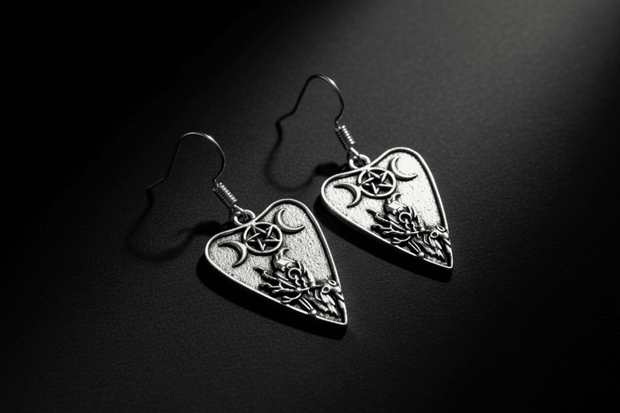
Planchettes also appear today as jewelry, décor, and artistic motifs. Wearing one does not mean a person practices spirit communication any more than wearing a moon pendant proves a specific religious belief.
Where talking boards came from
Modern talking boards developed during the rise of Spiritualism in the United States in the nineteenth century. Séances, table turning, automatic writing, and attempts to receive messages from the dead became popular in private homes and public demonstrations.
Alphabet boards offered a faster method than calling out letters one at a time. By the late nineteenth century, entrepreneurs patented and marketed commercial talking boards. What began within a larger culture of Spiritualist experimentation became both a household amusement and a purported divination device.
Its later reputation was shaped heavily by fiction, religious warnings, urban legends, and horror films. Those stories are culturally powerful, but they should not be confused with evidence that the board itself contains or summons an entity.
Why does the planchette move?
The ideomotor effect describes involuntary physical movement influenced by ideas, expectations, suggestion, and attention. A participant does not need to consciously push the planchette for their muscles to contribute to its movement.
With several hands involved, tiny movements combine. Each person feels that the pointer is being moved by someone or something else because no one experiences a deliberate decision to guide it. Meaningful words may emerge through shared expectations, pattern recognition, partial knowledge, and the group’s tendency to correct movement toward plausible letters.
This explanation does not require accusing participants of pretending. The movement can feel external precisely because it is not consciously planned.
Does the ideomotor effect settle every spiritual question?
It explains how the pointer can move without conscious pushing and why board responses are vulnerable to expectation and suggestion. It does not dictate anyone’s private theology. A Spiritualist may interpret unconscious movement differently from a skeptic, Witch, occultist, or psychologist.
What it does establish is a necessary boundary: movement alone is not reliable proof that a spirit is present or that a message is factually true. Board responses should not override evidence, consent, medical care, legal advice, personal safety, or direct communication with living people.
Why board sessions can become frightening
Fear can grow through a feedback loop:
- Participants expect a threatening answer.
- Unconscious movement reflects that expectation.
- The answer increases anxiety.
- Heightened anxiety makes ominous interpretations more likely.
- Every coincidence afterward is treated as confirmation.
Group pressure can intensify the experience. One participant may introduce a frightening idea that shapes everyone else’s movement and interpretation. Darkness, sleep deprivation, alcohol, grief, and emotionally charged questions can make the session feel even more authoritative than it is.
Grounded guidelines for using a talking board
Decide what kind of activity this is
Are you exploring a historical divination method, conducting a symbolic ritual, testing ideomotor movement, or playing a social game? Naming the purpose reduces confusion.
Get clear consent
Do not pressure frightened, grieving, intoxicated, or unwilling people to participate. Do not use a board to claim private information about someone who has not consented.
Avoid high-stakes questions
Do not use a talking board to diagnose illness, identify a criminal, determine whether someone is unfaithful, locate a missing person, make financial decisions, or decide whether immediate danger is real.
Record answers before interpreting them
Write the exact letter sequence rather than silently correcting it into a meaningful phrase. This reveals how much interpretation is being added after the movement.
Use a neutral observer or blind test
For an experiment, rotate the board without telling participants or have users close their eyes while an observer records the pointer. Accuracy often changes when visual feedback is removed. The purpose is not humiliation; it is learning how expectation guides movement.
Stop when distress rises
A session is not a test of courage. Turn on the lights, remove hands from the planchette, describe what is physically present, and shift to an ordinary activity. No ceremonial closing is required for physical safety, although a chosen closing gesture can help participants mark the activity as finished.
Our guide to pendulums and avoiding bias explains the same unconscious-movement problem in another form of divination.
What about saying goodbye?
Many board traditions instruct participants to move the planchette to “goodbye.” As a ritual boundary, that can be useful: it creates a clear endpoint, helps the group settle, and prevents the session from continuing indefinitely.
There is no evidence that failing to touch a printed word physically traps an entity in the room. The psychological value of closure is real without turning the instruction into a threat.
Spirit boards and ethical divination
Talking boards are especially vulnerable to leading questions because several people influence one pointer. Questions such as “Who here is in danger?” or “Which person betrayed me?” invite accusation, fear, and confirmation bias.
Better prompts focus on reflection:
- What concern is shaping the group’s attention?
- What assumption should we examine?
- What action is actually within our control?
- What information needs independent verification?
For broader consent and privacy boundaries, see The Ethics of Divining About Other People.
Collecting and wearing planchette imagery
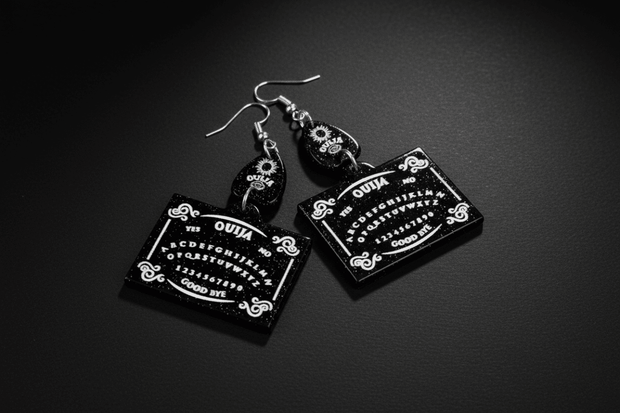
Planchette imagery has become part of Gothic, occult, and alternative design. It can represent curiosity, mystery, communication, mortality, Spiritualist history, or simply a visual style. Pieces such as planchette earrings or Ouija board earrings can be appreciated without treating them as active ritual instruments.
Frequently asked questions
Can one person use a Ouija board alone?
Yes, a single person can move a planchette through unconscious muscular action. The experience may feel different without a group, but solo movement is not evidence of an external force.
Can a board predict the future?
It may generate ideas or symbolic material, but it is not a dependable forecasting instrument. Specific predictions should be treated as unverified.
Is a handmade spirit board different from a commercial one?
The materials and artwork differ, but neither construction method establishes supernatural ability. Meaning comes from use, belief, design, and context.
Can a board cause possession?
There is no reliable evidence that a cardboard or wooden board causes possession. Fear, suggestion, panic, and existing mental-health symptoms can still produce genuine distress and should be taken seriously.
What should I do after a frightening session?
Stop using the board, return to normal lighting and routines, talk through what occurred without escalating it, and seek appropriate support if anxiety persists. Persistent voices, paranoia, inability to sleep, or fear of being controlled deserve professional mental-health attention rather than more divination.
A strange experience does not require a frightening conclusion
Talking boards sit at the meeting point of Spiritualist history, unconscious movement, social suggestion, ritual symbolism, and popular horror. Understanding those layers does not make the experience dull. It makes it easier to explore without handing a moving pointer authority over your safety, relationships, or reality.
Tools for this practice
Explore the products selected for this guide. Review each listing for what is included and how to use it.
Shop this guide · 2 items Collapse


Keep exploring the shop
You made it to the end of the guide. Keep exploring through related products, major departments, or the full catalog.
 RELATED TO THIS GUIDE
Occult Jewelry & Symbolic Adornments
Shop this topic
RELATED TO THIS GUIDE
Occult Jewelry & Symbolic Adornments
Shop this topic


Leave a comment