


Vegvísir and the Helm of Awe: Icelandic Magical Staves Beyond the Viking Myths

Vegvísir and Ægishjálmur—usually called the Helm of Awe—are among the most widely reproduced symbols associated with Norse-inspired spirituality. They appear on jewelry, tattoos, altar pieces, clothing, and modern protective charms. They are also routinely marketed as ancient Viking symbols.
That description is too simple. Both belong to the broader world of Icelandic magical staves, but the surviving evidence for their familiar designs comes from manuscripts written long after the Viking Age. Understanding that history does not strip them of meaning. It allows modern use to rest on accuracy rather than romantic invention.
What are Icelandic magical staves?
Icelandic magical staves, often called galdrastafir, are graphic signs preserved in early modern and later Icelandic manuscripts. Their designs combine lines, crosses, forked terminals, circles, letters, and other forms. Manuscripts assign them purposes such as protection, influence, finding thieves, success in conflict, luck, love, healing, and guidance.
These texts developed in a Christian Icelandic environment shaped by several currents: local folklore, learned European magic, Christian prayers and divine names, runic knowledge, and inherited Norse literary material. They should not be treated as a sealed survival of one unchanged pre-Christian Viking system.
What does Vegvísir mean?
Vegvísir can be translated approximately as “way-shower,” “pathfinder,” or “signpost.” The familiar radial stave is accompanied in a nineteenth-century Icelandic manuscript by a statement that a person carrying the sign would not lose their way in storms or bad weather, even when unfamiliar with the route.
The earliest known surviving attestation of this specific symbol is generally identified in the Huld manuscript, compiled by Geir Vigfússon in 1860. That date is nearly eight centuries after the conventional end of the Viking Age.
Is Vegvísir a Viking compass?
No surviving evidence establishes the familiar Vegvísir design as a navigational instrument used by Viking sailors. It does not mechanically point north, measure the sun, or replace a magnetic compass.
“Viking compass” is a modern popular label. The manuscript description presents it as a magical sign for avoiding disorientation in severe weather—not as a tested piece of maritime technology.
Modern users often interpret its guidance symbolically: staying oriented through uncertainty, finding one’s direction, or returning to a chosen path. That contemporary meaning can be sincere as long as it is not misrepresented as documented Viking navigation.
What is Ægishjálmur, the Helm of Awe?
Ægishjálmur is usually translated as “Helm of Awe” or “Helm of Terror.” The name has older roots than the familiar radial stave. In Old Norse literary material, the Helm of Awe can refer to an object, power, or terrifying quality connected with dominance and fear. The dragon Fáfnir famously speaks of bearing an ægishjálmr to inspire terror.
That older literary name does not prove that the exact modern graphic design existed in the Viking Age. Familiar multi-armed stave forms are documented in later Icelandic magical manuscripts. The history therefore has two layers:
- An older Norse literary concept or name associated with awe and terror.
- Later Icelandic magical-stave designs bearing that name and assigned protective or dominating functions.
Why Vegvísir and the Helm of Awe look alike
Both are radial staves built around a central point with branching arms. This shared visual grammar makes them easy to confuse, but they are not interchangeable.
- Vegvísir: associated in its manuscript description with finding the way and not becoming lost in poor conditions.
- Ægishjálmur: associated with protection, intimidation, strength, and the projection of awe or terror.
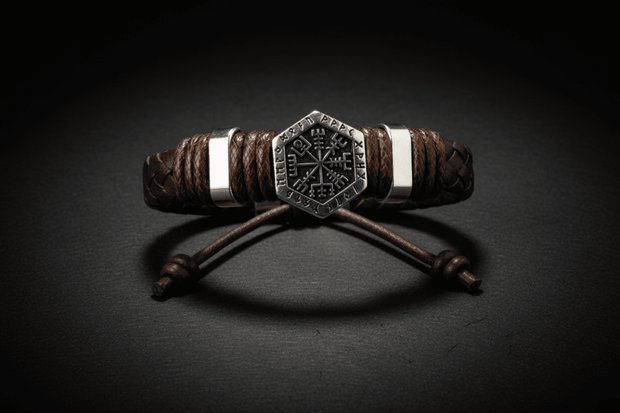
Many commercial designs alter the number of arms, add rune rings, place the stave inside a circle, or combine it with the Elder Futhark. Those additions may be modern design choices rather than faithful manuscript copies.
Are the symbols runes?
Not in the ordinary sense. A rune is a character in a runic alphabet. Vegvísir and Ægishjálmur are compound magical staves, not single runes. Some stave traditions use rune-like forms or appear in manuscripts alongside runic material, but calling every line a rune blurs useful distinctions.
Our beginner guide to the Elder Futhark explains runes as an alphabet and modern divination system. The stave tradition belongs to a related but distinct historical category.
Were Icelandic magical staves Pagan or Christian?
They emerged in a culture where Christian and magical materials overlapped. Some manuscript charms invoke Christian figures, divine names, scripture, or prayer. Others draw on folklore, older names, runic signs, and practical magic. Sorting every stave into a clean “Pagan” or “Christian” box imposes modern categories on a mixed historical environment.
A modern Pagan or Witch may use these symbols devotionally or magically, but that does not make the surviving manuscript tradition purely pre-Christian.
How modern practitioners use Vegvísir
Contemporary use often centers on:
- Travel and safe return.
- Direction during major life changes.
- Discernment when choices are unclear.
- Remembering one’s values or destination.
- Resilience through metaphorical storms.
A simple practice is to place the stave near a travel bag, journal, map, or doorway while naming the practical actions that support safe travel: planning the route, checking weather, maintaining the vehicle, sharing an itinerary, and carrying emergency supplies. A symbol can reinforce preparation; it should not replace it.
How modern practitioners use the Helm of Awe
Modern uses commonly include:
- Courage before a difficult confrontation.
- Psychological readiness and self-command.
- Protective symbolism.
- Establishing firm boundaries.
- Representing strength in adversity.
Because the older name includes the idea of terror or overpowering presence, practitioners should consider whether their intention is defense, confidence, intimidation, or coercion. Those are not morally identical goals.
How to evaluate jewelry and artwork
- Look at the center and arms. Similar radial designs are frequently mislabeled.
- Check added rune rings. Random or repeated runes may be decorative rather than historically meaningful.
- Be cautious with “authentic Viking” claims. Ask what manuscript, artifact, or archaeological evidence supports the wording.
- Separate reconstruction from inspiration. A modern artist can create a meaningful Norse-inspired design without claiming it is an ancient artifact.
- Learn the intended context. A Vegvísir bracelet emphasizes guidance, while a Helm of Awe hair clip presents a different protective symbol.
Respectful modern use
Historical honesty is the most important starting point. You do not need to claim that Vegvísir was carved on Viking ships to find value in it. You do not need to pretend the modern Helm of Awe design is identical to the older literary concept to use it as a sign of courage.
It also helps to distinguish Norse Pagan reconstruction from general Norse-inspired occultism. For a broader overview of religion, gods, and modern Heathen practice, read Norse Paganism and Ásatrú.
Common myths
“Vegvísir was a Viking navigation tool”
No surviving evidence demonstrates that claim. Its known manuscript attestation is nineteenth century and magical rather than mechanical.
“The Helm of Awe design appears in Viking artifacts”
The name has older literary roots, but the familiar stave design is documented in later Icelandic magical material. The name and the surviving graphic form should not be collapsed into one date.
“Every line in the symbols is a rune”
No. They are compound staves. Modern designs sometimes surround them with runes, but the central sign is not a single alphabetic rune.
“Historical inaccuracy is harmless because symbols evolve”
Symbols do evolve, but false historical claims still matter. Accurate labels let buyers and practitioners distinguish documented tradition, later folklore, revival, and modern invention.
Frequently asked questions
Can I use Vegvísir if I am not Icelandic?
There is no single authority controlling all modern use. Approach it with accurate history, avoid claiming inherited cultural authority you do not possess, and do not turn Icelandic tradition into generic “Viking magic.”
Can Vegvísir and the Helm of Awe be used together?
Modern practitioners may combine them, but their functions are distinct. Define why guidance and protective strength belong in the same working rather than assuming more symbols create more power.
Which way should the symbols face?
They are generally presented upright as copied or adapted from a chosen source. Because they are radial, rotation may not visibly change every design. Consistency and accurate reproduction matter more than invented universal rules.
Do these staves guarantee protection?
No symbol guarantees physical safety. Use them alongside ordinary preparation, boundaries, appropriate equipment, and professional help when needed.
History makes the symbols stronger, not weaker
Vegvísir and Ægishjálmur are compelling because they sit at a crossroads of older Norse language, Icelandic manuscript magic, folklore, revival, art, and modern spirituality. Their real histories are layered. Treating those layers honestly gives practitioners more to work with than a convenient but unsupported “ancient Viking” label.
Tools for this practice
Explore the products selected for this guide. Review each listing for what is included and how to use it.
Shop this guide · 1 item Collapse

Keep exploring the shop
You made it to the end of the guide. Keep exploring through related products, major departments, or the full catalog.
 RELATED TO THIS GUIDE
Occult Jewelry & Symbolic Adornments
Shop this topic
RELATED TO THIS GUIDE
Occult Jewelry & Symbolic Adornments
Shop this topic


Leave a comment