


What Is a Saturn Return? Timing, Meaning, Myths, and How to Work With It

The phrase Saturn return often appears whenever someone approaches their late twenties and begins questioning work, relationships, responsibility, identity, or the direction of adult life. Online discussions sometimes describe it as a guaranteed crisis. Others treat it as an unavoidable punishment. Neither interpretation is necessary.
In astrology, a Saturn return is the period when transiting Saturn moves back to approximately the same zodiac position it occupied at a person’s birth. Because Saturn takes about twenty-nine and a half years to orbit the Sun, this return usually occurs near the end of the twenties, again around the late fifties, and potentially once more in advanced age. The exact timing depends on the natal position and Saturn’s retrograde cycles.
Astrology is a symbolic and interpretive practice rather than a scientifically established method of prediction. A Saturn return cannot guarantee an event, diagnose a problem, or determine what someone must do. It is better used as a structured lens for examining maturity, obligations, limits, and long-term direction.
What Saturn Represents in Astrology
Astrologers traditionally associate Saturn with structure, time, boundaries, discipline, consequences, endurance, authority, and responsibility. These themes are not automatically negative. Structure can feel restrictive, but it also creates stability. Limits can be frustrating, but they can reveal where effort is being wasted. Responsibility can be heavy, yet it can also produce competence and self-respect.
A Saturn return is therefore interpreted less as a single dramatic event and more as a period when Saturn-related questions become difficult to ignore:
- What commitments are actually sustainable?
- Which responsibilities belong to you, and which were inherited or imposed?
- Where do you need stronger boundaries?
- What must be practiced consistently rather than wished into existence?
- Which structures have matured, and which have become cages?
When Does a Saturn Return Happen?
The first Saturn return is commonly associated with the late twenties into the early thirties. The second is generally associated with the late fifties into the early sixties. These are broad age ranges, not fixed birthdays.
Astrologers usually identify the return by comparing the current position of Saturn with the natal Saturn position. Because Saturn can appear to move backward during retrograde periods, it may cross the natal degree more than once. Some people therefore experience one exact conjunction, while others see several passes spread across months.
To understand where Saturn sits in your natal chart, begin with our guide to reading a birth chart for beginners. The sign, house, and aspects surrounding natal Saturn shape how an astrologer might interpret the return.
Why the First Saturn Return Feels Important
The first return often overlaps with ordinary developmental pressures: careers become more concrete, financial choices carry longer consequences, relationships may require clearer commitments, and earlier identities may no longer fit. Astrology gives those pressures a symbolic framework, but it should not be mistaken for their sole cause.
For one person, the period may involve building a career. For another, it may involve leaving a role that was chosen to please others. It can coincide with marriage, separation, parenthood, relocation, education, grief, leadership, illness, or no dramatic external event at all. The shared theme is not a predetermined event. It is the examination of structure and responsibility.
Common Saturn Return Myths
Myth: Everyone’s life falls apart
A Saturn return does not require catastrophe. Some people experience visible disruption, while others experience quieter internal decisions. A well-supported transition can be demanding without becoming destructive.
Myth: You must make a major life change
Sometimes the most Saturnian choice is not dramatic change but steady maintenance. Staying, repairing, budgeting, studying, practicing, or accepting a realistic timeline may be more appropriate than abandoning everything.
Myth: A difficult natal Saturn means a terrible return
Astrological placements should not be divided into permanently good or bad categories. Our article on difficult astrology placements explains why tension in a chart is better approached as complexity, pressure, and potential development rather than doom.
Myth: Saturn punishes people
Some spiritual language personifies Saturn as an authority delivering consequences. This can be meaningful within a devotional or mythic framework, but it can also produce unnecessary fear. A practical interpretation is that neglected structures eventually show their weaknesses, while consistent structures reveal their strength.
How to Read Your Saturn Return
Start with four chart factors:
- Natal Saturn’s sign: describes the style through which Saturn themes are interpreted.
- Natal Saturn’s house: points to the life area where questions of structure, responsibility, and limits may be emphasized.
- Natal Saturn’s aspects: show how Saturn’s themes interact with other parts of the chart.
- Current transits: provide context. A Saturn return never occurs in isolation from the rest of the chart or the person’s real circumstances.
Avoid reducing the reading to one keyword. Saturn in the seventh house, for example, does not automatically mean marriage or divorce. It may bring attention to agreements, reciprocity, boundaries, accountability, or the structures that make relationships sustainable.
Constructive Ways to Work With the Period
A Saturn return can be approached through ordinary, measurable actions rather than fear-driven ritual:
- Review recurring obligations and remove those that no longer serve a clear purpose.
- Examine debt, savings, schedules, contracts, and unfinished responsibilities.
- Choose one skill that deserves long-term practice.
- Clarify boundaries in work and relationships.
- Document what has become more stable since adolescence.
- Ask where perfectionism is being confused with discipline.
- Build support rather than assuming maturity means handling everything alone.
Those who include astrology in spiritual practice may also journal during exact Saturn contacts, create a simple altar focused on endurance and wise boundaries, or perform a commitment ritual. The ritual should support real-world action rather than replace it.
Questions for Saturn Return Reflection
- What structure in my life is no longer strong enough to carry its weight?
- Where am I avoiding responsibility, and where am I carrying too much?
- Which goal needs a longer timeline?
- What boundary would protect my energy and improve my reliability?
- Which definition of success did I inherit without examining?
- What am I willing to practice consistently for the next several years?
Frequently Asked Questions
Can a Saturn return begin before age twenty-nine?
Yes. The broader period can begin before the exact conjunction, depending on Saturn’s natal degree, current movement, and how widely an astrologer defines the transit. Exact timing requires a birth chart and current ephemeris or chart calculation.
How long does a Saturn return last?
There is no single agreed length. Some astrologers focus only on exact conjunctions, while others use a wider period that may extend across many months or longer, especially when retrograde motion creates repeated contacts.
Does everyone have a Saturn return?
Anyone who lives long enough for Saturn to complete an orbit has the astronomical return of Saturn to its natal region. The meaning assigned to that event belongs to astrology and varies by school and practitioner.
Can a Saturn return predict marriage, divorce, or career change?
No single transit can reliably guarantee a specific event. Astrology may be used to explore themes and timing symbolically, but major decisions should be based on circumstances, evidence, values, and qualified professional guidance where needed.
Is the second Saturn return different?
Astrologers often associate the second return with reviewing the structures built during adulthood, redefining authority, preparing for later life, and deciding what responsibilities or wisdom will be carried forward. Individual circumstances matter more than a universal script.
A Period of Assessment, Not a Sentence
The Saturn return is most useful when it becomes a question rather than a verdict. What has enough structure to last? What requires honest limitation? What deserves patient effort? Approached this way, the transit does not need to be feared. It becomes a symbolic checkpoint for building a life that can support its own weight.
Journal the Cycle, Not the Fear
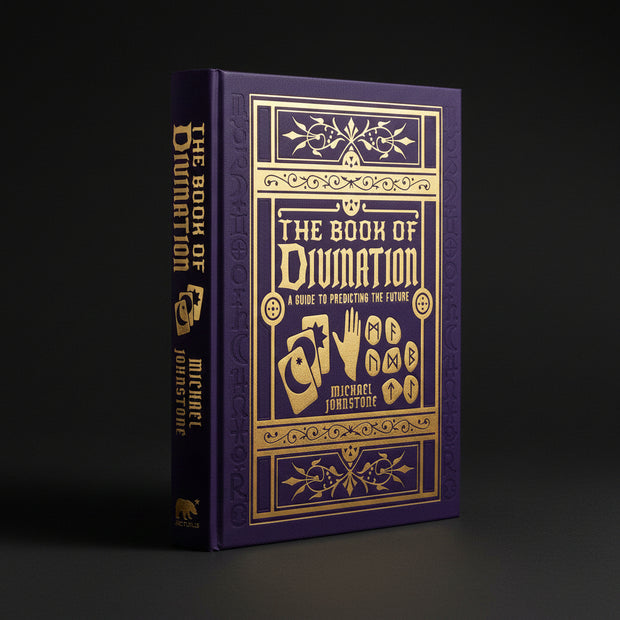
Use the Book of Divination or materials from our Divination Tools collection to record themes, dates, choices, and outcomes. These resources support reflection; they cannot predict a mandatory crisis or replace practical financial, legal, relationship, or health decisions.
Tools for this practice
Explore the products selected for this guide. Review each listing for what is included and how to use it.
Shop this guide · 1 item Collapse

Keep exploring the shop
You made it to the end of the guide. Keep exploring through related products, major departments, or the full catalog.


Leave a comment