


Why Are Crossroads Liminal? Three-Way vs. Four-Way Crossroads

Crossroads are called liminal because they interrupt a single route with multiple possible directions. They are simultaneously places of arrival, departure, meeting, separation, and choice. That makes them powerful symbols—but their ritual meaning is not universal, and a three-way junction does not mean exactly the same thing as a four-way intersection in every tradition.
What makes a crossroads liminal?
A road organizes movement from one place to another. A crossroads briefly suspends that certainty. Travelers must choose, negotiate traffic, meet someone approaching from elsewhere, or turn back. In ordinary speech, “at a crossroads” therefore means reaching a consequential decision.
That metaphor grows from a physical reality: a junction belongs completely to none of the roads that form it. It is defined by relationship and passage. This makes crossroads useful ritual symbols for decisions, exchange, communication, altered direction, and the boundary between jurisdictions.
Three-way vs. four-way crossroads
A three-way crossroads may be a fork, a Y-junction, or a place where one road ends at another. Ancient Greek material frequently connects Hecate with three ways, reflected in titles translated as “of the three roads” and in later three-bodied images that could face multiple approaches.
A four-way crossroads is the intersection of two routes. It creates four approaches and a central crossing point. Four-way intersections appear prominently in many European, African, Afro-diasporic, and American stories and ritual systems—but those traditions do not become one shared practice simply because the geometry resembles another crossroads.
The number of roads does not provide a universal ritual instruction. Tradition, local custom, purpose, ownership, and safety matter more than forcing every intersection into the same correspondence chart.
Do all crossroads belong to Hecate?
No. Hecate has a genuine historical relationship with roads, gates, and three-way crossroads in Greek religion. She is not the only sacred figure associated with junctions, and her rites should not be used as a generic explanation for every culture.
For example, Èṣù is an orisha with roles involving communication, uncertainty, change, and crossroads in Yoruba religion. The Lam Museum of Anthropology’s Èṣù figure describes possibilities, messages, and mediation within that specific religious context. Èṣù is not “the African Hecate,” and neither deity should be collapsed into a general crossroads archetype stripped of living traditions.
European and American folklore add still other layers: boundary burials, meetings with spirits, decisions made at road junctions, and the famous blues story of supernatural musical ability gained at a crossroads. Folklore, recorded religious practice, popular music, and modern witchcraft need to be labeled rather than blended into a false single origin.
Why are crossroads linked with spirits and offerings?
A junction can sit outside the social center while receiving traffic from several directions. It can also mark the boundary between towns, properties, or territories. Those qualities made some crossroads suitable for depositing offerings, transferring ritual remnants, contacting a particular power, or removing something from the household in particular traditions.
That history is not permission to leave food, wax, glass, coins, salt, oil, or other objects on a modern road. Traffic danger, litter laws, wildlife, private property, and local sanitation rules still apply. A home altar, symbolic map, crossroads diagram, or contained bowl can represent the junction without creating a roadside hazard.
How can a crossroads symbol be used responsibly?
For personal symbolic work, define the choice before selecting the tool. A Crossroads Candle is relevant to reflection on direction and pathworking because its stated purpose matches the symbolism of choosing a route. It does not predict which decision will succeed or remove the need to compare evidence and consequences.
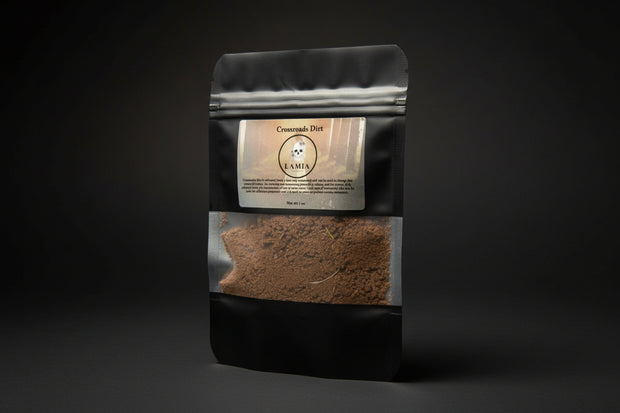
Crossroads Dirt is a material correspondence for practitioners whose method calls for it. The location, sourcing, and tradition behind ritual dirt matter; it is not interchangeable with cemetery, graveyard, bank, or deity-aligned dirt. Our guide to ritual dirt types, sourcing, storage, and disposal explains those differences.
Frequently asked questions
Does a T-junction count as a crossroads?
It is a road junction and can represent decision or changed direction. Whether a tradition requires a three-way, four-way, rural, boundary, or named crossroads is a separate question. Follow the actual source rather than assuming every junction is interchangeable.
Must I visit a crossroads at midnight?
No. Midnight is part of some stories and modern rituals, not a universal requirement. Never stand in a roadway or visit an isolated place because a dramatic source claims danger proves commitment.
Can I collect my own crossroads dirt?
Only where collection is lawful, safe, environmentally minor, and permitted by the landowner. Do not enter traffic, trespass, dig into infrastructure, or misrepresent ordinary soil as a material from a culturally specific rite.
Are crossroads always for spirit contact?
No. They can symbolize choice, trade, messages, travel, boundaries, meeting, or dispersal. Spirit contact is one use within particular religious and magical systems.
Why is Hecate connected with three roads?
Her ancient and later titles, roadside and gateway roles, offerings, and multi-facing imagery developed a strong relationship with three-way junctions. Our next guide explains why Hecate is called a liminal goddess without treating every modern association as ancient.
Tools for this practice
Explore the products selected for this guide. Review each listing for what is included and how to use it.
Shop this guide · 1 item Collapse

Keep exploring the shop
You made it to the end of the guide. Keep exploring through related products, major departments, or the full catalog.
 RELATED TO THIS GUIDE
Ritual Supplies & Altar Tools
Shop this topic
RELATED TO THIS GUIDE
Ritual Supplies & Altar Tools
Shop this topic


Leave a comment