


Why Is Hecate a Liminal Goddess? Gates, Crossroads, Keys & Torches

Hecate is called a liminal goddess because ancient and later sources place her at several kinds of boundary: roads and gates, household and wilderness, mortal life and the Underworld, darkness and torchlight, departure and return. “Liminal” is a useful modern description of those roles, but it should not flatten her into a generic goddess of spooky places.
Was Hecate always a goddess of witchcraft and the Moon?
Hecate’s history is broader than the labels most familiar in modern witchcraft. In Hesiod’s Theogony, she receives honor involving earth, sea, and sky and can assist people in several areas of life. In the Homeric Hymn to Demeter, she hears Persephone’s abduction, approaches Demeter with torches, and later becomes Persephone’s companion.
Later Greek and Roman sources increasingly associate her with night, ghosts, magic, crossroads, and the Underworld. The source collection assembled by Theoi’s Hecate archive is useful because it lets readers compare different ancient authors instead of treating a modern correspondence list as one timeless biography.
Why are gates and doorways associated with Hecate?
Ancient titles translated as “before the gate” or “at the gate” connect Hecate with entrances. A gate is both protective architecture and a decision point: it allows, refuses, or regulates passage. Household Hecate shrines and images could therefore have an apotropaic role—turning away harm—while marking the movement between public and domestic space.
This does not mean every doorway belongs to Hecate. It means gatekeeping and passage are historically appropriate themes when discussing her. Our article on threshold magic and boundary wards covers household practice without presenting it as an ancient Hecate rite.
Why is Hecate associated with crossroads?
Titles connected with roads and three ways, crossroads offerings, and multi-facing images all contribute to the association. A three-way junction allows a figure to watch or face several approaches at once. Pausanias reports both a one-bodied cult image at Aegina and a famous three-joined form attributed to Alcamenes, which demonstrates that Hecate did not always have one fixed appearance.
Crossroads also fit her role as a guide. Torches reveal a route in darkness, while a junction requires a traveler to select a direction. Read our companion article on three-way and four-way crossroads for the difference between Greek evidence and other crossroads traditions.
What do Hecate’s keys and torches mean?
Torches appear prominently in her connection with Demeter and Persephone. They provide light, guidance, search, witness, and safe movement through darkness. They are historically stronger symbols than the vague claim that Hecate is simply “dark.”
Keys fit her later roles at gates and between realms. Modern devotees may understand them as authority, access, guardianship, initiation, or the ability to open and close. A skeleton key on an altar remains a symbol; it is not an ancient object merely because it looks old. Our guide to skeleton-key symbolism and threshold work separates historic hardware from contemporary ritual use.
Is triple Hecate the Maiden, Mother, and Crone?
Not automatically. Ancient three-formed Hecate imagery can face several directions and reflects her multiplicity, but the familiar Maiden–Mother–Crone framework is a modern Pagan interpretive system. It should not be presented as the single ancient meaning of every three-bodied statue.
Likewise, Hecate has lunar associations, especially through later identification with figures such as Artemis, Selene, and Diana, but she was not reducible to “the dark-moon crone” across all ancient periods and places.
How can modern devotional products be used honestly?
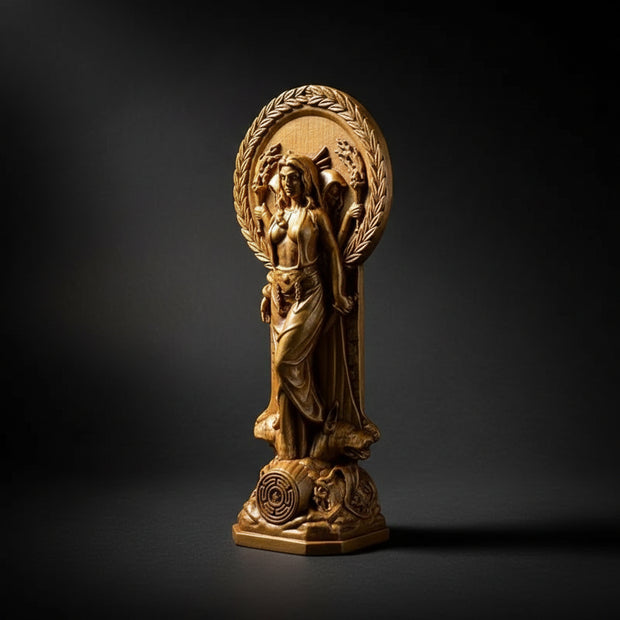
A Hecate Crossroads Deity Statue can serve as a modern devotional focus. Choose it for the symbols it actually depicts and label contemporary imagery as contemporary. Our guide to choosing and placing a deity statue explains scale, material, care, and respectful use.
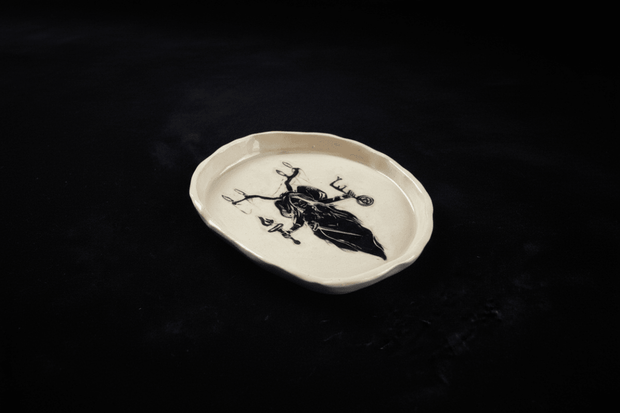
A Hekate Offering Plate keeps small, nonhazardous offerings contained on a home altar. It is safer and more responsible than leaving material at a public junction. Offerings are acts within a relationship or tradition, not vending-machine payments for guaranteed results; see our broader guide to offerings across modern Pagan paths.
Hecate Ritual Oil is a contemporary devotional formula, not an archaeological reconstruction. Use it according to its label for symbolic anointing or candle work, keep oils away from flames and vulnerable surfaces, and do not imply that owning it establishes divine contact.
Frequently asked questions
Is Hecate Greek or Roman?
Her cult and literary history are strongly rooted in the Greek world, including important worship in Caria. Roman writers and worshippers later identified and combined her with figures such as Trivia and Diana.
Is Hecate a Titan?
Hesiod describes her as the daughter of Perses and Asteria, members of the Titan generation. Unlike many Titans in the succession myth, she retains honor under Zeus.
Is Hecate only an Underworld goddess?
No. Chthonic, ghostly, and Underworld roles are important in later sources, but earlier and other traditions give her wider authority and protective functions.
Does seeing dogs, keys, or the number three mean Hecate is calling?
Those symbols can remind a devotee of Hecate, but ordinary encounters are not proof of a message. Look for context, repeated intentional practice, historical fit, and grounded alternatives before assigning supernatural certainty.
Should Hecate be spelled Hekate?
Hekate more closely transliterates the Greek name; Hecate is the established English and Latinized spelling. Neither spelling by itself proves a practitioner’s historical knowledge or devotional legitimacy.
Tools for this practice
Explore the products selected for this guide. Review each listing for what is included and how to use it.
Shop this guideHide product


Leave a comment