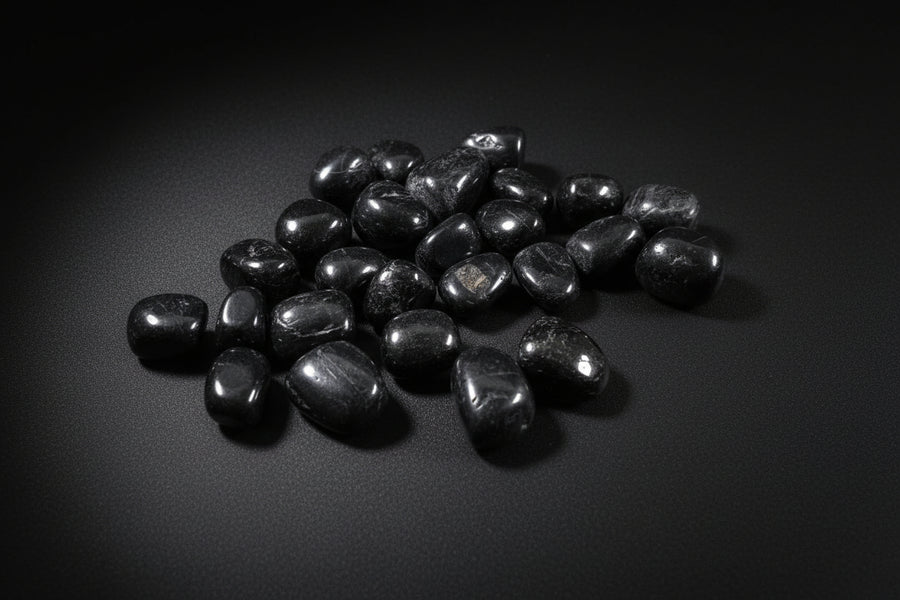
Tumbled StoneAvailability shown below

Black Tourmaline Tumbled Stone – Tourmaline-Group Material

One randomly selected polished black tourmaline-group trade stone

$2.95
Shipping calculated at checkout.
  • One randomly selected polished stone
  • Material sold as Black Tourmaline
  • Tourmaline-group identity with exact species undocumented
  • Black color with variable grain and surface character
  • Species, treatment, dimensions, weight, locality, and origin not documented
Ritual focusGrounding, boundaries, stability, banishing, and protection symbolism

Pickup available at Main Street

Usually ready in 2 hours

Free U.S. Economy shippingQualifying orders of $75 or more
Shipping destinationsCurrent rates and availability shown at checkout
Secure checkoutPayments processed by Shopify

Product Information

About This Item

Black Tourmaline Tumbled Stone – Tourmaline-Group Material includes one randomly selected polished black stone sold as black tourmaline for collecting, carrying, display, meditation, or symbolic ritual use. Tourmaline is a group of related borosilicate minerals, and black color alone does not establish schorl or another species; this listing has no item-level report confirming species, identity, natural color, treatment, dimensions, weight, mine locality, or origin. Black-to-brownish-black tone, grain, striations, inclusions, shape, polish, size, pits, chips, fractures, and surface features vary.

Specimen Details
Material status
Material identity not independently verified
Treatment
Treatment status not documented

Treatment notes

No item-level laboratory report or supplier disclosure confirms the tourmaline species, natural color, heat treatment, irradiation, dyeing, coating, fracture filling, stabilization, resin impregnation, reconstruction, or other enhancement.

Observable stone characteristics

No standardized gemological grade, item-level species determination or treatment report, calibrated dimensions, individual weight, mine locality, or origin documentation is provided. Black appearance does not independently establish schorl.

Condition notes

Polished retail stone selected from an assortment. Natural or process-related pits, chips, fractures, grain boundaries, striations, inclusions, flat areas, polish variation, and surface features may be present.

What contributes to this piece’s value

  • Black color
  • Luster
  • Grain and striations
  • Polish
  • Shape
  • Size
  • Condition
  • Species and treatment documentation
Mineral Profile

This profile covers material sold as Black Tourmaline when the exact tourmaline species is not documented. Tourmaline is a group of closely related trigonal borosilicate species, and black appearance alone does not establish schorl or any other species. This shared profile does not certify composition, treatment, locality, origin, or authenticity of a particular retail stone.

Stone or material
Black Tourmaline — Species Not Documented
Mineral family or group
Tourmaline Group
Family classification
Mineral group
Mineral species
Tourmaline Group; exact species not documented
Variety or trade name
Black Tourmaline
Chemical formula
Variable complex borosilicate; species determination requires compositional analysis
Mohs hardness
Approximately 7–7.5 across commonly encountered tourmaline species
Luster
Vitreous, Resinous on some fractures
Transparency
Opaque, Very dark translucent edges may occur
Typical colors
Black, Very dark brown, Brownish black
Mineral class
Silicates — cyclosilicates, Tourmaline Group
Crystal system
Trigonal
General occurrences
Brazil, Madagascar, Namibia, Pakistan, United States, Other tourmaline localities; product-specific source requires documentation

Geology and formation

Tourmaline-group minerals occur in diverse igneous, pegmatitic, hydrothermal, and metamorphic environments. The precise formation setting depends on species and locality, neither of which is established for a product sold only as Black Tourmaline.

Family context

Tourmaline is a group of closely related mineral species that share a crystal structure but vary greatly in chemical composition, physical properties, and color. Commercial color names and appearances do not by themselves establish the mineral species.

Identification note:

Tourmaline color is not species-specific. Green material may belong to several species, black material should not automatically be labeled schorl, and similar-looking red or copper-bearing material may require laboratory analysis for reliable species identification.

Metaphysical Correspondences

In contemporary Western crystal and occult practice, Black Tourmaline is commonly associated with grounding, boundaries, stability, purification, banishing, and protective symbolism. These are symbolic practitioner frameworks, not scientifically verified electromagnetic, protective, emotional, medical, energetic, or supernatural effects.

Traditional themes
Grounding symbolism, Boundary symbolism, Stability, Purification symbolism, Banishing symbolism, Protective symbolism
Primary element
Earth
Planets
Saturn
Zodiac
Capricorn
Modern birthstone
October — tourmaline group
Anniversaries
8th wedding anniversary — tourmaline group
Chakras
Root
Energy character
Grounding symbolism, Containing, Steady
Days
Saturday

Traditional ritual applications

Practitioners may carry an intact polished stone, place it near a doorway or workspace, or use it on a dry altar as a visual reminder of grounding, personal boundaries, stability, banishing, or protection intentions. It is not claimed to block electromagnetic fields, absorb harmful energy, prevent harm, heal, or produce supernatural outcomes.

Traditional pairings

Candle colors
Black, Dark brown, White

Tradition and source notes

Earth, Saturn, Saturday, Capricorn, root, boundary, and protection themes are common in contemporary Western systems but are not universal or measurable properties. The product remains species-undocumented rather than confirmed schorl.

Family correspondence scope

Black, pink, green, blue, rubellite, watermelon, and other tourmaline traditions often carry different metaphysical correspondences. Those associations belong on the exact variety or trade profile rather than being copied across the entire group.

About traditional correspondences: Metaphysical, astrological, elemental, chakra, and ritual associations vary among traditions and practitioners. They are presented for cultural, symbolic, and spiritual reference and are not scientific or medical claims.

Working With & Caring for This Stone

When practitioners may choose it

Choose this stone when building a symbolic practice around grounding, personal boundaries, stability, purification, banishing, or protection intentions.

Traditional role in practice

Used as a tactile and visual reminder of chosen intentions. It is not claimed to block electromagnetic fields, absorb harmful energy, prevent harm, cleanse, heal, or produce supernatural outcomes.

Suggested application

Carry it in a secure pouch, place it near a doorway or workspace, or use it on a dry, stable altar or grid.

Commonly paired with

Pairs with grounding, boundary, stability, banishing, purification, and protection-themed symbolic practices. Keep away from liquids, salt, acids, open flame, high heat, hot wax, harsh oils, and impact.

Product care

Clean briefly with lukewarm water, mild soap, and a soft cloth, then dry promptly. Avoid bleach, harsh chemicals, prolonged soaking, steam, ultrasonic cleaning, high heat, sudden temperature changes, and hard impacts. Protect fractures and edges.

Safety and handling

Decorative mineral material; not food or medicine. Do not ingest or place in drinking water. Keep small stones and fragments away from children and pets. Rough or fractured material can have sharp edges. Cutting, grinding, drilling, sanding, or crushing requires professional mineral-dust controls.

Natural variation

Each stone varies in black, brownish-black, or very dark-brown color, grain, striations, inclusions, shape, size, polish, pits, chips, fractures, and surface texture. The image is representative rather than an exact-stone guarantee.