


Book of Shadows vs. Grimoire: Differences, Uses, and How to Start

The terms Book of Shadows and grimoire are often used as though they describe the same object: a mysterious book filled with spells, symbols, and secret knowledge. In practice, the distinction is more useful than that. A Book of Shadows is most closely associated with modern Wiccan practice and personal or coven-based records, while a grimoire has an older history as a book of magical instruction, ritual methods, charms, correspondences, and formulas.
Modern practitioners frequently adapt both terms, and there is no universal authority that controls what you call your own working book. Still, understanding the usual difference between a Book of Shadows vs. grimoire can help you choose a structure that supports your actual practice instead of building a beautiful notebook you are afraid to use.
Book of Shadows vs. Grimoire: The Quick Difference
A Book of Shadows is commonly a personal or group record of beliefs, rituals, experiences, seasonal observances, prayers, correspondences, and lessons connected with a living practice. In modern Wicca, it may preserve material used by a coven or record how an individual practitioner understands and performs their craft.
A grimoire is more commonly organized as a manual of magical knowledge. It may contain procedures, spirit lists, talismans, seals, invocations, astrological timing, recipes, charms, protective methods, and instructions intended to be studied or followed.
The simplest practical distinction is this:
- A Book of Shadows often records a practice as it is lived.
- A grimoire often organizes magical knowledge so it can be studied or performed.
Those categories overlap. Your Book of Shadows may contain instructional material, and your grimoire may contain personal notes about what happened when you used it. The names describe tendencies, not rigid rules.
What Is a Book of Shadows?
The phrase Book of Shadows became especially associated with modern Wicca through Gerald Gardner and the development of Gardnerian Wicca in the mid-twentieth century. It should not be treated as evidence that every historical witch kept an identical secret book under that name. Modern practitioners have expanded the idea far beyond its original Gardnerian setting.
Within initiatory Wiccan traditions, a Book of Shadows may include ritual texts, teachings, liturgy, degree material, coven procedures, and other information transmitted within the tradition. Some material may be considered private to the coven or initiatory line. In solitary and eclectic practice, the term is often used more broadly for a personal record of beliefs, rituals, correspondences, and spiritual development.
Readers who are still learning the wider religious context can begin with Wicca 101: Introduction to Wiccan Beliefs and Rituals. A Book of Shadows does not automatically make someone Wiccan, but understanding where the term became prominent prevents modern usage from being confused with universal witchcraft history.
What Goes in a Book of Shadows?
A personal Book of Shadows may include:
- A statement of beliefs, ethics, or guiding principles
- Ritual outlines and opening or closing practices
- Seasonal observances, moon work, and devotional notes
- Prayers, chants, meditations, and invocations
- Personal correspondences for colors, plants, stones, planets, or elements
- Spell records, including dates, materials, goals, and results
- Dreams, omens, divination notes, and later interpretations
- Reflections on mistakes, changes, and lessons learned
- Sources, quotations, and reading notes
The most useful entries distinguish between inherited material, published information, personal interpretation, and direct experience. Writing “this herb is traditionally associated with protection” is different from writing “I used this herb in one ritual and felt more focused.” A careful record preserves that difference.
Personal and Coven Books of Shadows
A personal Book of Shadows belongs to the practitioner and can evolve freely. A coven Book of Shadows may contain shared material governed by the group’s tradition, leadership, privacy expectations, or initiatory rules. Do not copy, publish, photograph, or redistribute another group’s private material without permission.
Some practitioners keep a shared tradition book and a separate personal volume. The shared book preserves group material; the personal book records individual experiences, questions, adaptations, and results. This separation can protect both privacy and clarity.
What Is a Grimoire?
The word grimoire is generally used for a book of magical instruction. Historical grimoires developed across different periods and regions of Europe and often contained ritual directions, prayers, conjurations, seals, talismans, spirit names, astrological rules, protective formulas, and methods for preparing tools or sacred space.
A grimoire is not one single tradition. Historical texts differ greatly in language, theology, purpose, and method. Some are strongly Christian in their prayers and cosmology. Others combine astrological, angelic, folkloric, ceremonial, or spirit-working material. Modern practitioners also create personal grimoires that organize techniques from their own path.
If you are building a study-based practice, it is worth learning how to evaluate sources before copying material into a permanent reference book. Witchcraft Books for Beginners: How to Build a Reliable Study Library explains how to compare authors, identify repetition, and separate strong references from unsupported claims.
What Goes in a Grimoire?
A modern personal grimoire may include:
Blank notebooks leave you free to develop your own index, symbols and research notes. The grimoire and ritual-journal selection compares bindings, covers and writing formats without prescribing any spiritual practice.
- Ritual structures and step-by-step procedures
- Tool descriptions and preparation methods
- Planetary, elemental, lunar, or seasonal timing systems
- Symbols, seals, sigils, alphabets, and diagrams
- Herbal, mineral, incense, oil, and color correspondences
- Prayers, invocations, charms, and spoken formulas
- Protective procedures and closing methods
- Divination systems and interpretation frameworks
- Bibliographies, citations, and source comparisons
- Revisions based on testing and later research
A specialized grimoire may focus on one subject rather than attempting to contain everything. An herbal working book, for example, can record identification, folklore, symbolic correspondences, handling cautions, and personal ritual observations. The guide How to Build a Materia Magica provides a practical model for that kind of focused reference.
Key Differences Between a Book of Shadows and a Grimoire
Religious Context
A Book of Shadows is strongly associated with modern Wicca, although many non-Wiccan witches now use the term. A grimoire is not inherently Wiccan and may belong to ceremonial, folk, devotional, Christian, occult, spirit-working, or personally developed systems.
Primary Purpose
A Book of Shadows often combines spiritual identity, lived experience, ritual records, and personal development. A grimoire more often emphasizes organized instruction and reference material.
Voice and Style
A Book of Shadows may read like a spiritual journal, ritual archive, and personal handbook combined. A grimoire may read more like a technical manual: ingredients, timing, diagrams, steps, cautions, and expected functions.
Privacy
Both can be private. A coven Book of Shadows may have explicit confidentiality rules. A grimoire may be private because it contains personal methods, spirit-work records, or unfinished research. Neither term automatically means the book must be secret from everyone.
Historical Use
The term Book of Shadows is modern and closely connected with twentieth-century Wicca. Grimoires have a much longer documented history as books of magical instruction. That does not make one more legitimate than the other; it simply means they come from different historical contexts.
Are the Terms Interchangeable?
In everyday modern witchcraft, they often are. A practitioner may call a personal magical notebook a grimoire, Book of Shadows, working book, ritual journal, spell book, or simply “my notes.” The label matters less than whether the book is organized, honest, and usable.
However, the distinction becomes important when discussing history or a specific tradition. Calling a medieval magical manuscript a Book of Shadows would impose a modern Wiccan term on a much earlier text. Calling a coven’s initiatory Book of Shadows merely a generic notebook may ignore its role within that tradition.
Use the terms flexibly for your own practice, but precisely when describing someone else’s religion, historical material, or private group tradition.
Should You Start a Book of Shadows or a Grimoire?
Choose a Book of Shadows if your priority is recording your path as it develops. It works well for ritual reflections, seasonal practice, devotional experiences, ethical questions, dreams, spell results, and personal growth.
Choose a grimoire if your priority is building an organized reference manual. It works well for correspondences, recipes, ritual procedures, diagrams, tool instructions, researched traditions, and material you expect to consult repeatedly.
Choose both if you want a clean separation between reference material and personal experience. One volume can hold polished instructions; another can hold dated records of what you tried, what changed, and what you learned.
You can also begin with one notebook and divide it into sections. Do not delay practice because you have not found the perfect terminology or the perfect book. A working record becomes meaningful through consistent use, not through an impressive cover alone.
How to Organize a Magical Working Book
Chronological Method
Write entries in date order and create an index at the front or back. This is the easiest method for beginners because it does not require predicting how many pages each subject will need. Number the pages, assign each entry a clear title, and update the index as you go.
Section Method
Divide the book into categories such as rituals, herbs, stones, divination, dreams, deities, seasonal practice, and spell records. This looks orderly but can create empty or overcrowded sections. Removable tabs help, but leave more space than you think each subject requires.
Modular Method
Use several smaller books or a binder with removable pages. One book might hold dream records, another herbal notes, and another polished rituals. This approach is practical for people whose interests change or who revise material frequently.
Draft-and-Copy Method
Keep rough notes in an inexpensive notebook or digital file, then copy tested and verified material into a more permanent volume. This protects a formal grimoire from becoming crowded with untested claims while still preserving the messy process of learning.
What to Record After a Ritual or Spell
A useful magical record contains more than the final wording of a spell. Record enough information to understand what actually happened later:
- Date, time, location, and relevant timing system
- Goal stated in clear language
- Tools, ingredients, quantities, and substitutions
- Source of the ritual or whether you created it
- Physical and emotional condition before beginning
- What you did, including departures from the plan
- Immediate observations without exaggeration
- Practical actions taken outside the ritual
- Results reviewed after an appropriate period
- What you would repeat, change, or discontinue
A record should not force every coincidence into a supernatural explanation. Note ordinary causes, uncertainty, and failed attempts. Discernment improves when the book contains honest observations rather than only dramatic successes.
Choosing a Physical Book
The best journal is one you can comfortably write in. Before choosing, consider page size, line style, binding, paper texture, closure, portability, and whether the book lies flat enough for diagrams or long entries. Browse the live Journals collection to compare practical formats rather than choosing by cover art alone.
Lined or Unlined Pages?
Lined pages support long-form writing, study notes, and chronological records. Unlined pages are better for sigils, diagrams, seals, pressed material, illustrations, and layouts that do not fit ordinary rows. Dot-grid paper offers a compromise, although it is not required.
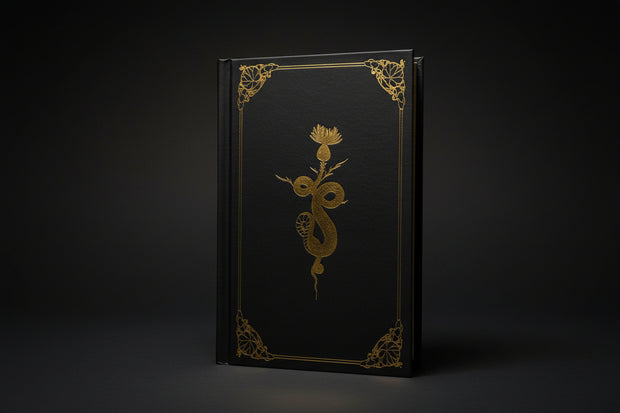
A book such as the Devotion Gilded Grimoire provides unlined space for mixed writing and symbolic work. A lined general-purpose journal can be equally effective when your practice centers on reflection, research, and detailed records.
Portable or Altar-Sized?
A smaller book is easier to carry for field notes, plant observations, classes, travel, or rituals outside the home. The Rune Symbols Leather Journal is an example of a compact format suited to portable recordkeeping.
A larger or more elaborate book may be easier to read at an altar and may provide more room for diagrams, but it can become too precious or inconvenient for daily use. Choose according to where you will actually write.
Closure and Page Security
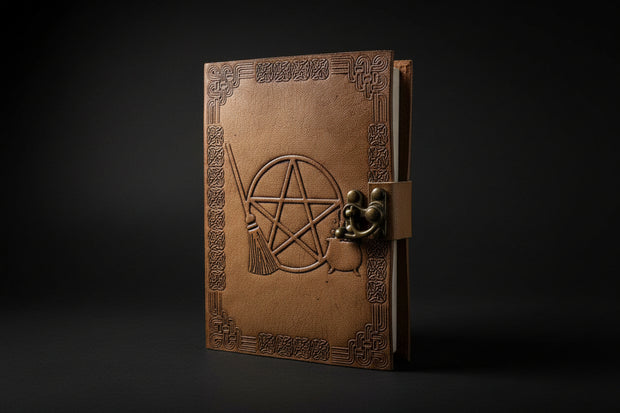
Clasps, elastic bands, and ties help keep loose notes or bookmarks contained, but they do not provide true privacy. A design such as the Pentagram and Broom Leather Journal offers a physical latch, while a lockable box or private digital backup is more appropriate for genuinely sensitive material.
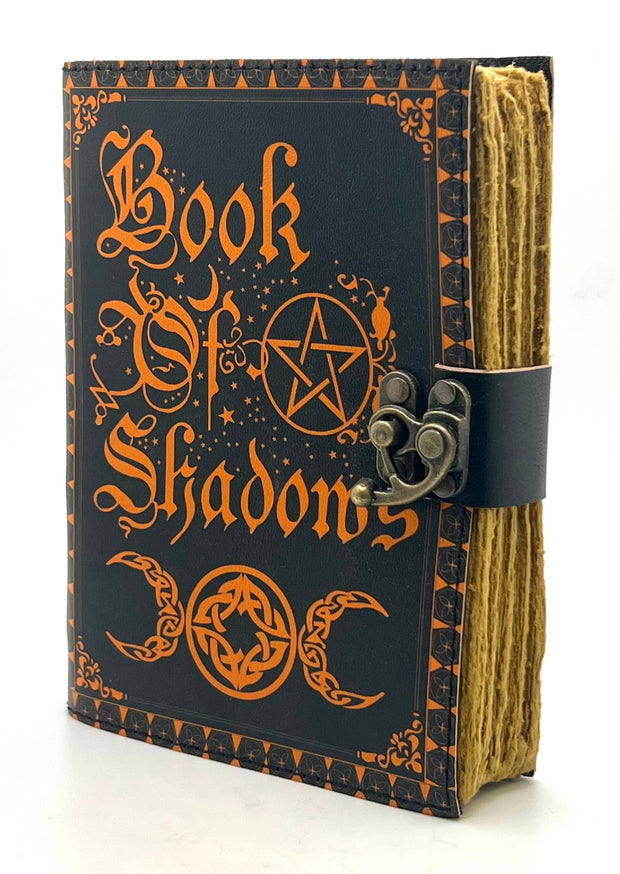
The Deckle-Edge Book of Shadows Journal offers a deliberately traditional visual style, but aged-looking paper does not make an entry historically authentic. Appearance can inspire regular use; accuracy still depends on research and careful attribution.
Privacy, Ethics, and Responsible Recordkeeping
Your magical book may contain names, health information, relationship details, divination notes, or experiences involving other people. Record only what is necessary, and consider initials or neutral descriptions when full names would create a privacy risk.
Do not record coercive plans, dangerous instructions, or private information as though a decorative cover makes them safe. Keep medical, legal, chemical, fire, and plant safety information clearly separated from spiritual symbolism. A correspondence copied from a book does not prove that a substance is safe to burn, ingest, apply to skin, or use around pets.
Cite your sources. Note the author, title, page number, website, teacher, tradition, or family source when known. Avoid presenting material from a closed tradition, living culture, private coven, or named practitioner as your own discovery.
Personal reflection also needs boundaries. A magical journal can support self-observation, but it is not a substitute for mental-health treatment. For a grounded approach to difficult personal writing, see Shadow Work for Beginners.
A Simple First Ten Pages
You do not need to fill the book before it becomes useful. A practical first ten-page plan might look like this:
- Title page: Your name or chosen book title and the date begun.
- Purpose: What this book will contain and what it will not contain.
- Ethics and safety: Your boundaries around consent, fire, plants, health claims, and privacy.
- Index: Leave several pages for future entries.
- Core practice: A brief description of your path, current beliefs, and areas of uncertainty.
- Opening method: A simple grounding, prayer, or preparation routine.
- Closing method: How you conclude, clean up, and return to ordinary activity.
- First working: One ritual, meditation, divination method, or study exercise.
- Record template: A repeatable format for future entries.
- Review page: Questions to revisit monthly or seasonally.
Leave room for correction. Date revisions instead of erasing every earlier belief. A record of how your understanding changed is one of the most valuable things the book can preserve.
Frequently Asked Questions
Does a Book of Shadows have to be black or made of leather?
No. The color and cover material are aesthetic choices. A spiral notebook, binder, plain journal, handmade book, or digital document can all serve the same practical purpose.
Does a grimoire have to be handwritten?
No. Historical grimoires were copied by hand because that was how texts circulated, but a modern grimoire can be typed, printed, digitally organized, or assembled in a binder. Handwriting may support memory and personal engagement, but it is not a requirement.
Can a beginner start a Book of Shadows?
Yes. Begin with dated observations, reading notes, questions, and simple practices. Mark uncertain information clearly instead of copying every online correspondence as fact.
Can one book be both a Book of Shadows and a grimoire?
Yes. Many personal working books combine instruction, belief, ritual records, research, and reflection. You may call the combined book whichever term best fits your path.
Should anyone else be allowed to read it?
That is your decision unless the book contains material governed by a coven, teacher, client, or tradition. Protect other people’s privacy and honor any agreements you have made.
What happens when the book is full?
Label the finished volume with its date range and begin another. Create an index that points across volumes, or copy only the most useful material into a revised reference book. A completed working book is not a failure of space; it is evidence of sustained practice.
Build a Book You Will Actually Use
The difference between a Book of Shadows and a grimoire is helpful, but it should not become another barrier to beginning. A Book of Shadows commonly preserves a living spiritual practice. A grimoire commonly organizes magical instruction. Your own book may do either or both.
Choose a format that welcomes notes, corrections, and honest results. Record sources. Protect private material. Separate symbolism from physical safety. Most importantly, let the pages become a working record rather than a flawless prop.
Explore the Journals collection to compare lined, unlined, portable, and altar-ready formats, then begin with one page you can use today.
Tools for this practice
Explore the products selected for this guide. Review each listing for what is included and how to use it.
Shop this guide · 3 items Collapse


Keep exploring the shop
You made it to the end of the guide. Keep exploring through related products, major departments, or the full catalog.
 RELATED TO THIS GUIDE
Ritual Supplies & Altar Tools
Shop this topic
RELATED TO THIS GUIDE
Ritual Supplies & Altar Tools
Shop this topic


Leave a comment