


How to Build a Crystal Grid: Purpose, Layout, Center Stones, and Activation

A crystal grid is an intentional arrangement of stones, symbols, and space built around one clearly defined purpose. It can function as a meditation focus, altar arrangement, visual reminder, devotional design, or structured form of modern crystal practice.
You do not need sacred-geometry expertise, an expensive kit, or one stone for every correspondence. A useful grid is stable, understandable, safe for the materials, and simple enough that you can explain why each part is present.
Begin with one purpose
Write the purpose in one sentence before choosing stones. Useful examples include:
- supporting consistent study habits;
- creating a visual focus for household boundaries;
- marking a period of grief or remembrance;
- supporting a savings or business plan;
- reflecting on communication in a relationship;
- honoring a deity, ancestor, season, or place;
- building a calming meditation arrangement.
Avoid stacking several unrelated goals into one design. “Love, money, protection, psychic power, healing, and luck” is not a focused grid; it is a collection display without a clear organizing principle.
Choose a practical grid location
The location should match how long the grid will remain in place and who shares the space.
- Use a stable table, shelf, tray, cloth, board, or shallow box.
- Keep small stones away from children and animals.
- Do not block vents, doors, work surfaces, or emergency access.
- Avoid direct sunlight for light-sensitive minerals.
- Keep stones away from candle flames, dripping wax, incense ash, water, and ritual oil.
- Use a lidded tray or photographed temporary grid in a shared home.
A grid does not have to remain untouched for weeks. A ten-minute arrangement used during journaling can be complete.
The basic parts of a crystal grid
| Part | Possible role | Is it required? |
|---|---|---|
| Center stone | Represents the main purpose or focal point | No, but useful |
| Supporting stones | Represent qualities, actions, people, stages, or resources | Usually |
| Path or connecting stones | Create visual movement between the center and outer positions | No |
| Boundary stones | Mark the edge of the working or arrangement | No |
| Written petition | States the goal, timeframe, or commitment | No |
| Cloth or board | Provides structure, protection, or a printed pattern | No |
| Directional marker | Establishes north, a doorway, altar center, or chosen orientation | No |
Choosing the center stone
The center stone should be easy to identify as the focus. It may be:
- a tower or natural point;
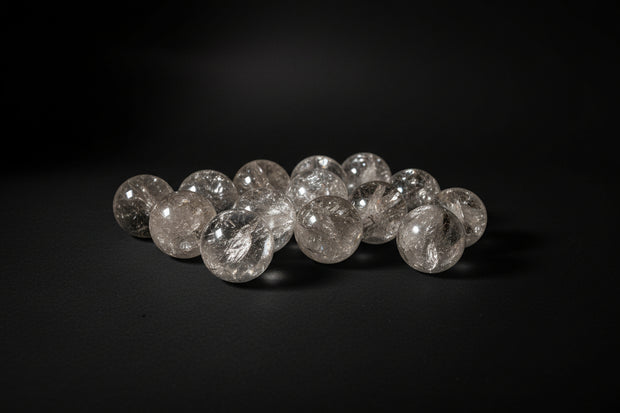
- a sphere on a secure stand;
- a palm stone;
- a cluster;
- a meaningful tumbled stone;
- a statue, candle holder, written word, photograph, or non-crystal object.
A larger or pointed stone is visually convenient, not inherently more powerful. Choose a stable piece that will not roll, tip, shed, or damage the surface beneath it.
Compare forms in Tumbled Stones, Palm Stones, Towers, and Natural Specimens.
Choosing supporting stones
Use a small set with defined jobs. You can choose by:
- color: a visual palette connected to the purpose;
- mineral identity: stones you already associate with particular qualities;
- personal history: gifts, travel pieces, inherited stones, or objects connected to the goal;
- geology: a study grid comparing crystal habits, localities, or species;
- practical stages: one stone for planning, one for action, one for review;
- availability: the stones you own and can use safely.
Correspondences vary by author and tradition. Read How to Read Magical Correspondence Tables Critically instead of treating an online list as universal law.
Simple grid layouts
The circle
Place the focus in the center and supporting stones around it. A circle is useful when the arrangement emphasizes continuity, protection, community, or repeated practice.
The four directions
Place one stone at each cardinal direction and one in the center. Assign each direction a role only when that system fits your tradition or purpose. Directions are not universally connected to the same elements or meanings.
The path
Arrange stones in a line from present condition to desired action. This works well for transitions, study plans, recovery of routine, or a multi-step project.
The triangle
Use three outer stones for three related functions—such as clarity, action, and review—with an optional center focus. Do not assume every triangle carries one ancient meaning.
The square or boundary
Mark four corners around a petition or object. This layout supports themes of structure, household boundaries, stability, and defined space.
The freeform constellation
Build around visual relationships, size, color, or a personal map. Write down the rules you used so freeform arrangement does not become meaningless decoration.
Do you need sacred geometry?
No. Printed geometry can provide symmetry and a repeatable layout, but a pattern does not automatically make the grid historical, universal, or more effective. Symbols such as the Flower of Life, hexagrams, pentagrams, spirals, and planetary figures have different histories and contexts.
Use a symbol because you have studied and chosen it, not because a product listing calls every geometric design ancient.
Using a petition beneath the grid
A written statement can keep the grid focused. Include:
- the specific purpose;
- the actions you will take;
- the timeframe or review date;
- important ethical boundaries;
- what will count as progress;
- when the grid will be dismantled.
Keep private names and information concealed in shared spaces. Oil, wax, and sharp crystal points can damage paper, so use a protective layer when needed.
A beginner five-stone grid
- Write one purpose and one practical action.
- Place a center stone to represent the purpose.
- Place one stone above it for the quality you want to develop.
- Place one below it for the practical foundation.
- Place one to the left for what must be understood or released.
- Place one to the right for the next action.
- Spend five minutes observing the arrangement.
- Record one decision, then set a review date.
The layout is a reflective structure, not a guaranteed prediction or medical treatment.
What does “activating” a grid mean?
Activation is the deliberate point at which the arrangement becomes an active part of your practice. It can be simple:
- read the petition aloud;
- touch each position and name its job;
- trace the layout in the air with a finger or wand;
- sit in meditation with the arrangement;
- ring a bell or use a brief sound;
- photograph the completed grid and begin the practical action;
- offer a prayer connected to the purpose.
No dangerous flame, ingestion, smoke, or outdoor disposal is required.
Using a wand, point, or finger
Some practitioners connect positions by tracing from the center outward, the boundary inward, clockwise, counterclockwise, or according to a tradition-specific sequence. None of these is a universal rule.
Choose one sequence, write it down, and use it consistently. A finger is sufficient. A wand or polished point is optional and should not scrape the stones or grid surface.
Maintenance during a long-term grid
For a grid that remains in place:
- photograph the original arrangement;
- keep a map of each stone and its purpose;
- dust the area without dragging fragile specimens;
- check towers and spheres for stability;
- inspect for sunlight, moisture, wax, oil, insects, and pet access;
- replace only a stone that is damaged, unsafe, or intentionally revised;
- review whether the practical actions are occurring;
- set an end date instead of leaving it indefinitely from guilt.
Physical care follows mineral identity. Use How to Cleanse and Charge Crystals Safely.
What if the grid is disturbed?
A bumped stone, pet, cleaning session, or forgotten layout does not automatically ruin the working.
- Stop and make the space safe.
- Use the photograph or map to rebuild it when desired.
- Replace damaged objects only after checking the material.
- Restate the purpose briefly.
- Continue—or decide the interruption is a reasonable closing point.
Read What to Do When a Ritual Is Interrupted.
Dismantling the grid
Close a grid deliberately rather than leaving it because you are afraid to move it.
- Review the original goal and practical outcome.
- Record what changed, what did not, and what you learned.
- Thank or acknowledge the symbols according to your practice.
- Remove stones one at a time and return them to labeled storage.
- Clean the surface according to its material.
- Archive or dispose of the petition securely.
- Update your catalog if any stone changed location or condition.
Common crystal-grid mistakes
- buying many stones before defining the purpose;
- using a pattern without understanding it;
- placing unstable towers, spheres, or clusters near an edge;
- combining oil, water, salt, and sunlight without checking mineral care;
- assuming more stones create more power;
- copying health claims that exceed evidence;
- leaving private names visible;
- rearranging the grid repeatedly from anxiety;
- forgetting the real-world action connected to the goal;
- treating an accidental disturbance as a spiritual emergency.
Frequently asked questions
How many stones do I need?
One stone can function as a focus. Three to seven pieces are enough for many layouts. Use only as many as you can assign a clear role.
Does the center have to be a crystal tower?
No. Use any stable object that represents the purpose, including a tumble, sphere, statue, petition, photograph, or empty space.
Can I mix different minerals?
Yes, when their material needs and symbolic roles are compatible. Keep water-sensitive, soft, powdering, sharp, or hazardous specimens contained and labeled.
Do stones have to point inward or outward?
No universal direction applies. Inward may symbolize gathering and outward may symbolize expansion or boundary, but define your own method before arranging the grid.
Can I move the grid?
Yes. Build it on a tray, board, cloth, or shallow box when portability matters. Photograph it before transport.
How long should a grid stay up?
Set a timeframe based on the purpose: one meditation, one lunar cycle, a project deadline, or another review point. Indefinite duration is not required.
Can a crystal grid replace practical action?
No. Use the grid to organize attention and commitments, then take the relevant financial, medical, legal, relationship, study, or household steps outside the ritual.
Build with purpose before quantity
Explore Crystals & Stones to compare small tumbled pieces, palm stones, towers, spheres, and natural specimens. Use a journal to map the layout, record its purpose, and evaluate it honestly at the closing date.
Tools for this practice
Explore the products selected for this guide. Review each listing for what is included and how to use it.


Shop this guide · 4 items Collapse


Keep exploring the shop
You made it to the end of the guide. Keep exploring through related products, major departments, or the full catalog.
 RELATED TO THIS GUIDE
Crystals & Stones
Shop this topic
RELATED TO THIS GUIDE
Crystals & Stones
Shop this topic


Leave a comment