


How to Choose an Altar Cloth: Size, Symbols, Materials, and Safety

An altar cloth can do far more than decorate a table. It can protect the surface beneath your tools, establish a visual boundary for ritual, organize a working area, create a clean foundation for divination, and help a temporary altar feel deliberate rather than improvised.
Choosing one, however, is not simply a matter of selecting the most striking symbol. Size, fabric, intended use, cleaning requirements, and proximity to candles or incense all matter. A beautiful cloth that is too small for the tools placed upon it—or unsafe around an active flame—will not serve the practice well.
This guide explains how to choose an altar cloth by function, size, material, symbolism, and safety. It also covers practical altar layouts, using a cloth for tarot or rune readings, cleaning and storage, and common mistakes to avoid.
What Is an Altar Cloth?
An altar cloth is a textile placed beneath ritual tools, devotional objects, divination systems, offerings, or ceremonial arrangements. Depending on the practitioner and tradition, it may be called an altar cloth, ritual cloth, tarot cloth, reading cloth, grid cloth, or altar tapestry.
The cloth does not need to possess a specific color, symbol, or material to be useful. Some practitioners select one because its imagery reflects their path. Others use a plain, washable textile because it protects furniture and keeps the working surface visually ordered. Both approaches are valid.
An altar cloth commonly serves several purposes:
- Defining space: It marks where the ritual or devotional arrangement begins and ends.
- Protecting surfaces: It helps guard furniture from dust, scratches, wax drips, oil residue, and minor spills.
- Organizing tools: Borders and central designs can provide a natural structure for arranging objects.
- Supporting focus: A consistent visual foundation can help distinguish ritual time from ordinary activity.
- Providing portability: A folded cloth can turn a temporary table, shelf, or travel surface into a defined working area.
An altar cloth is optional. A practitioner can maintain a meaningful altar without one, and a cloth does not make a surface sacred by itself. Its value comes from the practical and symbolic role it serves within the larger arrangement.
Choose the Function Before the Symbol
Before comparing designs, decide how the cloth will be used. A permanent devotional altar has different needs from a portable reading setup or a candle-heavy working table.
Permanent Altar
A cloth used beneath a permanent altar should fit the surface without creating long, loose edges that can be pulled by pets, children, sleeves, or passing objects. It should also be easy enough to clean that dust and residue do not become permanent features of the arrangement.
Temporary Ritual Surface
For temporary rites, a foldable cloth can establish a clear working boundary and simplify cleanup. A medium-size cloth often provides enough room for a central object, a few tools, and a small offering vessel without requiring a dedicated altar table.
Divination or Reading Cloth
Tarot, oracle, rune, and pendulum work benefit from a smooth surface that reduces glare, softens the sound of casting pieces, and separates the reading from the table beneath it. The design should not be so visually busy that cards, symbols, or small objects become difficult to see.
Crystal Grid or Structured Layout
A cloth used for a crystal grid or directional arrangement should lie flat and provide enough uninterrupted space for the complete design. Sacred geometry or compass-style artwork may offer a helpful layout, but the printed lines should support the intended arrangement rather than dictate it.
For a broader look at how cloths relate to other implements, read Tools of the Craft: 10 Essential Pagan Altar Tools and Supplies.
Altar Cloth Size Guide
Altar cloth sizes vary considerably. The best choice depends on the dimensions of the surface, the number of tools used, and whether the cloth should cover the entire table or define only the central working area.
| Approximate Size | Best Suited For | Practical Considerations |
|---|---|---|
| 18 × 18 inches | Compact altars, single-card readings, small ritual kits | Easy to store and travel with; limited room for larger arrangements |
| 19 × 19 inches | Portable altars, rune casting, small tarot spreads | A balanced size for flexible everyday use |
| 24 × 24 inches | Standard altar tables, medium readings, multi-tool layouts | Provides more working room while remaining manageable |
| 36 × 36 inches | Large spreads, crystal grids, broad tables, group work | Requires more storage space and careful flame placement |
Measure the Surface First
Measure both the width and depth of the altar or table. Then decide whether the cloth should:
- Cover the entire surface
- Leave a visible border around the edge
- Hang slightly over the sides
- Define only a central ritual area
A cloth does not need to match the table exactly. In many arrangements, a smaller cloth centered beneath the primary tools creates a cleaner and safer layout than fabric hanging from every side.
Account for the Tool Footprint
Place the largest objects on the bare table before selecting a cloth. A statue, cauldron, offering bowl, tarot spread, or group of candles may occupy more space than expected. Include the clearance needed between flames and other objects rather than measuring only the object bases.
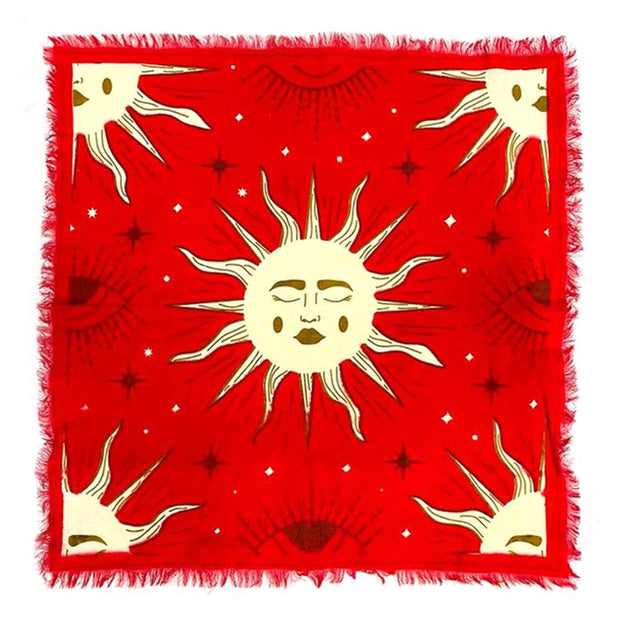
For compact setups, an 18-inch Floral Pentacle Altar Cloth can define a focused working area. A 24-inch Celestial Sun Altar Cloth provides more room for a medium arrangement, while the 36-inch Flower of Life Altar Cloth is better suited to large surfaces and expansive layouts.
Choosing an Altar Cloth Material
Fabric affects durability, texture, cleaning, folding, and fire behavior. Product descriptions should identify the material when known, but care requirements can still vary between individual textiles.
Cotton
Cotton generally feels natural, lies comfortably on a table, and may be easier to wash than heavily embellished fabrics. It can wrinkle, absorb oils and wax, and retain strong incense aromas. Dark or saturated dyes may transfer during early washes, so separate cleaning is wise.
Polyester and Synthetic Blends
Polyester cloths are often lightweight, resist wrinkles, and travel well. They may be easier to fold into a compact ritual kit. However, synthetic fibers can melt, shrink, or deform when exposed to heat. They must be kept away from candle flames, hot charcoal, heated burners, and freshly used vessels.
Velvet and Textured Fabrics
Velvet can provide an elegant reading surface and help prevent cards or small pieces from sliding. It also attracts dust, may hold incense scent, and can be more difficult to clean. Thick texture may interfere with objects that require a perfectly level base.
Embroidered, Fringed, or Metallic-Printed Cloths
Decorative details can make an altar visually distinctive, but they require additional care. Fringe can approach a flame without being noticed, embroidery can create an uneven base, and metallic print may react poorly to ironing or harsh detergents. Always follow the most conservative care method when the manufacturer’s instructions are unavailable.
Understanding Altar Cloth Symbols
Symbolic meanings are shaped by history, religion, culture, magical tradition, and personal interpretation. No printed design has one universal meaning, and a symbol should not be selected solely because a product description assigns it a desirable result.
Learn where a symbol comes from, consider how it is used within the relevant tradition, and choose imagery that is appropriate for the work actually being performed.
Pentacle and Pentagram
A pentagram is a five-pointed star. A pentacle commonly refers to a pentagram enclosed within a circle, although historical usage is broader. Within many modern Pagan and witchcraft settings, the points may represent earth, air, fire, water, and spirit, while the surrounding circle can represent unity or containment.
A pentacle cloth can provide a balanced central design for general altar work. It is not exclusive to one modern tradition, and its meaning changes by context. The Occult Pentagram Altar Cloth offers a larger symbolic field for practitioners who want the star to serve as the dominant visual anchor.
Triple Moon
The Triple Moon commonly depicts waxing, full, and waning lunar forms. It is often associated with lunar cycles, change, growth and release, and—in some modern Pagan or Wiccan contexts—Goddess symbolism. Not every lunar practitioner interprets it identically.
A Triple Moon Pentacle Altar Cloth can suit moon-centered work, cyclical observances, or an altar where lunar imagery already plays an established role.
Tree of Life
Tree imagery appears in many religious, philosophical, and mythological systems. Common themes include connection, growth, ancestry, the relationship between visible and unseen worlds, and the linking of roots and branches. The exact interpretation depends on the specific cultural or esoteric framework.
The Tree of Life Altar Cloth offers a compact foundation for nature-oriented, ancestral, devotional, or general contemplative arrangements without requiring the design to be assigned one rigid meaning.
Sun and Solar Imagery
Solar designs are commonly associated with illumination, vitality, visibility, authority, warmth, and cycles of renewal. They can provide a strong visual center for work involving clarity, confidence, creative action, or seasonal observance.
Moon, Moth, and Nocturnal Imagery
Lunar phases, moths, and night imagery are frequently used to express transformation, intuition, hidden movement, dreamwork, and navigation through uncertainty. These are modern symbolic associations rather than guaranteed properties of the printed design.
The Moonbloom Luna Moth Altar Cloth combines moon phases with transformation imagery for practitioners who prefer a softer, botanical visual field.
Raven and Compass Designs
Ravens carry different meanings across cultures and should not be reduced to a single generic definition. In contemporary occult artwork, they are often connected with observation, messages, liminality, memory, or hidden knowledge. Compass imagery may suggest direction, orientation, or finding one’s way.
The Ravenward Compass Altar Cloth can be useful for divination or directional layouts when those themes already fit the practitioner’s system.
Evil Eye and Protective Imagery
Eye-shaped protective symbols have long and culturally specific histories across regions including the Mediterranean, West Asia, North Africa, and South Asia. When using such imagery, approach it with awareness rather than treating every eye design as interchangeable decoration.
An Evil Eye Altar Cloth may appeal to practitioners who understand and respectfully engage with its protective context.
Sacred Geometry
Geometric designs can help structure crystal grids, meditation points, or symmetrical altar arrangements. Their visual order may support concentration even when the practitioner does not assign them supernatural power. Research specific designs rather than assuming all sacred geometry belongs to one universal system.
Does Altar Cloth Color Matter?
Color can reinforce a theme, improve visibility, or coordinate an altar, but it is not a requirement. Black creates contrast with many tools and candles. White can make dust and spills more visible. Purple is frequently associated with spirituality or divination in modern metaphysical practice, while green may support a nature-centered visual theme.
These correspondences vary by tradition. Practical visibility should also guide the choice. Dark runes disappear against some dark cloths; pale cards can become washed out against highly reflective fabric; and complicated prints may make small objects difficult to locate.
How to Arrange an Altar Cloth
Center the Cloth Before the Tools
Lay the cloth flat, align its primary image or border, and smooth folds before placing objects. If the design has a clear top and bottom, orient it toward the practitioner unless the ritual system requires another direction.
Build From the Largest Objects Outward
Place statues, bowls, cauldrons, or central devotional items first. Add smaller tools only after confirming that the larger objects are stable. Avoid using folded fabric to correct a wobbling base; use a level, heat-safe support instead.
Keep Active and Decorative Areas Distinct
A cloth can visually separate an active working zone from decorative or devotional objects. This is especially helpful when candles, oils, water, powders, or offerings are present. The arrangement should make it obvious where heat and liquids are being used.
Use Layering Carefully
Some practitioners layer a small symbolic cloth over a larger plain table covering. This can protect the primary cloth and create a defined center. Too many layers, however, can make candle holders unstable and trap spilled liquids between textiles.
For more help constructing a coherent ritual arrangement, see Crafting Pagan Rituals: A Step-by-Step Guide.
Using an Altar Cloth for Tarot, Runes, or Divination
An altar cloth can double as a reading cloth when the material is smooth and the design does not interfere with interpretation. For cards, choose a surface large enough for the spreads you actually use. For runes or casting lots, select a cloth with enough weight that it does not bunch when pieces land.
A dedicated divination cloth can also protect cards and tools from dust or rough table surfaces. It does not need to be permanently displayed. Fold it after each session and store it with the deck, rune set, or pendulum if that supports a consistent reading routine.
Do not assume that wrapping a deck in cloth is required to preserve its spiritual effectiveness. It is primarily a practical and personal choice.
Altar Cloth Fire Safety
Any textile placed near candles, incense, charcoal, or burning herbs creates a potential fire hazard. An altar cloth is not a heat barrier unless it is specifically manufactured and rated for that purpose. Most decorative altar textiles are not.
- Keep fabric well away from candle flames, hot wax pools, charcoal, incense embers, and heated metal.
- Place candles in stable holders on noncombustible drip trays.
- Set incense burners, cauldrons, and charcoal vessels on heat-resistant surfaces or trivets—not directly on the cloth.
- Remember that synthetic fabric may melt from heat even when it does not visibly ignite.
- Trim candle wicks and keep the arrangement away from drafts, fans, curtains, shelves, and hanging fabric.
- Remove loose fringe from the active flame area.
- Do not use an altar cloth to smother a fire or handle a hot vessel.
- Never leave burning candles, incense, herbs, or charcoal unattended.
- Keep flames and hot materials inaccessible to children and pets.
If an altar is too small to provide safe clearance, remove the cloth during active flame work or move the burning component to a separate, clear, noncombustible surface. Symbolic appearance should never take priority over fire safety.
Cleaning and Caring for an Altar Cloth
Follow the product’s care instructions when available. When they are not provided, begin with the least aggressive method.
- Shake out loose dust outdoors or use a lint roller gently.
- Spot-test water and mild detergent on an inconspicuous area.
- Hand wash cold when the fabric, dye, fringe, or print is uncertain.
- Wash strongly colored cloths separately to prevent dye transfer.
- Avoid bleach and harsh cleaners unless the textile is specifically rated for them.
- Air dry flat or hang carefully, depending on the material.
- Do not iron metallic print, synthetic fabric, or unknown decoration at high heat.
Remove spilled oils quickly by blotting rather than rubbing. Wax should be allowed to cool completely before gently lifting excess material. Aggressive scraping, high heat, or solvents can damage the print and spread the stain.
How to Store an Altar Cloth
Clean and fully dry the cloth before storage. Fold it loosely along existing seams or roll it around an acid-free tube when minimizing creases is important. Keep it away from leaking oils, loose charcoal, damp herbs, and heavily scented incense unless fragrance transfer is desired.
A cloth used only seasonally can be labeled and stored with the relevant tools. A frequently used reading cloth may be kept with the associated deck or rune set. The goal is to protect the textile without making it difficult to access.
The guide How to Store Witchcraft Supplies provides a broader system for separating fabrics, tools, liquids, herbs, crystals, and active ritual materials.
Common Altar Cloth Mistakes
- Buying a design before measuring the altar surface
- Choosing a highly detailed print that obscures cards or small tools
- Letting fabric hang where it can be pulled or brushed against
- Placing candles or hot incense burners directly on the textile
- Assuming a decorative cloth is fire-resistant
- Using symbolism without learning its historical or cultural context
- Allowing oils, water, powders, or wax to accumulate without cleaning
- Folding the cloth while damp
- Using an uneven or heavily textured cloth beneath unstable vessels
A Simple Altar Cloth Selection Checklist
Before choosing, ask:
- What will I use the cloth for?
- How large is the actual working surface?
- Which tools must fit safely on it?
- Will cards, runes, or small objects remain visible against the design?
- Can the material be cleaned using methods available to me?
- Will candles, incense, or charcoal be used nearby?
- Do I understand the symbol and its relationship to my practice?
- Can the cloth be stored without exposure to oils, moisture, or heat?
Frequently Asked Questions
Do I need an altar cloth?
No. It is a useful surface protector, organizer, and symbolic boundary, but it is not required for a valid altar or meaningful practice.
Can a tarot cloth be used as an altar cloth?
Yes. Many textiles can serve both purposes when the size, design, and material suit the arrangement. Clean the cloth between uses when wax, oil, incense ash, or offerings could affect cards.
Can I use ordinary fabric?
Yes. A plain scarf, table runner, cotton square, or other suitable textile can work. Check stability, washability, dye transfer, and fire safety before placing ritual tools upon it.
Should an altar cloth match my tradition?
It may, but it does not have to. Some practitioners prefer path-specific symbols; others use neutral colors or natural fabrics. Informed and practical selection matters more than forcing every altar component into one visual theme.
How often should I change an altar cloth?
Change it when it becomes dirty, damaged, seasonally inappropriate for your purposes, or no longer supports the arrangement. There is no universal spiritual schedule for replacing one.
Choose a Cloth That Serves the Work
The best altar cloth is not necessarily the most elaborate. It is the one that fits the surface, supports the tools, remains safe around the intended practice, and carries symbolism that the practitioner understands.
Measure first. Select the material second. Consider the imagery with care. Then build the arrangement with stability, visibility, cleaning, and flame safety in mind.
Explore the live Altar Cloths collection alongside Altar Tools and Altar Supplies to create a working surface suited to your available space and practice.
Tools for this practice
Explore the products selected for this guide. Review each listing for what is included and how to use it.
Shop this guide · 1 item Collapse
Keep exploring the shop
You made it to the end of the guide. Keep exploring through related products, major departments, or the full catalog.
 RELATED TO THIS GUIDE
Ritual Supplies & Altar Tools
Shop this topic
RELATED TO THIS GUIDE
Ritual Supplies & Altar Tools
Shop this topic


Leave a comment