


How to Choose and Use a Ritual Wand

A ritual wand is one of the most recognizable tools associated with witchcraft, Wicca, ceremonial practice, and modern Pagan ritual. Yet it is also one of the most misunderstood. A wand is not a requirement for practicing magic, it does not possess automatic power simply because it looks impressive, and there is no single universal rule governing how it must be made or used.
At its most practical, a wand is a symbolic extension of the hand. It can help a practitioner direct attention, mark ritual boundaries, trace symbols, call the quarters, bless an object, or give physical form to an intention. The value of the tool comes from how clearly and consistently it supports your practice.
This guide explains how to choose a ritual wand by size, construction, symbolism, and material; how wands differ from athames and smoke-cleansing bundles; how to use one in a simple ritual; and how to clean, consecrate, and store it safely.
What Is a Ritual Wand?
A ritual wand is a handheld implement used to point, direct, trace, indicate, or symbolize movement within a spiritual or magical practice. Depending on the tradition, it may be associated with Air, Fire, the will, divine authority, growth, communication, or the living power of wood. These associations are not universal. Different traditions assign different meanings, and many solitary practitioners develop their own working relationship with the tool.
Wands range from simple branches to carved, sculpted, crystal-tipped, and mineral pieces. Decoration can support symbolism, but it does not make one wand inherently more effective. The useful question is not, “Which wand is most powerful?” but, “Which wand supports the work I intend to do?”
Is a Wand Necessary for Witchcraft?
No. A wand is optional. Many practitioners direct intention with a finger, hand, breath, gaze, spoken word, bell, staff, athame, or no physical tool at all. A wand can improve focus and ritual consistency, but it should never become a barrier that prevents you from practicing.
Beginners sometimes feel they must collect every traditional altar tool before beginning. In reality, a small number of tools used with confidence is usually more helpful than a crowded altar filled with objects whose purpose is unclear. Our broader guide to Pagan altar tools can help you decide which implements genuinely fit your path.
Ritual Wand vs. Smoke-Cleansing Wand
The word wand is also used for bundles of dried herbs intended for smoke cleansing. These are completely different products.
- A ritual wand is a reusable handheld tool used for pointing, tracing, directing, blessing, or symbolic ritual actions.
- A smoke-cleansing wand is a combustible bundle of plant material that is burned to produce smoke.
Do not assume that every product containing the word “wand” belongs on the altar as a directing tool. When shopping, check the construction, intended use, care instructions, and product category. The store’s Ritual Wands collection is organized specifically around reusable ritual and display wands rather than herb bundles.
Common Uses for a Ritual Wand
There is no single required method, but wands commonly serve several practical ritual functions.
Directing Attention and Intention
Pointing the wand toward a candle, symbol, offering, doorway, or altar object can help bring your attention to that part of the rite. The physical movement gives the mind a clear signal: this is where the work is focused.
Tracing Symbols
A wand may be used to trace a pentagram, circle, sigil, spiral, rune-like personal mark, or other symbol in the air. The symbol does not need to become physically visible. The gesture acts as a deliberate ritual action.
Casting or Marking a Circle
In some Wiccan and eclectic practices, a wand may be used to mark the perimeter of sacred space. Move slowly, remain aware of furniture and other people, and avoid swinging the wand dramatically. Our guide to casting a Wiccan circle explains how tools can fit into a complete opening and closing structure.
How to Choose a Ritual Wand
A good ritual wand should feel manageable, durable enough for its intended use, and meaningful without requiring you to force an interpretation. Consider function before decoration.
1. Start With the Work You Plan to Do
Ask where and how you expect to use it. A compact wand may suit a small altar, seated ritual, travel kit, or discreet practice. A longer wand creates a stronger visual gesture but needs more room and careful storage. A heavily decorated wand may be ideal for display and formal ritual, while a simpler piece may be easier to handle frequently.
2. Check the Length and Available Space
Before purchasing, measure the shelf, altar, drawer, box, or wall display where the wand will live. Also consider the room needed to move it safely. A long wand can strike candles, shelves, ceiling fans, hanging decorations, pets, or another participant if used in a cramped area.
For close indoor practice, a short or medium wand is often easier to control. A longer piece may work better in open ceremonial space or as a stationary altar symbol.
3. Consider Grip and Balance
The wand should rest securely in your hand without requiring a tight grip. Look for a comfortable handle area and consider whether sculpted details, crystal points, branches, or raised designs could catch on sleeves or become uncomfortable during longer use.
Balance matters more than perfect symmetry. A wand can be heavier at one end, but you should be able to point and trace with it without wrist strain.
4. Examine Construction
Look for loose decorations, sharp seams, unstable tips, cracks, splinters, or attached pieces that could detach. Decorative wands should be handled as carefully as any other sculpted object. They are not impact tools, walking sticks, toys, or weapons.
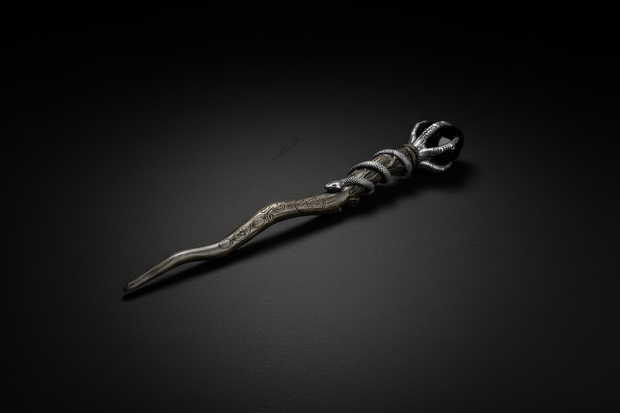
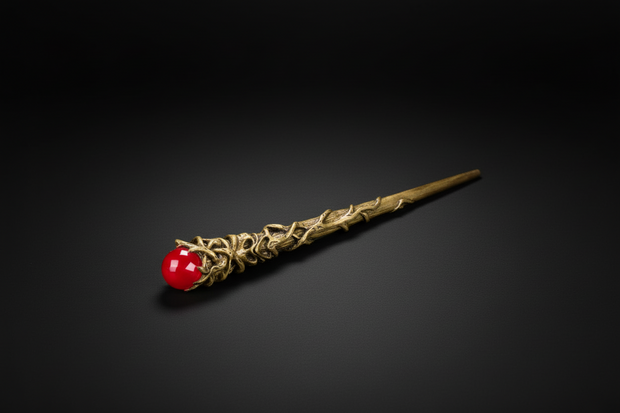
A design such as the Serpentbound Sky Wand may appeal to practitioners who want an overtly symbolic altar piece, while the Greenman Tree Wand may suit a practice centered on woodland, seasonal, or land-based imagery. These themes are invitations for personal interpretation, not fixed promises about what the object will accomplish.
5. Choose Symbolism You Understand
Dragons, serpents, moons, skulls, branches, figures, crystals, and colors can carry many meanings. Choose imagery that supports your actual practice rather than selecting it only because it appears dramatic. A considered personal meaning is more useful than a borrowed correspondence you cannot explain.
Choosing by Material
Wood and Wood-Look Wands
Wood is often associated with growth, rootedness, life cycles, and connection to the land. However, product names and appearances do not always confirm the exact material. Some ornate wands may be resin or another sculpted material made to resemble wood. Read the product description rather than assuming construction from appearance alone.
A naturally gathered branch can also become a wand, but collect responsibly. Do not cut living branches without permission, remove material from protected land, or take wood from private property. Fallen material should still be checked for insects, rot, mold, sharp points, and local collection rules.
Crystal and Mineral Wands
Stone wands can be used as ritual pointers, meditation objects, altar pieces, or tools for symbolic crystal work. They are generally heavier and more breakable than wood or resin. A fall onto tile or concrete may chip, fracture, or shatter them.
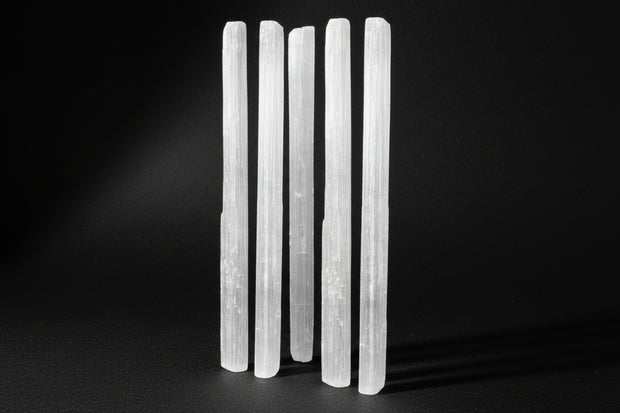
Selenite is especially popular because of its luminous appearance, but it is soft, easily scratched, and sensitive to prolonged contact with water. Keep selenite dry, avoid soaking it, do not scrub it aggressively, and store it where harder stones cannot scrape it. A Raw Selenite Wand can provide a simple mineral option, but it should be treated as a fragile crystal specimen rather than an indestructible tool.
Resin and Sculpted Decorative Wands
Sculpted wands can carry detailed imagery that would be difficult to achieve in plain wood. They often work well as formal altar tools or display pieces. Their raised details and attached tips may make them more vulnerable to drops or pressure, so store them in a padded or stable position.
Wand vs. Athame
Both a wand and an athame may be used to point, trace, or direct within some Wiccan and occult traditions. Their meanings and elemental associations differ among lineages, books, and individual practitioners.
The practical distinction is straightforward: an athame is a ritual blade, while a wand is non-bladed. That difference affects handling, storage, public display, travel, household safety, and local rules. A wand may be the more comfortable choice for a home with children, visitors, or anyone who does not want a blade on the altar.
Neither tool is automatically superior. Some people use both for different ritual functions; others use only one. See our guide to athame meaning, use, and safety before deciding which tool better fits your practice.
How to Clean a Ritual Wand
Cleaning should protect the physical object first. Spiritual symbolism never requires damaging the tool.
- Dust: Use a soft, dry cloth or clean brush.
- Light surface dirt: Use a barely damp cloth only when the material is known to tolerate moisture, then dry immediately.
- Selenite and water-sensitive minerals: Keep dry and use a soft brush or cloth.
- Painted or sculpted surfaces: Avoid solvents, abrasive cleaners, soaking, and hard scrubbing.
- Unknown materials: Use the gentlest dry method available.
Do not coat a wand with ritual oil unless the maker confirms the finish and materials can tolerate it. Oil can stain wood, soften adhesive, cloud finishes, collect dust, or damage painted details.
How to Cleanse or Consecrate a Wand
Consecration is a ritual dedication, not a physical requirement. A new wand can be used immediately, or you can mark the beginning of your relationship with it through a simple ceremony.
A Material-Safe Dedication
- Physically inspect and clean the wand.
- Place it on a stable cloth or hold it securely.
- Take several slow breaths and state the purpose you want it to serve.
- Pass your hand above it without touching, ring a bell nearby, speak a blessing, or place it in indirect moonlight for a brief period.
- Hold it and say a clear dedication, such as: “I set this wand apart as a tool of focus, deliberate action, and responsible practice.”
- End by placing it in its chosen storage location.
Smoke, salt, water, flame, and oil are not necessary. Avoid any method that could scorch, corrode, stain, scratch, weaken adhesive, or expose people and animals to irritating smoke.
A Simple Beginner Wand Practice
This exercise uses the wand as a focusing tool without claiming that the object creates results on its own.
- Choose one practical intention. Examples include completing a difficult task, protecting an hour for study, speaking more clearly, or maintaining a household boundary.
- Stand or sit comfortably. Make sure you have clear space around your arm.
- Hold the wand gently. Notice its weight and balance.
- Name the intention aloud. Keep it specific and connected to an action you can take.
- Trace one simple shape. A circle can represent completion, a straight line can represent direction, or a personal sigil can represent the goal.
- Point toward the place of action. This might be your desk, calendar, journal, doorway, or project materials.
- State the next physical step. For example: “I will work on this for twenty minutes now.”
- Put the wand down safely and begin.
The wand helps create a moment of commitment. The practical follow-through is what turns intention into change.
Ritual Wand Safety
A wand may not have a blade, but it still requires responsible handling.
- Never strike, jab, throw, or swing it toward another person or animal.
- Keep it away from open flame, hot wax, burners, and heated cauldrons.
- Do not use decorative or mineral wands to stir food, beverages, oils, baths, or herbal preparations.
- Do not place a heavy wand where it can roll from a shelf or altar.
- Keep small crystals, detachable decorations, and sharp tips away from children and pets.
- Check it periodically for cracks, loose pieces, splinters, or sharp edges.
- Use restrained movements in group ritual and establish boundaries before beginning.
How to Store a Ritual Wand
Store the wand in a way that protects both the object and the people in the home. A drawer, padded box, wall rack, covered altar shelf, or cloth wrap may all work depending on its construction.
Do not stack heavy tools on top of sculpted details or crystal points. Keep selenite separate from harder minerals. Long wands should lie flat or rest in a secure stand rather than leaning where they can fall. For more organization ideas, see our guide to storing witchcraft supplies and ritual tools.
Common Mistakes When Choosing a Wand
- Buying only for appearance: Consider size, grip, fragility, and storage as well as design.
- Assuming expensive means more powerful: Price may reflect materials and detail, not guaranteed results.
- Mixing correspondences without context: Learn the ritual system you are using instead of combining rules at random.
- Using damaging cleansing methods: Soaking, salting, oiling, smoking, or intense sunlight can harm some materials.
- Replacing action with ritual: A wand can focus commitment but cannot replace practical work or professional help.
Frequently Asked Questions
Which hand should hold a ritual wand?
Some systems distinguish between a dominant or “projective” hand and a receptive hand. Others do not. Begin with the hand that offers the safest, most controlled grip. Consistency and comfort matter more than forcing a rule that does not fit your body.
Does a wand need a crystal point?
No. A crystal point is decorative and symbolically useful for some practitioners, but it is not required. Plain wood, sculpted material, stone, or a carefully selected branch can all serve the same basic directing function.
Can I make my own wand?
Yes. Use legally and ethically obtained material, smooth dangerous edges, remove loose bark or debris as appropriate, and avoid toxic finishes. Do not harvest from private or protected land without permission.
How long should a ritual wand be?
There is no mandatory length. Choose a size that fits your hand, altar, storage area, and ritual space. Short wands are easier to control indoors; longer wands make larger gestures but require more clearance.
Can I use a selenite wand with water?
Avoid soaking or prolonged water exposure. Selenite is soft and water-sensitive. Clean it with a dry cloth or soft brush and store it away from moisture and harder stones.
What should I do if my wand breaks?
Stop using it if it has sharp edges or loose pieces. Depending on the damage, you may repair it, retire it as an altar object, reuse safe components, or dispose of it according to the material. A broken tool is not automatically an omen.
Choosing a Wand That Supports Your Practice
The best ritual wand is not the one with the most elaborate design or the longest list of claimed correspondences. It is the one you can handle safely, understand symbolically, care for properly, and use with a clear purpose.
Start with function. Choose a size that fits your space, materials you can maintain, and imagery that genuinely belongs in your practice. Then use the wand consistently as a tool of attention rather than expecting the object to do the work for you.
Explore our current Ritual Wands to compare sculpted, symbolic, and mineral styles, or visit The American Occultist in Coshocton, Ohio, to see available pieces in person.
Tools for this practice
Explore the products selected for this guide. Review each listing for what is included and how to use it.
Shop this guide · 3 items Collapse


Keep exploring the shop
You made it to the end of the guide. Keep exploring through related products, major departments, or the full catalog.
 RELATED TO THIS GUIDE
Ritual Supplies & Altar Tools
Shop this topic
RELATED TO THIS GUIDE
Ritual Supplies & Altar Tools
Shop this topic


Leave a comment