


How to Prepare for Your First Tarot Reading

Your first tarot reading should not feel like a test. You do not need to understand every card, use special language, or arrive with a perfectly worded question. A little preparation simply helps the reader understand what you want from the session and gives you more time to explore the part that matters.
Tarot is best approached as an interpretive tool for reflection, perspective, patterns, and possible directions. It should not be treated as a guaranteed prediction or a replacement for medical, legal, financial, or mental-health support.
Choose One Main Area of Focus
A short reading can become scattered when it tries to cover relationships, work, money, family, health, spirituality, and the distant future all at once. Choose one primary topic and one secondary topic in case time remains.
- A decision you are considering
- A pattern you want to understand
- A project or relationship that needs perspective
- A transition you are preparing to navigate
- A general check-in when no single crisis is present
You can still mention relevant context, but a clear focus gives the cards and conversation somewhere useful to go.
Turn Predictions Into Useful Questions
Questions that ask only for a fixed yes, no, date, or guaranteed outcome often produce less practical information than questions about choices and conditions.
| Instead of Asking | Try Asking |
|---|---|
| Will I get the job? | What should I understand about this opportunity, and how can I prepare? |
| When will I meet someone? | What relationship patterns or opportunities should I pay attention to? |
| Is this person my soulmate? | What is the current dynamic, and what would support a healthy decision? |
| Will everything work out? | What factors can I influence, and what requires patience or acceptance? |
For a complete question-building method, read How to Ask Better Divination Questions.
Write Down the Essential Context
You do not need to tell your entire life story. Bring the minimum context needed to distinguish the people, choices, and timeframe involved. A few notes can prevent nerves from making you forget what mattered.
- The main question
- Important dates or deadlines
- The choices already available
- What you have already tried
- Any subject you do not want discussed
Allow the reader to work before supplying every detail. You can add context when it improves interpretation.
Decide Your Privacy Boundaries
A reading does not require surrendering privacy. You may decline to discuss a topic, ask the reader to move to another card, or stop a line of interpretation that feels intrusive. Questions about another person should respect consent and avoid turning divination into surveillance. Review The Ethics of Divining About Other People and Privacy and Confidentiality in Spiritual Practice.
Ask before recording audio, taking photographs, or bringing another person into the session. The reader should receive the same courtesy.
Arrive Ready to Participate
- Arrive on time so the session is not shortened.
- Avoid alcohol or substances that interfere with judgment and consent.
- Silence notifications when possible.
- Bring glasses, hearing devices, mobility supports, or other accessibility tools you use.
- Bring a notebook if you want to record themes and practical next steps.
You do not need to cleanse yourself, buy a crystal, or memorize tarot meanings before the appointment.
What Happens During the Reading?
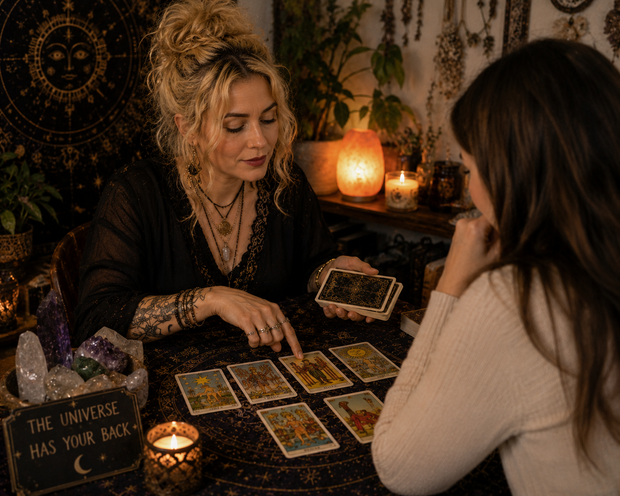
The reader may ask what you want to explore, select a spread, shuffle or invite you to participate, lay out the cards, and explain how the images relate to one another. Styles differ. Some readers emphasize traditional meanings, some emphasize narrative and intuition, and many combine both.
Useful questions during the session include:
- What makes that card important in this position?
- How does this card change the meaning of the one beside it?
- What part of this can I act on?
- What would a healthier alternative look like?
- Can we clarify the timeframe or conditions?
You are allowed to say that an interpretation does not fit. A responsible reading is a conversation, not a demand that you accept every statement.
Do Not Chase Certainty With Endless Clarifiers
One clarifying card can focus an unclear point. Repeatedly pulling cards until a preferred answer appears weakens the usefulness of the session. When uncertainty remains, record it honestly. Real decisions often contain information that tarot cannot settle for you.
After the Reading
- Write down the main themes before details fade.
- Separate what the reader said from what you inferred later.
- Identify one or two practical actions.
- Allow time for those actions to produce information.
- Revisit the notes after the stated timeframe.
A reading should leave you with greater clarity or better questions, not a new obligation to consult cards before every choice.
Explore Tarot Readings in Store
View current details and availability on our Tarot Readings page or see all In-Store Services. Readers who want to study the cards themselves can browse the Tarot collection, including the Dark Wood Tarot Deck and Celtic Tarot Deck.
Frequently Asked Questions
Do I need a specific question?
No. A general reading can work, but a clear area of focus usually produces a more useful conversation.
Should I tell the reader everything first?
Give enough context to define the situation, then add details when they help. You are not required to disclose private information unrelated to the question.
Can a tarot reading guarantee the future?
No. A reading can explore patterns, possibilities, and choices, but it cannot guarantee an event or remove uncertainty.
Can I ask about another person?
You can discuss how a relationship affects you, but responsible questions avoid claiming access to another person’s private thoughts or future without consent.
May I take notes?
Yes. Notes are useful. Ask permission before recording audio, video, or photographs.
What if a card frightens me?
Ask how the reader interprets it in context. Dramatic cards often represent change, endings, conflict, release, or transformation rather than a literal catastrophe.
Preparation Creates Room for a Better Conversation
Choose a focus, bring a few useful facts, establish privacy boundaries, ask open questions, and leave space for interpretation without demanding certainty. The goal is not to perform tarot correctly. It is to use the session thoughtfully.
Tools for this practice
Explore the products selected for this guide. Review each listing for what is included and how to use it.


Shop this guide · 4 items Collapse




Keep exploring the shop
You made it to the end of the guide. Keep exploring through related products, major departments, or the full catalog.


Leave a comment