


How to Use Crystals on a Wiccan Altar

Crystals on a Wiccan altar should support the altar’s purpose, elemental structure, and safe working space. They are optional secondary tools rather than mandatory objects or substitutes for the athame, wand, chalice, pentacle, candle, or offering vessel.
Plan the Altar Before Adding Stones
Begin with the ritual’s actual needs:
- What is the altar for: devotion, circle work, spellcraft, an Esbat, or a Sabbat?
- Which core tools are being used?
- Where will candles, incense, liquids, and written materials sit safely?
- How much clear working space is required?
- Are any stones heavy, sharp, unstable, soft, toxic, or fragile?
Add stones after the functional layout is established.
Crystal Placement at the Four Quarters
Some Wiccans place one stone at each directional quarter. Correspondences vary by lineage and author.
- North / Earth: Jasper, hematite, obsidian, or black tourmaline
- East / Air: Clear quartz, fluorite, or a pale stone chosen for clarity
- South / Fire: Carnelian, garnet, sunstone, or tiger’s eye
- West / Water: Amethyst, aquamarine, moonstone, or blue calcite
Quarter stones reinforce an elemental map; they do not replace calling or acknowledging the elements when that is part of the tradition.
Using a Central Focus Stone
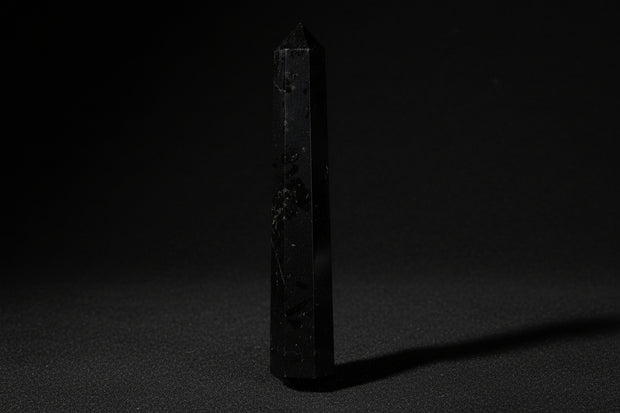
A single clear quartz, sphere, tower, or personally meaningful specimen may be placed near the center, pentacle, deity image, or written intention.
Its function might be:
- Providing a visual center
- Representing Spirit or ritual unity
- Anchoring a written goal
- Supporting meditation
- Marking the center of a crystal pattern
Secure tall, round, pointed, or heavy stones with appropriate stands and keep them away from table edges.
Crystal Layouts for Spellwork
- Circle: Boundary, protection, or completion symbolism
- Triangle: Direction, manifestation, or a three-part intention
- Square: Stability, household matters, or Earth symbolism
- Straight line: Movement, progression, separation, or a defined path
- Single stone: Clear focus without visual clutter
Keep every layout far enough from the candle that stones cannot obstruct access, trap heat, or destabilize the holder.
Crystals Beside Deity Images
Stones may be selected by color, cultural association, mineral history, personal devotion, or modern correspondence. Research the deity’s historical tradition before presenting a recent crystal association as ancient fact.
A deity altar does not require an expensive specimen. A written name, image, offering bowl, and safe light can form a complete shrine.
Seasonal and Sabbat Stones
- Samhain: Obsidian, jet, or smoky quartz
- Yule: Garnet, clear quartz, or snowflake obsidian
- Imbolc: Amethyst or clear quartz
- Ostara: Green aventurine or moss agate
- Beltane: Rose quartz or carnelian
- Litha: Sunstone, citrine, or tiger’s eye
- Lughnasadh: Citrine, jasper, or carnelian
- Mabon: Jasper, smoky quartz, or tiger’s eye
Rotate a few stones with the season rather than overcrowding the altar.
Permanent and Rotating Stones
Permanent Stones
These may include quarter markers, a central stone, or a personally significant devotional specimen.
Rotating Stones
These may change with the Sabbat, lunar cycle, deity, spell, or current study focus.
Review the arrangement regularly and remove anything without a clear function.
Altar Safety and Mineral Care
- Keep stones away from flames, charcoal, hot wax, and incense ash.
- Use stands for spheres, towers, slabs, and points.
- Do not place water-sensitive stones beside cups or offering bowls.
- Protect furniture from rough bases, rusting minerals, and dyes.
- Leave enough room to lift tools without knocking over the arrangement.
- Keep small specimens away from children and pets.
- Dust and inspect stones during regular altar maintenance.
Frequently Asked Questions
Where should clear quartz go on a Wiccan altar?
It may be placed at the center, near the pentacle, beside a written intention, or wherever it supports the specific ritual.
How many crystals belong on an altar?
Use the smallest number that clearly supports the purpose and leaves safe working space.
Do altar crystals need to be cleansed first?
Many practitioners symbolically reset and assign them before use, but no universal rule requires a specific cleansing method.
Related Reading
Tools for this practice
Explore the products selected for this guide. Review each listing for what is included and how to use it.
Shop this guide · 1 item Collapse

Keep exploring the shop
You made it to the end of the guide. Keep exploring through related products, major departments, or the full catalog.
 RELATED TO THIS GUIDE
Crystals & Stones
Shop this topic
RELATED TO THIS GUIDE
Crystals & Stones
Shop this topic


Leave a comment