


Sigil Magic: Creating, Charging, and Activating Symbols of Intention

Sigils are symbols created to represent a focused intention. In modern witchcraft, they are commonly used to give an abstract goal a visible form that can be carried, displayed, carved, burned, or incorporated into a larger ritual.
The process is adaptable and requires very little equipment. A practitioner defines an intention, converts it into a personal symbol, charges the symbol through focused attention, and activates it through a deliberate action. A sigil is therefore more than a drawing: it is a complete process built around clarity, symbolism, attention, and practical follow-through.
Choose Your Sigil-Magic Path
- Write the intention: Begin with How to Write Effective Sigil Intentions.
- Create the symbol: Use the method in this guide, then compare Sigil Creation Tools: Alphabet and Numeric Systems and How Sigil Generators Work.
- Charge it: Read How to Charge a Sigil: 8 Practical Methods.
- Activate it: Continue with How to Activate a Sigil: Methods With and Without Fire.
- Use candle magic: Follow Using Sigils in Candle Magic.
- Create household wards: Read Protection Sigils for Home Warding and Defense.
- Troubleshoot the practice: Review Common Mistakes Beginners Make With Sigil Magic.
- Use a repeatable construction system: Explore the educational overview before choosing among the Sigil Forge alphabet and numeric methods.
What Is a Sigil?
A sigil is a deliberately constructed symbol associated with a specific intention. Unlike widely recognized occult symbols, a personal sigil is usually created for one purpose and may be meaningful only to the person who designed it.
Modern sigil methods draw from several streams of occult practice, including ceremonial symbolism, personal magical alphabets, twentieth-century occult experimentation, and chaos-influenced magic. Methods vary, but the practical function remains consistent: the symbol becomes a concentrated visual anchor for the work.
Why Practitioners Use Sigils
Sigils can help organize a working by reducing a long intention to one memorable symbol. Practitioners commonly use them to:
- focus meditation or spellwork;
- reinforce a personal commitment or desired behavior;
- mark a protective boundary;
- carry an intention on a candle, charm, journal, altar, or doorway;
- connect repeated ritual actions to the same goal.
The symbol does not replace practical effort. A sigil for focus still requires studying, planning, and removing distractions. Its value is that it gives those actions a consistent ritual anchor.
Step One: Write a Clear Intention
Every sigil begins with language. The statement should be concise, centered on one outcome, and easy to understand.
Examples include:
- “I maintain steady focus while studying.”
- “I move through challenges with calm confidence.”
- “My home remains peaceful and protected.”
Avoid combining unrelated goals into one statement. A sigil intended simultaneously for confidence, money, protection, and recognition becomes difficult to define and harder to use consistently.
For a deeper guide to this stage, read How to Write Effective Sigil Intentions.
Step Two: Transform the Statement Into a Symbol
One common method is to write the intention in capital letters, remove repeated letters, and combine the remaining shapes into a single design.
- Write the intention.
- Remove spaces and repeated letters.
- Rotate, overlap, simplify, or mirror the remaining letter forms.
- Refine the result until it feels balanced and no longer reads like ordinary text.
There is no requirement that the finished sigil be elaborate. A simple symbol is often easier to remember, redraw, carve, and visualize.
Want a Repeatable Way to Build Your Sigils?
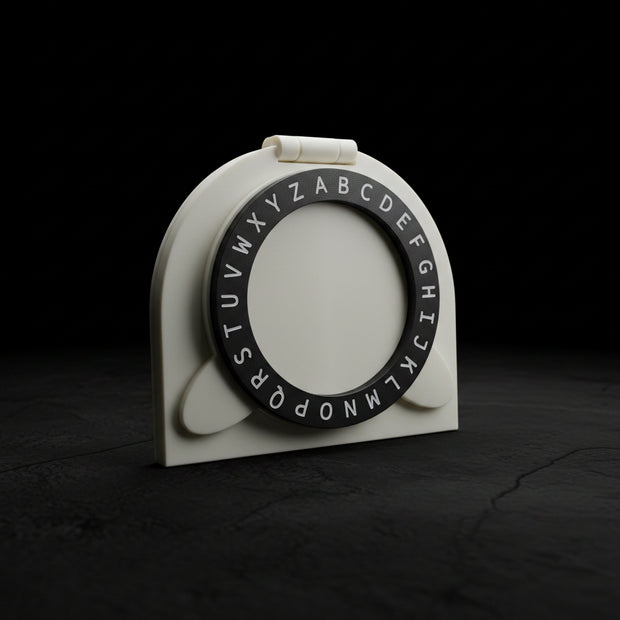
You can create sigils entirely by hand. If you prefer a consistent construction method, the Sigil Forge Starter Set pairs the beginner-friendly Classic Edition with the Companion Holder so the plate and paper stay aligned while you work.
Explore the Sigil Forge Starter Set →
Want to compare methods first? Browse all Sigil Magick tools →
Step Three: Charge the Sigil
Charging is the period of deliberate attention that connects the symbol with its intended purpose. Traditions explain this in different ways: some describe energy entering the symbol, while others emphasize concentration, emotion, and subconscious association.
Common charging methods include:
- quiet meditation while looking at the sigil;
- slow breathing and visualization;
- focused emotional intensity;
- movement, chanting, drumming, or repeated gestures;
- placing the sigil at the center of a candle or altar ritual.
Charging does not need to be theatrical. A short period of undivided attention is usually more useful than a long ritual performed while distracted. See Methods for Charging Sigils for additional approaches.
Step Four: Activate the Sigil
Activation marks the point at which the prepared symbol is put into use. The method should match the intended duration and purpose of the working.
- Burning: used for release or a decisive transition. Burn only in a fireproof container with ventilation and constant supervision.
- Carrying: appropriate for ongoing intentions connected to daily behavior.
- Placement: useful for household, altar, workspace, or protective sigils.
- Candle work: the sigil may be carved into wax or placed safely beneath a stable candle holder.
- Ritual destruction: tearing or otherwise retiring the paper can symbolize completion without flame.
Read How to Activate Sigils in Spellwork for a fuller comparison.
Using Sigils in Candle Magic
A sigil can be carved into a candle, drawn on a petition beside it, or placed beneath a heat-safe holder. The symbol defines the intention while the candle provides a timed ritual action.
Never place loose paper where it can contact flame or hot wax. Keep candles away from herbs, curtains, shelves, pets, and drafts, and never leave a burning candle unattended.
For a complete method, see Using Sigils in Candle Magic.
Protection and Long-Term Sigils
Not every sigil is destroyed after activation. Protective sigils may remain near doors, windows, mirrors, altars, or private household boundaries. Long-term sigils can be redrawn or revisited periodically as part of routine cleansing and maintenance.
Learn more in Protection Sigils for Home Warding and Defense.
Releasing Attachment to the Result
Some sigil traditions encourage practitioners to stop repeatedly checking whether a working is succeeding. This does not mean ignoring the goal. It means completing the ritual, taking the practical actions connected to it, and avoiding anxious repetition that undermines focus.
Keep records when useful, but judge the working by observable changes and your own actions rather than by constant interpretation of every coincidence.
Common Beginner Mistakes
- using vague or contradictory language;
- encoding too many goals in one symbol;
- making the design too complicated to reproduce;
- skipping the charging or activation stage;
- expecting the sigil to replace practical effort;
- using fire, smoke, or outdoor disposal without adequate safety precautions.
For troubleshooting, read Common Mistakes Beginners Make With Sigil Magic.
Developing a Personal Sigil Practice
A consistent process is more important than an elaborate one. Define the intention, create the symbol, charge it, activate it, and record what you did. Over time, those notes will show which methods are practical, memorable, and meaningful within your own tradition.
Sigils remain popular because they can be adapted without requiring a large collection of tools. Used carefully, they provide a simple structure for bringing intention, symbolism, ritual action, and practical follow-through into the same working.
Sigil magic is a spiritual and symbolic practice. It should not replace medical, mental-health, legal, financial, or emergency assistance. Use flame, smoke, sharp tools, and ritual materials responsibly.
Sigil Making Tools & Kits
If you want a repeatable physical framework for constructing sigils, browse our Sigil Making Tools & Kits and Sigil Making for Beginners. The tools support the design process; intention, interpretation, and use remain with the practitioner.
Tools for this practice
Explore the products selected for this guide. Review each listing for what is included and how to use it.
Shop this guide · 1 item Collapse

Keep exploring the shop
You made it to the end of the guide. Keep exploring through related products, major departments, or the full catalog.
 RELATED TO THIS GUIDE
Ritual Supplies & Altar Tools
Shop this topic
RELATED TO THIS GUIDE
Ritual Supplies & Altar Tools
Shop this topic


Leave a comment