


Palmistry Basics: Dominant Hand, Major Lines, Mounts, and Responsible Interpretation

Palmistry, also called chiromancy or palm reading, is a family of interpretive traditions that examines the hands. A reader may consider hand shape, fingers, flexibility, skin texture, raised areas called mounts, and major or minor lines. Different schools do not assign every feature the same meaning.
A responsible palm reading treats these features as symbolic material for reflection—not as medical diagnosis, proof of personality, a fixed map of destiny, or a reliable measurement of lifespan.
What palmistry actually examines
| Feature | What a reader may observe | Important limit |
|---|---|---|
| Overall hand | Proportion, width, length, texture, flexibility, and balance | No shape determines character with scientific certainty |
| Fingers | Length, spacing, joints, tips, flexibility, and relative proportion | Injury, work, age, mobility, and anatomy affect appearance |
| Major lines | Depth, length, direction, branches, breaks, and relationship to other lines | Line names are symbolic and are not medical or lifespan measurements |
| Minor lines | Smaller markings used by particular schools | Many are faint, temporary, or interpreted inconsistently |
| Mounts | Raised areas of the palm named after traditional planetary associations | Prominence changes with anatomy, hand position, and pressure |
| Both hands | Similarities and differences between left and right | Schools disagree about what each hand represents |
Which hand is read?
Many readers examine both hands. Common modern approaches include:
- Dominant hand as current expression: the hand used most often is read as developed habits, choices, or present life.
- Nondominant hand as inherited potential: the other hand is read as tendencies, background, or earlier pattern.
- Left and right as receptive and active: some traditions use symbolic polarity rather than writing dominance.
- Gender-assigned systems: some older or regional methods assign hands by sex or gender.
- Both hands as one comparison: differences are interpreted without declaring one hand the “real” hand.
None of these rules is universal. Left-handed, ambidextrous, injured, disabled, or occupationally adapted hands may not fit a simple dominant-versus-nondominant formula. A reader should explain the system being used.
The major palm lines
The heart line
The heart line usually runs across the upper palm beneath the fingers. Palmistry traditions commonly associate it with emotional expression, affection, relationships, values, and the way feelings are processed or communicated.
Its name does not make it a cardiovascular test. Shape, depth, branches, or breaks should not be used to diagnose heart disease, predict emotional tragedy, or declare another person incapable of love.
The head line
The head line generally crosses the middle of the palm. It is often interpreted in relation to thinking style, focus, imagination, communication, learning, or decision-making.
A short, divided, chained, or sloping line does not diagnose intelligence, mental illness, neurological conditions, or learning disability. Interpretive language should remain descriptive and nonfatalistic.
The life line
The life line curves around the base of the thumb. Traditional readings may associate it with vitality, pace, physical engagement, major transitions, grounding, or the way a person moves through life.
A short life line does not predict a short life. No responsible reader should give a death date, lifespan estimate, or medical conclusion from this line.
The fate or Saturn line
The fate line, when visible, often runs vertically toward the middle finger. It may be read in relation to vocation, structure, external pressures, responsibility, direction, or changing life paths.
Many people have a faint, partial, multiple, or absent fate line. Absence does not mean a person has no purpose, career, destiny, or future.
The Sun or Apollo line
This vertical line may be associated with expression, recognition, creativity, satisfaction, or public visibility. It is not present clearly on every hand and should not be used to promise fame or wealth.
The Mercury or health line
Some systems use a line toward the little-finger side of the palm and call it the Mercury or health line. The historical name does not make it medically diagnostic. Changes in pain, skin, nails, color, swelling, sensation, or movement belong with an appropriate healthcare professional.
What are mounts?
Mounts are padded areas of the palm named through planetary symbolism. Common categories include:
- Mount of Venus: base of the thumb; often associated with affection, pleasure, vitality, and attachment.
- Mount of Jupiter: beneath the index finger; often associated with ambition, leadership, confidence, and ideals.
- Mount of Saturn: beneath the middle finger; often associated with responsibility, seriousness, discipline, and solitude.
- Mount of Apollo or Sun: beneath the ring finger; often associated with creativity, visibility, joy, and expression.
- Mount of Mercury: beneath the little finger; often associated with communication, adaptability, business, and skill.
- Mounts of Mars: areas associated with courage, resistance, assertion, or endurance.
- Mount of the Moon or Luna: outer lower palm; often associated with imagination, intuition, travel, dreams, and receptivity.
Pressing the hand flat, cupping it, flexing the thumb, swelling, body composition, and normal anatomy all change how prominent a mount appears. Compare both hands in the same relaxed position.
Hand-shape systems
Some modern palmistry books classify hands through four elemental types:
- Earth: broad palm and shorter fingers
- Air: square or rectangular palm and longer fingers
- Fire: longer palm and shorter fingers
- Water: long palm and long, often slender fingers
Real hands frequently fall between categories. These types are interpretive models, not biological classifications. Do not force every person into one element or use hand shape to judge morality, intelligence, compatibility, or employability.
Branches, breaks, crosses, islands, and chains
Readers may use smaller markings to modify the main line:
- Branch: a line extending from another line
- Break: a visible interruption or change in continuity
- Island: a divided section that encloses a small space
- Chain: repeated linked or fragmented appearance
- Cross: intersecting short lines
- Star: several lines meeting at a point
- Square: a small box-like marking
Fine markings are especially vulnerable to lighting, dry skin, lotion, hand position, camera processing, and wishful pattern recognition. A dramatic name does not justify a dramatic prediction.
Can palm lines change?
The visible appearance of hands can change. Skin hydration, movement, repeated work, calluses, injury, age, inflammation, scarring, camera angle, and lighting can make lines appear deeper, fainter, longer, or interrupted.
Palmistry traditions may interpret changes symbolically, but a before-and-after comparison should use:
- the same hand position;
- similar lighting and camera distance;
- dated photographs;
- no heavy lotion immediately beforehand;
- notes about injury, work, and skin condition;
- cautious language rather than retrospective certainty.
A grounded way to read your own palm
- Wash and dry your hands normally.
- Rest both hands comfortably without stretching the fingers.
- Photograph each palm under even neutral light.
- Identify the major lines before looking for tiny markings.
- Describe what you see without interpretation.
- Choose one palmistry source or school.
- Write two possible interpretations for one feature.
- Connect the interpretation to a reflective question.
- Avoid checking the same line repeatedly for danger.
- Review your notes after a month rather than rewriting them immediately.
Useful reflective questions
- How do the two hands differ, and what story does this palmistry system assign to that difference?
- Where do my habits support or conflict with the quality associated with this line?
- Which interpretation is specific enough to be useful?
- What alternative explanation fits the same marking?
- What practical action could I take without treating the reading as fate?
For broader question design, use How to Ask Better Divination Questions.
What palmistry should not be used to claim
- the date or cause of death;
- medical diagnosis or pregnancy status;
- proof of infidelity, crime, or secret intentions;
- fixed sexual orientation or gender identity;
- guaranteed number of marriages or children;
- intelligence, moral worth, or employability;
- certainty about wealth, fame, or disaster;
- that a frightening outcome can only be removed through a paid service.
Fear-based claims followed by urgent demands for curse removal, cleansing, or additional payments are a major warning sign. Review Fake Psychics and Spiritual Scams.
Consent, touch, and photographs
A palm reader should ask before touching, moving fingers, tracing lines, taking photographs, or retaining images. Clients can request:
- a visual reading without touch;
- one hand at a time;
- shorter positioning for pain or mobility needs;
- no photographs or recording;
- avoidance of a private topic;
- an explanation of which feature supports an interpretation.
Prepare for a session with How to Prepare for Your First Palm Reading.
Frequently asked questions
Which hand shows the future?
No universal palmistry rule establishes one future hand. Many readers compare dominant and nondominant hands, while other systems use left/right symbolism. Ask which method is being used.
Does a broken life line mean death or illness?
No. A line marking is not a medical or lifespan test. Palmists may interpret breaks symbolically, but frightening health claims are irresponsible.
What if I do not have a fate line?
Many hands have a faint, partial, multiple, or absent fate line. It does not mean you lack purpose, work, or direction.
Can calluses change a reading?
Calluses, scars, work, injury, and dry skin can change visibility and texture. A reader should acknowledge the physical condition of the hand.
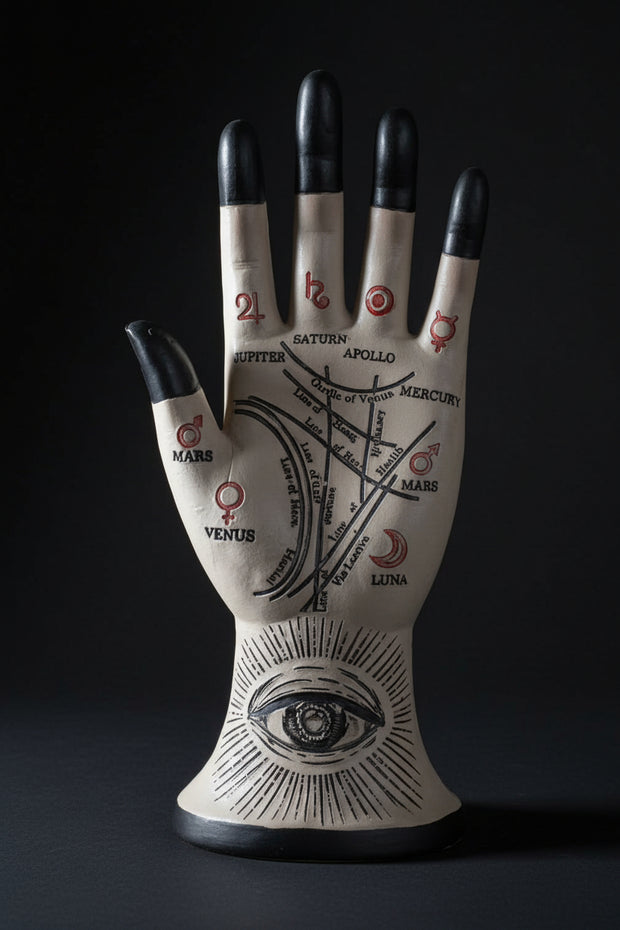
Are palmistry hand statues accurate?
They are educational and decorative diagrams based on a particular interpretive system. They should not be treated as a universal map shared by every tradition.
Can I learn palmistry from photographs?
Photographs help compare lines and preserve records, but they flatten depth, mounts, flexibility, texture, and proportion. Use consistent images and cautious interpretation.
How often should I have my palm read?
Palmistry is often used less frequently than situational tarot because the reading may consider broad patterns. Return when there is a meaningful reason, not to repeatedly inspect one frightening line.
Study the hand without turning it into a sentence
Explore current Palm Readings and other In-Store Services. For visual study, see the Palmistry Hand Statue and Palmistry Hands Tray. Use them as symbolic reference tools, not medical diagrams or fixed maps of destiny.
Tools for this practice
Explore the products selected for this guide. Review each listing for what is included and how to use it.

Shop this guide · 2 items Collapse


Keep exploring the shop
You made it to the end of the guide. Keep exploring through related products, major departments, or the full catalog.


Leave a comment