


Satin Spar vs. Selenite vs. Desert Rose: What Is the Difference?

Satin spar, selenite, and desert rose are often displayed beside one another in crystal shops—and frequently labeled as though they were completely different minerals. The relationship is more interesting than that.
Satin spar and selenite are both forms of gypsum. Most desert roses are also made primarily of gypsum, although some desert rose formations are composed of barite or another mineral. What separates them is usually not their basic chemistry, but the way their crystals formed, grew, and arranged themselves.
Understanding those differences can help collectors identify specimens more accurately, care for them properly, and recognize one of the most common naming issues in the crystal trade.
The Mineral They Share: Gypsum
Gypsum is a naturally occurring sulfate mineral with the chemical formula CaSO4·2H2O. In simple terms, it is calcium sulfate with water incorporated into its crystal structure.
Gypsum measures 2 on the Mohs hardness scale. It is soft enough to be scratched by a fingernail, although deliberately scratching a finished or collectible specimen is not recommended. Gypsum also has excellent cleavage, meaning it can split readily along certain internal planes.
The mineral can grow in several habits, including clear blades, parallel fibers, fine-grained masses, and sand-filled rosettes. The names selenite, satin spar, and desert rose describe some of these distinct appearances and growth habits.
What Is Selenite?
Selenite is the transparent or highly translucent crystalline form of gypsum. Classic specimens are clear and colorless, though inclusions and mineral staining can produce pale yellow, gray, brown, or reddish tones.
Selenite commonly forms as transparent blades, flat tabular crystals, elongated sheets, twinned formations, or clear crystal clusters. Its broad faces can show a glassy or pearly luster, and some pieces split into thin, windowlike sheets along their cleavage planes.
How to Recognize Selenite
- Clear or noticeably transparent areas
- Flat, bladed, or tabular crystal faces
- A glassy or pearly appearance rather than a fibrous sheen
- Distinct individual crystal shapes
- Smooth cleavage surfaces
In precise mineralogical usage, the name selenite does not accurately describe every white piece of gypsum. It refers more specifically to transparent, well-crystallized gypsum.
What Is Satin Spar?
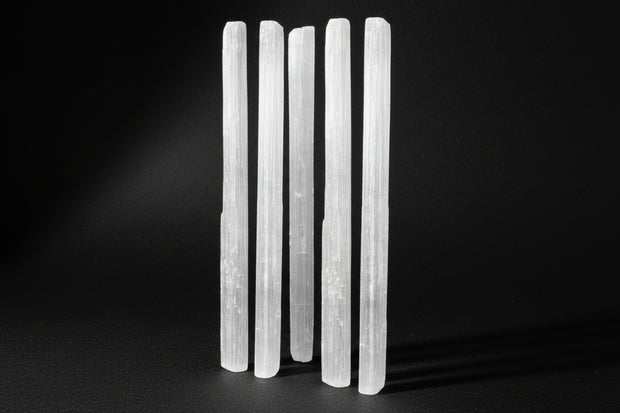
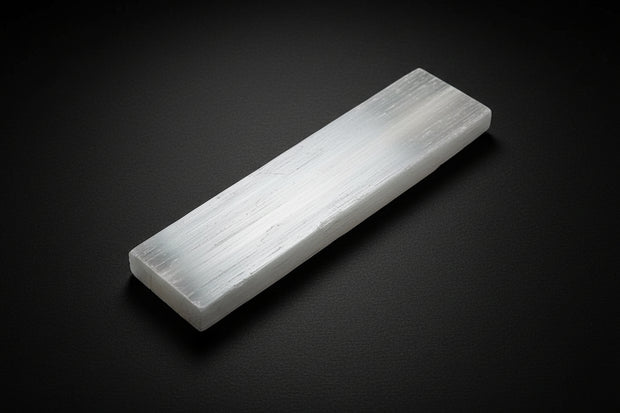
Satin spar is a fibrous variety of gypsum made from many fine crystals growing alongside one another in parallel. Rather than forming broad transparent blades, the fibers create a soft, silky-looking surface.
Light reflects across the tightly packed fibers, producing the luminous line or shifting glow associated with polished satin spar. It is usually white or cream, but natural staining can create orange, peach, tan, or gray material.
How to Recognize Satin Spar
- A fibrous or layered internal structure
- A silky sheen that moves across the surface
- Translucency rather than clear transparency
- Long parallel lines running through the piece
- Common forms such as wands, sticks, towers, bowls, plates, and carved tools
Most white gypsum wands, towers, charging plates, and bowls sold as “selenite” in modern crystal retail are actually satin spar gypsum. The trade name is deeply established, so careful product labeling often uses both terms—for example, satin spar gypsum, commonly sold as selenite.
Our Raw Satin Spar Gypsum Wand and Satin Spar Gypsum Charging Plate are labeled this way so shoppers can find the familiar name while still receiving accurate mineral identification.
What Is a Desert Rose?
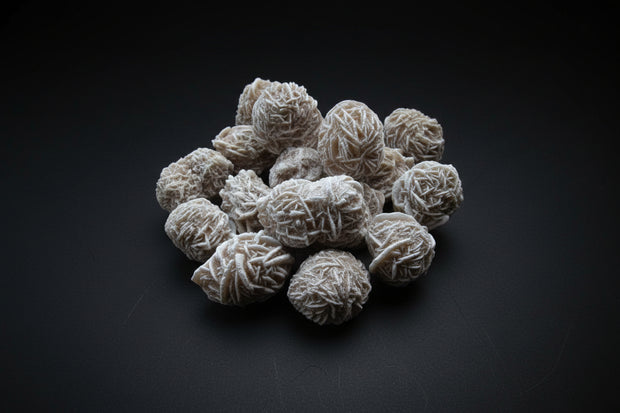
A desert rose is a rosette-shaped mineral formation made from intergrown crystal blades that resemble petals. These formations usually develop in arid, sandy environments where mineral-rich water evaporates and crystals grow around or between grains of sand.
Many desert roses are gypsum, but the term describes the shape and formation rather than one mineral species. Barite can also form desert roses, and less common examples may involve other minerals. For that reason, “desert rose” alone does not provide a complete mineral identification.
How to Recognize a Gypsum Desert Rose
- Overlapping crystal blades arranged like petals
- Tan, beige, cream, rust, or pale brown coloration
- Visible sand trapped within or coating the crystal blades
- A rosette, cluster, or rounded flowerlike shape
- A softer and generally lighter feel than a comparable barite rose
Because sand is incorporated as the crystals grow, desert roses are usually opaque or only faintly translucent. Calling every gypsum desert rose “selenite” can therefore be misleading, even though the underlying mineral may still be gypsum.
You can see the characteristic bladed rosette structure in our Desert Rose Gypsum Clusters.
Satin Spar vs. Selenite vs. Desert Rose at a Glance
| Feature | Selenite | Satin Spar | Desert Rose |
|---|---|---|---|
| Typical mineral | Gypsum | Gypsum | Usually gypsum; sometimes barite or another mineral |
| Crystal habit | Clear blades, sheets, or tabular crystals | Parallel fibrous growth | Intergrown rosette-shaped blades |
| Transparency | Transparent to highly translucent | Translucent, commonly milky | Usually opaque because of trapped sand |
| Surface appearance | Glassy or pearly | Silky or satiny | Sandy, earthy, or matte |
| Common retail forms | Natural blades and clusters | Wands, towers, bowls, plates, carvings | Natural rosettes and clusters |
Why Are Satin Spar and Selenite Confused?
The confusion is largely a matter of retail language. “Selenite” became the familiar umbrella term for pale gypsum crystals in metaphysical shops, while “satin spar” remained less familiar to many shoppers. Over time, the recognizable trade name was applied to fibrous gypsum objects that mineral collectors would identify more precisely as satin spar.
This does not mean every seller using the word selenite is intentionally misrepresenting a product. In many cases, the seller is following long-established customer language. A better approach is to include both the precise identification and the familiar trade term.
This distinction is part of a broader issue explored in our guide to crystal trade names versus mineral species.
Can You Identify Them by Appearance Alone?
Often, yes—especially when comparing classic examples—but appearance is not always enough for a definitive identification.
A clear bladed gypsum crystal is reasonably described as selenite. A milky white object with strong parallel fibers is satin spar gypsum. A sandy flowerlike cluster is a desert rose, but its exact mineral may require additional information.
For uncertain specimens, useful observations include luster, transparency, crystal habit, weight, cleavage, locality, and provenance. Our beginner’s guide to mineral identification explains how those properties work together.
A scratch test should be a last resort and should never be performed on a valuable finished surface. Hardness alone also does not tell you how easily a specimen may split or chip. For that distinction, see crystal hardness, toughness, and cleavage.
Care and Cleaning
All gypsum varieties require gentle handling. Their softness and cleavage make them vulnerable to scratches, chips, splitting, and edge damage.
- Keep them dry. Avoid soaking gypsum specimens or leaving them in standing water.
- Do not use saltwater. Salt grains can abrade the surface, and prolonged moisture is unnecessary.
- Avoid harsh cleaners. Use a soft, dry brush or clean microfiber cloth instead.
- Support desert roses from underneath. Their thin blades can break when pressure is placed on the outer edges.
- Separate pieces during storage. Harder stones can scratch gypsum easily.
- Keep them away from direct flame. Satin spar plates and bowls are not candle holders unless specifically designed and tested for that use.
For broader specimen-care advice, read how to clean, store, and display mineral specimens without damaging them.
Do They Have Different Metaphysical Meanings?
In modern crystal and spiritual practice, gypsum varieties are commonly associated with clarity, purification, peace, reflection, and intentional space. Practitioners sometimes assign additional symbolism based on form and appearance.
- Selenite: clarity, illumination, focused awareness, and reflection
- Satin spar: cleansing, calm, boundaries, and directed intention
- Desert rose: grounding, resilience, patience, and growth under difficult conditions
These are spiritual and cultural correspondences rather than scientifically established properties. Since satin spar and selenite share the same mineral composition, distinctions between their metaphysical uses arise from tradition, symbolism, shape, and individual practice rather than a difference in chemistry.
Is Satin Spar Fake Selenite?
No. Satin spar is a genuine natural variety of gypsum. It is not synthetic, fake, or an imitation of selenite.
The issue is terminology, not authenticity. Calling a fibrous gypsum tower “satin spar gypsum, commonly sold as selenite” gives shoppers both the familiar retail term and the more precise mineral name.
Which One Should You Collect?
Choose selenite when you appreciate transparent crystal blades, clear cleavage surfaces, and distinct natural crystal faces.
Choose satin spar when you prefer luminous fibers, silky bands of light, carved forms, or affordable display pieces.
Choose desert rose when you enjoy natural rosettes, earthy textures, sand inclusions, and formations shaped by evaporation in arid environments.
None is inherently better than the others. Each preserves a different record of how a mineral formed.
Browse our Crystals & Stones collection to compare natural specimens, carved forms, and other mineral pieces currently available.
Accurate Names Make Crystals More Interesting
Learning the distinction does not diminish the beauty or spiritual meaning of these specimens. It adds another layer to them.
A satin spar wand becomes more interesting when you understand that its glow comes from parallel gypsum fibers. A transparent selenite blade becomes more remarkable when you see how differently the same mineral can crystallize. A desert rose becomes a record of mineral-rich water, evaporation, sand, and time.
They may share a mineral family, but each tells a different geological story.
Tools for this practice
Explore the products selected for this guide. Review each listing for what is included and how to use it.

Shop this guide · 4 items Collapse


Keep exploring the shop
You made it to the end of the guide. Keep exploring through related products, major departments, or the full catalog.
 RELATED TO THIS GUIDE
Crystals & Stones
Shop this topic
RELATED TO THIS GUIDE
Crystals & Stones
Shop this topic


Leave a comment