


Secular Witchcraft: Symbolic Ritual, Skepticism, and Practice Without Deities

Witchcraft does not have one central authority that decides which beliefs every practitioner must hold. Some witches are polytheists, animists, Christians, occultists, agnostics, atheists, or skeptics. Others use religious language in one part of life and a secular framework in another.
Secular witchcraft treats ritual, symbolism, divination, seasonal observance, and crafted objects as meaningful practices without requiring a claim that deities, spirits, energy, or supernatural forces objectively cause the result.
This approach is not “pretending to believe.” It is a decision to use ritual honestly within the worldview a person actually holds.
What Does Secular Mean Here?
In this article, secular means that the practice does not depend on worship, revelation, divine authority, or a required supernatural belief. A secular witch may be:
- atheist;
- agnostic;
- skeptical but open to uncertainty;
- religious in another part of life while keeping witchcraft nonreligious;
- interested in folklore, art, psychology, nature, or ritual studies;
- unwilling to make claims that exceed available evidence.
These positions are not identical. The shared feature is that ritual can carry meaning without requiring the practitioner to assert that an invisible being or force produced an external event.
Is Secular Witchcraft Still Witchcraft?
The definition of witchcraft changes across history, scholarship, religion, folklore, law, and modern identity. Some religious witches believe supernatural agency is essential. Some folk traditions define witchcraft differently from modern self-identified practice. Some secular practitioners use the word because their methods, symbols, ancestry, community, or personal history place them within contemporary witch culture.
No single answer will satisfy every tradition. The honest approach is to describe the practice precisely:
- “I use secular witchcraft as a reflective ritual practice.”
- “I use tarot as a structured prompt, not infallible prediction.”
- “I celebrate seasonal changes without worshiping deities.”
- “I study magical history without claiming its cosmology as fact.”
Precision reduces unnecessary arguments about labels.
Ritual Can Have Human Effects Without Proving Magic
A ritual can influence attention, memory, emotion, motivation, group identity, and the way a person marks a transition. Symbols can organize complex ideas. Repetition can create habit. A chosen action can make an intention easier to remember.
Those effects do not prove that a spell changed probability, sent energy, compelled another person, or caused a distant event. A secular approach can value the human function while remaining careful about causation.
Read Religious Experience vs. Historical Evidence for a method of respecting experience without turning it into unsupported fact.
Common Secular Models of Practice
| Practice | Secular Interpretation |
|---|---|
| Spell | A focused symbolic action connected to a practical plan |
| Altar | A designed space for memory, values, attention, or creativity |
| Divination | A prompt for reflection, perspective, and question development |
| Cleansing | Physical cleaning or a symbolic transition between activities |
| Offering | An act of gratitude, remembrance, generosity, or ecological reciprocity |
| Seasonal ritual | A way to notice climate, daylight, food cycles, and personal time |
| Ancestor practice | Memory, genealogy, family history, grief, and inherited influence |
| Correspondence | A symbolic association used consistently rather than a proven force |
A practitioner may use one of these interpretations while remaining uncertain about others.
Intention Is Not the Same as Wishful Thinking
In a secular practice, intention works best when linked to behavior.
Instead of:
“This candle will make me financially secure.”
use:
“This candle marks the beginning of a thirty-day plan to review expenses, apply for two opportunities, and ask for qualified help.”
The ritual does not need to be dismissed as useless. It becomes a memorable starting signal for actions that can be observed and revised.
Use Why Manifestation Isn’t Working for a fuller distinction between intention and control over outcomes.
Tarot Without Fortune-Telling
Tarot can be used as a visual language for reflection. A card may prompt questions such as:
- What assumption am I making?
- Which part of this situation have I ignored?
- What would restraint, courage, grief, or change look like here?
- Whose perspective is absent?
- What action is within my control?
The card does not need to contain a hidden command. The value can arise from the interaction between image, question, memory, and interpretation.
Keep the method bounded. Do not use cards to replace medical diagnosis, legal advice, financial analysis, consent, or evidence. See How to Ask Better Divination Questions.
Seasonal Practice Without Worship
A secular practitioner may observe solstices, equinoxes, local weather changes, harvests, migration, first frost, flowering, or personal anniversaries.
A seasonal observance can include:
- record the daylight and weather;
- prepare or notice one seasonal food;
- learn which plants and animals are active locally;
- review the previous season;
- choose one realistic priority for the next;
- take a small ecological or community action.
You do not need to adopt deities, myths, or festival names that are not part of your practice. Low-Energy Sabbats offers adaptable practices that can also be used in a nonreligious framework.
Ancestor Work Without Claims of Communication
Ancestor practice can focus on documented family history, cultural inheritance, grief, recipes, photographs, migration, labor, harm, resilience, and the ways earlier generations shaped current life.
You can:
- preserve names and stories;
- research records;
- cook a family dish;
- repair a neglected photograph;
- acknowledge harmful patterns without romanticizing them;
- support living relatives within healthy boundaries;
- donate or volunteer in memory of someone.
No claim of spirit contact is required. You may also decline ancestor practice when family history is unsafe, unknown, or painful.
Symbols Do Not Need to Be Literally True
A symbol can be meaningful without being a scientific mechanism. A key may represent access. A bowl may represent receptivity. A threshold may mark transition. A moon image may help organize a monthly review.
Problems arise when symbolic language is quietly converted into factual claims. Say “I use rosemary as a symbol of remembrance,” rather than claiming that rosemary has been scientifically proven to repel harmful energy.
Use How to Read Magical Correspondence Tables Critically before treating modern lists as universal laws.
Personal Experience Still Requires Interpretation
A powerful feeling during ritual is real as an experience. The explanation remains open.
Possible contributing factors include:
- expectation;
- music and rhythm;
- breathing and posture;
- memory and association;
- group synchrony;
- lighting, scent, and sensory change;
- relief after making a decision;
- coincidence;
- a spiritual interpretation the practitioner personally accepts.
A secular practitioner does not have to ridicule spiritual interpretations. They can simply avoid claiming certainty they do not possess.
Evidence and Experimentation
If a ritual is meant to affect a measurable goal, define the goal before beginning.
- State the desired outcome clearly.
- Record the starting condition.
- List practical actions.
- Set a review date.
- Define what would count as success, partial success, failure, or unrelated coincidence.
- Do not rewrite the goal after the outcome is known.
- Compare the ritual period with ordinary effort and external conditions.
This will not settle every philosophical question, but it prevents every result from being interpreted as confirmation.
Use Ritual Recordkeeping to document the process.
Secular Practice and Ethics
Removing divine commandments does not remove ethical responsibility.
A secular framework can prioritize:
- informed consent;
- honesty about evidence;
- privacy;
- harm reduction;
- cultural context;
- environmental responsibility;
- respect for medical and professional expertise;
- accountability when a practice affects another person.
Do not present a reflective ritual as treatment, guarantee results, diagnose strangers through cards, or charge for certainty you cannot provide.
Avoid Cultural Extraction
Secularizing a practice does not erase its cultural ownership or history. Calling a restricted ceremony “just symbolic” does not make it open for use.
Research where a practice came from, whether a living community governs it, and whether initiation or permission is required. Read What Does “Closed Practice” Mean?.
Community With Religious Practitioners
Secular and religious witches can share spaces when expectations are explicit.
- Do not mock another person’s deity or spiritual experience.
- Do not require skeptics to speak belief they do not hold.
- Label devotional, symbolic, and historical claims clearly.
- Offer non-theistic wording in group rites when possible.
- Do not interpret disagreement as spiritual deficiency.
- Set boundaries around evangelizing and debate.
A group can say, “Participants may understand this symbol religiously, psychologically, artistically, or personally.”
A Simple Secular Ritual Structure
- Name the situation: describe what is happening without mystical inflation.
- Choose a symbol: select an object connected to the value or action.
- Mark the beginning: use a breath, light, sound, or gesture.
- Reflect: write, speak, draw, or arrange cards.
- Commit: identify one observable next action.
- Close: put the object away and return to ordinary activity.
- Review: evaluate the action on a set date.
This structure can be brief, smoke-free, inexpensive, and compatible with uncertainty.
Build a Practice That Matches Your Worldview
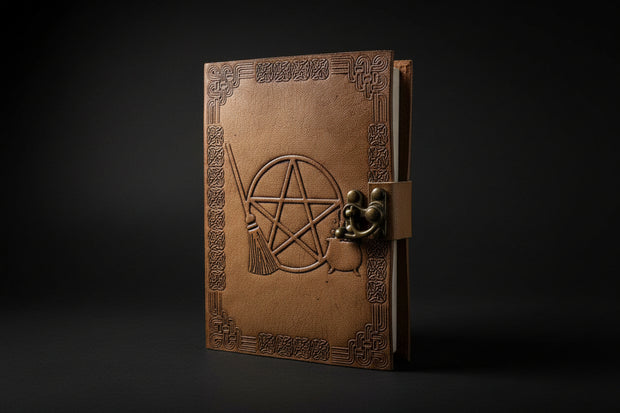
Browse Printed Works to compare historical, religious, and practical approaches rather than searching for one book that declares a universal truth. Journals can hold source notes, ritual plans, and outcome reviews. The Pentagram Broom Leather Journal offers a compact record for symbolic work, while Ritual Supplies should be chosen only when an object has a defined function in the practice.
Frequently Asked Questions
Can an atheist be a witch?
Many contemporary practitioners identify that way, though some religious traditions define witchcraft differently. Describe your own framework clearly rather than claiming one definition controls every community.
Do I have to believe a spell is supernatural?
No. You can use spell structure as symbolic focus connected to practical action. Be honest about what you believe the ritual does.
Is secular witchcraft just psychology?
It can include psychology, but it may also include art, folklore, seasonal observation, identity, community, ethics, history, and embodied ritual.
Can I work with deity imagery without believing the deity is literal?
You can study or use mythology symbolically, but disclose that interpretation and respect living religious communities. Do not present symbolic use as equivalent to devotional worship.
Can a skeptic use tarot?
Yes, as a reflective visual system. Set clear limits and do not claim that the cards provide verified facts about another person or the future.
Do I need ritual tools?
No. Words, movement, paper, ordinary objects, and attention can be enough. Buy tools only when they improve a defined practice.
Honesty Is the Foundation
Secular witchcraft allows ritual without forced belief. Use symbols deliberately, connect intention to action, distinguish experience from evidence, respect the cultural origins of practices, and let uncertainty remain uncertainty.
Tools for this practice
Explore the products selected for this guide. Review each listing for what is included and how to use it.
Shop this guide · 3 items Collapse


Keep exploring the shop
You made it to the end of the guide. Keep exploring through related products, major departments, or the full catalog.


Leave a comment