


Sigil of Lucifer Meaning: History, Symbolism & Responsible Use

The Sigil of Lucifer is a modern occult emblem associated with Luciferianism, some forms of Satanism, and personal philosophies centered on illumination, inquiry, independence, and self-directed transformation. It is widely reproduced in jewelry, artwork, books, and altar pieces, but its meaning is not fixed across every tradition.
The symbol should not be treated as an ancient universal mark of Lucifer or as proof that everyone displaying it holds the same beliefs. Its historical source, modern interpretations, and personal use are three different questions.
Where Does the Sigil of Lucifer Come From?
The design commonly called the Sigil of Lucifer is generally traced to the European grimoire tradition surrounding the Grimorium Verum. That text circulated in multiple manuscripts, editions, and translations, making simple claims about one exact date or uninterrupted line of use difficult to support.
The emblem became far more visible during the twentieth and twenty-first centuries through occult publishing, modern Luciferian practice, music, jewelry, and online culture. Its present popularity is therefore modern even though it draws from an older grimoire source.
Is It an Ancient Roman Symbol?
No reliable evidence establishes the familiar design as an ancient Roman emblem of the morning star or the historical planet Venus. Lucifer was a Latin word connected with the morning star and later developed additional literary and religious meanings, but that does not make every modern Luciferian symbol an artifact of ancient Rome.
What Does the Design Look Like?
The sigil is usually drawn as a geometric arrangement of crossing lines, an upper V-like form, and a curved lower section. Reproductions vary in line weight, proportion, and small details.
Modern practitioners sometimes interpret its shapes as a chalice, a gateway, a torch, the meeting of opposing forces, or movement between material and spiritual awareness. These interpretations can be meaningful, but they should be identified as modern readings rather than presented as one historically proven code.
What the Sigil Can Mean Today
- Illumination: Seeking knowledge and bringing hidden assumptions into view
- Inquiry: Questioning inherited authority and examining claims critically
- Self-sovereignty: Taking responsibility for one’s values and choices
- Transformation: Deliberately changing habits, identity, or understanding
- Adversarial thought: Testing convention without treating opposition as an excuse for cruelty
- Luciferian identity: Expressing affiliation with a Luciferian philosophy or devotional path
Not every Luciferian is a Satanist, and not every Satanist uses the sigil. Some people understand Lucifer as a spiritual being, others as a mythic or literary figure, and others as a symbol. For a broader comparison, see Luciferianism vs. Satanism.
Sigil of Lucifer vs. Sigil of Baphomet
The two emblems are visually and historically distinct. The Sigil of Lucifer uses an abstract linear design associated with Lucifer. The Sigil of Baphomet combines an inverted pentagram, a goat’s head, Hebrew letters spelling Leviathan, and an enclosing circle.
They may appear in some of the same modern occult settings, but they are not interchangeable and do not carry one universal theology.
Responsible Ways to Use the Sigil
Physical symbols are optional to this kind of study. If you want to compare decorative objects and traditional altar formats, see Satanic altar tools and symbolic objects, paying attention to the item's actual imagery rather than assuming every symbol has the same meaning.
Study and Reflection
Use the emblem as a prompt for journaling about knowledge, responsibility, freedom, or a belief you are reevaluating. The symbol does not need to be “activated” through danger, bodily harm, or illegal activity.
Jewelry and Portable Symbols
A Lucifer symbol pendant can express identity or serve as a private reminder of personal principles. A smaller Lucifer talisman can be carried or placed in a compact study space. Neither object guarantees supernatural effects.
Altar or Display Use
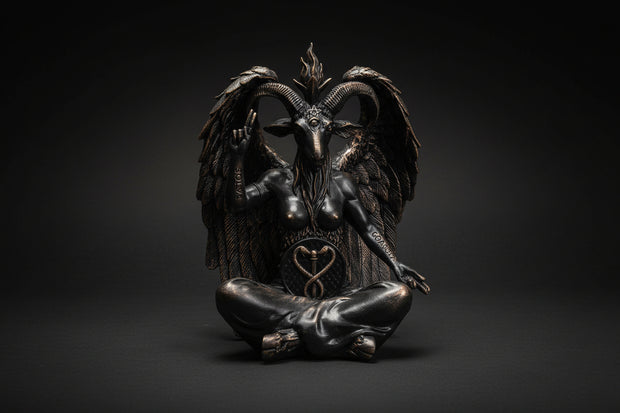
A printed sigil may be enough for an altar focal point. Practitioners who prefer figurative imagery can use a Lucifer statue while leaving clear space around candles, incense, and liquids. See Satanic Ritual Tools and Altar Construction for practical layout and safety considerations.
Ritual Use
The sigil can provide a visual focus during reading, meditation, a spoken affirmation, or a symbolic ritual. A labeled anointing product such as Lucifer ritual oil is optional. Follow the product directions, do not ingest it, and never assume an oil is safe to burn or place near flame.
Common Misconceptions
“The sigil summons Lucifer automatically.”
A printed or worn symbol does not establish an objectively verifiable supernatural event. Interpretations of ritual experience vary, and ordinary psychological and environmental explanations should remain available.
“Everyone wearing it worships a literal Devil.”
No. The wearer may be a theistic practitioner, a non-theistic Luciferian, a Satanist, an artist, or someone interested in occult symbolism.
“Lucifer and Satan always mean the same thing.”
No. Their relationship differs across theology, literature, folklore, occult systems, and personal practice.
Frequently Asked Questions
Is the Sigil of Lucifer evil?
Symbols do not possess one universal moral meaning. The emblem’s significance depends on historical context, the practitioner’s interpretation, and how it is used.
Do I need the sigil to practice Luciferianism?
No. Luciferian paths vary, and no single symbol, object, purchase, or ritual is universally required.
Can the sigil be drawn by hand?
Yes. It can be drawn, printed, engraved, worn, or omitted entirely. Precision of reproduction is an artistic choice rather than a measure of spiritual sincerity.
Related Reading
Tools for this practice
Explore the products selected for this guide. Review each listing for what is included and how to use it.


Shop this guide · 4 items Collapse



Keep exploring the shop
You made it to the end of the guide. Keep exploring through related products, major departments, or the full catalog.
 RELATED TO THIS GUIDE
Ritual Supplies & Altar Tools
Shop this topic
RELATED TO THIS GUIDE
Ritual Supplies & Altar Tools
Shop this topic


Leave a comment