


Theistic Satanism: Belief, Devotion, and Modern Religious Practice

Theistic Satanism is a modern religious category in which Satan, Lucifer, or related adversarial beings are understood as real spiritual entities rather than only symbols or archetypes.
The path is decentralized and includes many independent theologies. No single organization, scripture, ritual system, ethical code, leader, or account of spiritual experience represents every theistic Satanist. This article describes the category without claiming that supernatural beings or personal experiences can be objectively verified.
Related tools: Readers exploring devotional or ceremonial material can browse Satanic Altar Supplies. No object is required to identify with or study theistic Satanism.
Modern development
Organized modern Satanism became publicly visible with the Church of Satan in 1966, but that organization was explicitly non-theistic. Theistic Satanism developed through decentralized occult networks, independent practitioners, printed esoteric material, small groups, and later online communities. It does not have one universally accepted founding date or central institution.
Modern theistic Satanism should not be presented as a documented uninterrupted survival of medieval “devil worship.” Historical accusations, literary portrayals, ceremonial magic, modern occultism, personal theology, and contemporary religious innovation all contribute to the category’s development.
Core theological beliefs
The defining characteristic is ontological belief: Satan or a related figure is understood to exist independently of the practitioner’s mind. Interpretations may include Satan as:
- a deity opposed to or independent from the Christian God;
- a liberating spiritual intelligence;
- an adversarial teacher or initiator;
- a primordial force associated with will, knowledge, or autonomy;
- a member or leader of a wider spiritual hierarchy.
Many practitioners reject the Christian claim that Satan represents absolute evil and instead emphasize knowledge, opposition to tyranny, personal sovereignty, spiritual development, or another privately defined theology.
Luciferian and light-bringer interpretations
Some practitioners emphasize Lucifer as a being or symbol associated with illumination, inquiry, independence, or self-development. Not all Luciferians identify as Satanists, and Lucifer and Satan are not treated as identical in every system.
Demonolatry and polytheistic approaches
Some practitioners honor multiple spirits or deities described as demons in later religious literature. Modern systems may draw from grimoires, folklore, personal devotion, and reconstruction, but they should not automatically be presented as unchanged ancient religions.
Ritual and devotional practice
Practice varies, but may include:
- prayer or spoken devotion;
- offerings and altar care;
- invocation and meditation;
- study of occult, religious, historical, and literary sources;
- art, poetry, music, or reflective writing;
- personal gnosis or interpreted spiritual experience;
- ritual marking dedication, transition, remembrance, or relationship;
- practical action connected to personal values.
Unlike non-theistic psychodrama, a theistic practitioner may understand ritual as communication or relationship with an external presence. That interpretation remains personal and should be approached with grounded discernment.
Offerings and altar practice
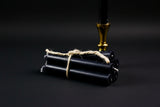
A devotional altar may include a symbolic image, journal, ordinary food or water, supervised candle or LED light, and other personally meaningful objects. If the practice includes offerings, a simple brass ritual offering bowl gives water, food, or another appropriate offering a dedicated vessel. If candlelight is part of the practice, a black chime candle is a compact option when black symbolism fits the practitioner’s own system. Entity-specific images and devotional products make more sense only when they match the practitioner’s particular theology.
Offerings should be disposed of hygienically. Do not leave food, wax, glass, salt, or other materials outdoors where they may harm wildlife or become litter. Do not burn unknown herbs, powders, oils, plastics, or treated materials.
Prayer, divination, and discernment
Thoughts, dreams, emotional shifts, candle movement, coincidences, and divination results may feel spiritually significant, but they are not automatic proof of an external message. Record the experience, consider ordinary explanations, compare it with reliable sources, and avoid making major decisions solely from an impression.
Automatic writing, pendulums, tarot, trance, and dream interpretation are influenced by expectation and interpretation. They should never be treated as unquestionable commands concerning health, money, relationships, legal matters, safety, or another person’s consent.
No blood pact or dangerous initiation is required
Cutting, finger-pricking, blood signatures, bodily fluids, self-injury, weapons, intoxication, sexual access, illegal acts, cemetery trespass, animal harm, or destruction of property are not measures of spiritual sincerity. A dedication can be expressed through ordinary ink, spoken words, prayer, art, study, or a private statement of values.
Any teacher or group that presents injury, sex, illegal conduct, or unquestioning obedience as mandatory initiation is creating a safety problem, not demonstrating deeper religious authority.
Relationship to the Left-Hand Path
Theistic Satanism is frequently discussed within the Left-Hand Path because of its emphasis on personal authority, self-directed initiation, adversarial symbolism, and resistance to externally imposed religious law. Devotion is not necessarily understood as submission; practitioners may describe it as alliance, mentorship, kinship, reciprocity, or another relationship.
Organization and diversity
Theistic Satanism has no single central institution. Variation includes:
- the identity and nature of Satan;
- the relationship between Satan, Lucifer, demons, or other deities;
- ritual structure and acceptable offerings;
- ethics and community standards;
- the use of Christian, Pagan, ceremonial, or personal cosmology;
- the role of revelation, historical sources, and individual practice.
Broad claims about “what all theistic Satanists believe” should therefore be treated cautiously.
How to evaluate teachers and communities
Healthy communities allow questions, respect boundaries, publish clear expectations, and permit members to leave. Warning signs include:
- racism, antisemitism, political violence, or praise of extremist movements;
- demands for secrecy about abuse or illegal conduct;
- pressure to isolate from friends, family, or professional care;
- sexual coercion presented as initiation;
- large unexplained fees, financial control, or required gifts;
- claims that one leader alone speaks for Satan and cannot be questioned;
- instructions to harm people, animals, or yourself;
- threats that leaving the group will cause supernatural punishment.
Extremism, cruelty, and exploitation are not evidence of deeper occult knowledge. Leave unsafe groups and seek support from trusted people or appropriate authorities when necessary.
Mental wellbeing and grounded practice
Pause any practice that causes persistent fear, loss of sleep, compulsive checking, isolation, paranoia, or a belief that threatening instructions must be obeyed. Spiritual practice should not replace medical or mental-health care.
Common misconceptions
“Theistic Satanism is one organized religion.”
No. It is an umbrella category covering varied devotional and spiritual traditions.
“It is identical to medieval devil worship.”
No. Modern theistic Satanism is a contemporary development rather than a documented uninterrupted medieval religion.
“Theistic Satanism is inherently criminal or violent.”
No. Religious belief should not be confused with criminal conduct or moral-panic narratives.
Frequently asked questions
What makes Satanism theistic?
The practitioner understands Satan or a related figure as a real spiritual being rather than only a symbol.
Is Lucifer always the same as Satan?
No. Some practitioners identify them, while others treat them as different beings, aspects, or symbols.
Does every theistic Satanist perform invocation?
No. Practice may emphasize prayer, study, meditation, offerings, art, or private devotion instead.
Is a blood pact required?
No. Blood, cutting, or self-injury is unnecessary. A dedication can be made through ordinary writing, prayer, art, or study.
Related reading
- Left-Hand Path vs. Right-Hand Path: Meaning, Differences & Examples
- How Scholars Distinguish Theistic and Atheistic Satanism
- Non-Theistic Satanism
- Exploring Satanism: Beliefs, Ethics, and Finding Your Path
- Satanic Ritual Tools and Altar Construction
Selected references
- Dyrendal, Asbjørn, James R. Lewis, and Jesper Aa. Petersen. The Invention of Satanism.
- Faxneld, Per. Satanic Feminism.
- Petersen, Jesper Aa., ed. Contemporary Religious Satanism.
- van Luijk, Ruben. Children of Lucifer.
Related Occult Jewelry & Devotional Tools
Readers interested in wearable or altar symbolism can browse Occult Necklaces & Pendants and Statues, Idols & Talismans. These are symbolic goods rather than evidence for any theological claim described above.
Tools for this practice
Explore the products selected for this guide. Review each listing for what is included and how to use it.

Shop this guide · 1 item Collapse
Keep exploring the shop
You made it to the end of the guide. Keep exploring through related products, major departments, or the full catalog.
 RELATED TO THIS GUIDE
Candles & Incense
Shop this topic
RELATED TO THIS GUIDE
Candles & Incense
Shop this topic


Leave a comment