


How to Build an Occult Study Plan: Questions, Sources, and Sustainable Progress

Occult study becomes difficult when every new book, tradition, symbol, and recommendation feels equally urgent. A person may collect a large library while still feeling unable to explain what they believe, where a claim came from, or how one subject connects with another.
A study plan solves that problem by giving curiosity a temporary structure. It does not lock you into one path forever. It helps you choose a question, identify suitable sources, schedule realistic work, and decide what you have learned before moving on.
Start With a Question, Not a Shopping List
A useful study plan begins with a question narrow enough to answer. “Learn witchcraft” is a direction, not a research question. Better questions include:
- How did protective household practices differ from modern protection spells?
- What is the historical relationship between grimoires and modern personal magical journals?
- How do three modern Pagan traditions understand offerings?
- Which parts of a correspondence system come from an identifiable text, and which are later additions?
- What does a particular ritual tool do within one named tradition?
Your question should identify a subject, a boundary, and a reason for studying it. Write down what you hope to understand, not what conclusion you want the sources to confirm.
Choose the Type of Study
Survey study
A survey gives you vocabulary, major divisions, important names, and a map of the subject. It is useful when you are new, but it should not be mistaken for mastery.
Focused historical study
This examines a limited period, region, text, movement, or material tradition. It requires attention to dates, editions, translations, and scholarly disagreement.
Tradition-based study
This asks how a living or reconstructed religious or magical tradition understands its own practice. Community sources, liturgy, teachers, and internal terminology may matter alongside academic work.
Practical study
This examines a skill through controlled practice, such as learning a tarot spread, maintaining a devotional routine, or comparing incense methods. Practice notes should remain separate from claims about universal history or causation.
Many plans combine these types, but naming the primary type helps you select sources.
Define the Boundaries
Before gathering material, write what the plan will not cover. A six-week study of European witch bottles cannot also become a complete history of folk magic, demonology, household religion, archaeology, and modern spell jars.
Useful boundaries include:
- one period or century;
- one region or language;
- one tradition or comparison between two traditions;
- one object, text, practice, or concept;
- a fixed number of books or articles;
- a start date and review date.
Boundaries protect the study from endless expansion. New questions can be placed on a later-reading list rather than added immediately.
Build a Source Ladder
Use several kinds of sources instead of expecting one book to do every job.
- Orientation: a reliable overview that defines vocabulary and introduces major debates.
- Secondary scholarship: historians, archaeologists, religious-studies scholars, or other specialists analyzing evidence.
- Primary material: historical texts, inscriptions, objects, court records, liturgy, diaries, interviews, or field records relevant to the question.
- Tradition and practitioner sources: material that explains how participants understand or perform the practice.
- Reference tools: dictionaries, catalogues, bibliographies, manuscript descriptions, museum records, and indexes.
These sources answer different questions. A modern practitioner manual may be excellent for learning that author’s method while remaining weak evidence for a claim about the ancient world.
Use How to Evaluate an Occult Book and Primary vs. Secondary Sources in Occult Study when building the list.
Check Editions and Translations
A title alone may not identify the text you are actually reading. Record the author or attributed author, translator, editor, publisher, publication date, edition, and whether the book is complete or abridged.
Older occult texts may survive in several manuscripts or later printed forms. Modern editors can choose different source texts, modernize language, rearrange material, or add commentary. Read Why Occult Books Disagree before treating differences as evidence that one edition is fraudulent.
Turn the Topic Into Modules
A four- to eight-week plan works well for many focused subjects. Each week should have one question and one achievable output.
Example six-week structure
- Vocabulary and scope: define the subject and list disputed terms.
- Historical context: identify dates, places, communities, and social conditions.
- Primary evidence: examine selected texts, objects, or records.
- Modern interpretation: compare practitioner and popular presentations.
- Practice or case study: analyze one method without claiming universal results.
- Review: summarize what is supported, uncertain, disputed, or still unknown.
The final output might be a two-page summary, timeline, annotated bibliography, comparison table, or set of revised questions. It does not need to become a public article.
Set a Sustainable Reading Load
Estimate time rather than pages alone. A difficult chapter with footnotes may require more attention than an entire introductory book. A realistic weekly plan might include:
- one substantial chapter;
- one academic or museum article;
- one primary-source excerpt;
- thirty minutes of note review;
- one short practical or reflective exercise.
Leave space for rereading. Speed is not progress when nothing can be recalled, compared, or explained afterward.
Use a Consistent Note System
For every source, record:
- full bibliographic information;
- page numbers or stable section references;
- the author’s main claim;
- the evidence offered;
- important terms;
- short quotations clearly marked as quotations;
- your questions and objections;
- connections with other sources;
- what the source cannot establish.
Keep direct quotations, paraphrases, and personal interpretations visibly different. Our guide Ritual Recordkeeping applies the same principle to practice: preserve what happened before deciding what it means.
Connect Study With Practice Carefully
Practical exercises can help you understand structure, symbolism, and skill, but they should match the subject and your level of access.
Suitable exercises might include:
- diagramming a ritual sequence;
- comparing translations of a short passage;
- tracking one devotional practice for a defined period;
- building a sourced correspondence table;
- observing how one tool is described across several books;
- visiting a museum collection or reading an archaeological catalogue.
Do not imitate dangerous historical treatments, consume unknown substances, trespass, remove artifacts, or reproduce restricted rites simply to make the study feel authentic.
Schedule Review Points
At the midpoint, ask:
- Is the original question still workable?
- Are all sources repeating one another?
- Am I missing a primary source or a tradition-based perspective?
- Has one major term changed meaning across time?
- Do I need to narrow the plan?
At the end, divide conclusions into four categories: well supported, plausible but uncertain, disputed, and unsupported. This is more useful than forcing every question into a confident answer.
Common Study-Plan Mistakes
- Buying many books before defining the question.
- Reading only authors who cite one another.
- Confusing a modern practice guide with a historical source.
- Taking notes without page references.
- Expanding the topic whenever a new term appears.
- Treating disagreement as proof that research is impossible.
- Practicing every method immediately.
- Never scheduling a final review.
A Reusable Study-Plan Template
- Central question:
- Why it matters:
- Dates, places, or traditions included:
- What is excluded:
- Key vocabulary:
- Orientation source:
- Secondary sources:
- Primary material:
- Practitioner or community sources:
- Weekly schedule:
- Practical exercise:
- Midpoint review:
- Final output:
- Next questions:
Build a Working Library
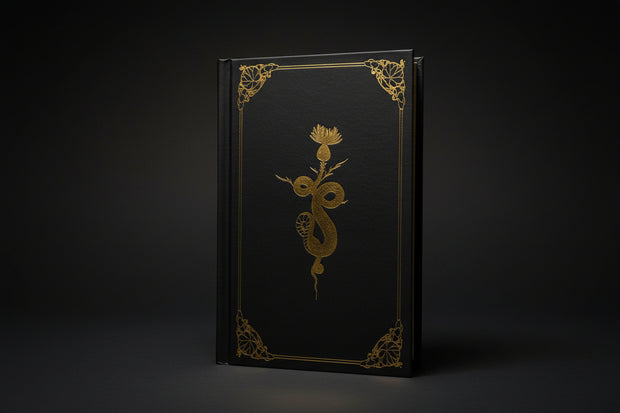
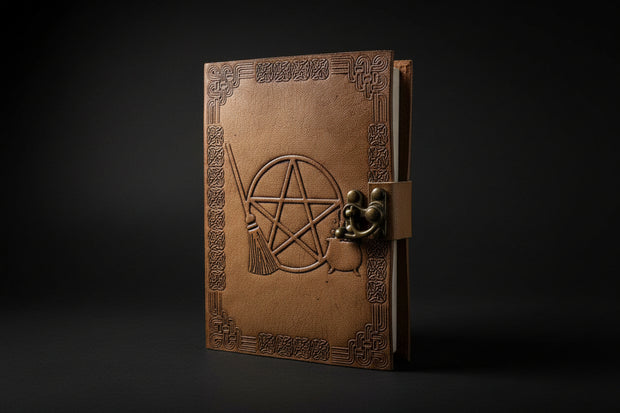
Explore Printed Works for books that can support a focused reading plan and Journals for organized notes. The Pentagram Broom Leather Journal and Book of Shadows Paper Journal can provide dedicated space for source notes, timelines, and questions.
Frequently Asked Questions
How many books should be in one study plan?
Use the smallest number that gives you a reliable overview, evidence, and more than one perspective. Three carefully chosen books can be more useful than twenty unread titles.
How long should a study plan last?
Four to eight weeks is manageable for a focused question. Larger subjects can be divided into several plans.
Do I need academic sources?
They are especially important for historical, archaeological, linguistic, and comparative claims. They should be read alongside relevant primary and community sources rather than treated as the only possible perspective.
Can practice count as research?
Practice can reveal personal experience and help you understand a method. It does not by itself prove that the method is ancient, universal, or causally effective for everyone.
What if the sources disagree?
Record the disagreement, identify the evidence and assumptions behind each position, and leave the conclusion open when the available material does not settle it.
Study With an Ending in Mind
A useful occult study plan does not promise complete knowledge. It turns a broad fascination into a question you can investigate honestly. Choose the scope, build a balanced source ladder, make notes you can verify, and finish with a clear account of what you learned and what remains uncertain.
Tools for this practice
Explore the products selected for this guide. Review each listing for what is included and how to use it.
Shop this guide · 2 items Collapse


Keep exploring the shop
You made it to the end of the guide. Keep exploring through related products, major departments, or the full catalog.
 RELATED TO THIS GUIDE
Ritual Supplies & Altar Tools
Shop this topic
RELATED TO THIS GUIDE
Ritual Supplies & Altar Tools
Shop this topic


Leave a comment