


How to Use Crystal Towers: Altars, Grids, Meditation, Display, and Care

Crystal towers are polished mineral forms shaped with a flat base, an upright body, and a pointed top. Their strong vertical profile makes them easy to place at the center of an altar, meditation area, crystal grid, shelf, or working space. In modern crystal practice, the point is often used symbolically to represent direction, concentration, movement, or focused intention.
The shape is only one part of the object. A tower may be carved from quartz, calcite, fluorite, obsidian, jasper, glass, resin, or another natural or manufactured material. Each has different physical characteristics. Before choosing a cleansing method, placing a tower in sunlight, or using it around water, identify what the piece is actually made from.
This guide explains how to use crystal towers for ritual, meditation, grids, and display while separating physical facts from metaphysical belief. It also covers point direction, stability, care, storage, and the difference between a polished tower and a naturally formed crystal point.
What Is a Crystal Tower?
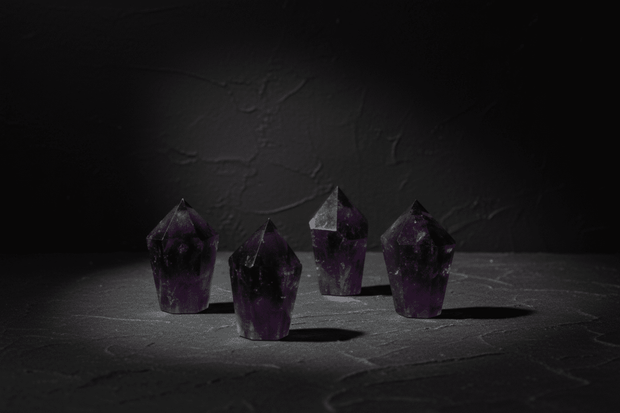
A crystal tower is usually a polished, human-shaped piece with a level base and a tapered point. Some towers have six distinct sides, while others have more faces, rounded transitions, irregular edges, or decorative carving. The term describes the finished form rather than one mineral species.
Retailers and practitioners may also use words such as obelisk, point, or generator. These labels are not applied consistently. One seller may call a simple polished point a tower, while another reserves “generator” for a larger central point or a multi-point cluster. When comparing pieces, rely on the actual construction, dimensions, material, and base rather than assuming that every label identifies a standardized shape.
A tower is usually cut and polished from a larger piece of material. Its point did not necessarily grow that way in the earth. This distinction matters when discussing geology, rarity, and price. A polished tower can reveal beautiful color, pattern, inclusions, and banding, but the finished geometry is generally produced by lapidary work.
What the Shape Changes
The tower form changes how a specimen stands, displays, and functions as a visual focal point. It can make internal patterns easier to see, provide a stable upright orientation, and create a clear direction through the point.
What the Shape Does Not Change
Cutting a material into a tower does not change its mineral identity. Quartz remains quartz, fluorite remains fluorite, and glass remains glass. The shape also does not prove that a piece is more powerful than a tumble, palm stone, sphere, slab, or natural specimen.
Claims that a point directs, amplifies, gathers, or projects spiritual energy belong to modern metaphysical belief and ritual interpretation. They are not scientifically established properties of the geometry. The symbolism may still be meaningful within a practitioner’s system, but it should be presented as symbolism rather than physical fact.
Crystal Tower, Natural Point, Wand, and Sphere
The store’s broader guide to tumbled stones, palm stones, towers, and natural specimens compares the major forms. The following distinctions are especially useful when choosing a directional crystal piece.
Polished Crystal Tower
A tower normally has a flat base and stands upright without a separate holder. Its point gives the arrangement a strong vertical line. This makes it useful for permanent displays, altar centers, tabletop grids, and visual meditation.
Natural Crystal Point
A natural point developed through the mineral’s growth process and may preserve crystal faces, a termination, matrix, contact marks, or other geological features. It may not stand upright without support. Natural points vary greatly in completeness and condition, and a damaged or incomplete termination does not make a specimen worthless.
Double-Terminated Point or Wand
A double-terminated form has a point at both ends. It may be natural or shaped. Because it usually lacks a flat base, it is commonly placed horizontally, held briefly, or supported in a stand. Modern practitioners may associate its two directions with exchange, connection, or movement between two positions.
Crystal Sphere
A sphere has no single permanent point. Practitioners often interpret it as radiating evenly, representing wholeness, or supporting scrying and contemplation. A tower creates a clear directional emphasis, while a sphere creates a more centralized, non-directional visual form. For sphere-specific guidance, see Crystal Spheres in Witchcraft.
How to Choose a Crystal Tower
Identify the Material First
Do not choose care methods based only on color. Similar-looking towers can be made from very different substances. Purple material may be amethyst, fluorite, dyed quartz, glass, or another stone. Black towers may be obsidian, onyx, tourmaline-bearing material, jasper, glass, or a composite.
Ask for the exact material name and whether the piece has been dyed, coated, stabilized, filled, reconstructed, or manufactured. Treatments do not automatically make a tower undesirable, but they affect care, value, and accurate description.
Inspect the Base
Place the tower on a level surface and lightly test its stability. The base should sit flat enough that ordinary vibration does not make the piece rock. A tall tower with a narrow or uneven base can tip easily even when the material itself is heavy.
Do not force an unstable tower to stand near the edge of a shelf, beside a candle, above a bed, or where a pet can reach it. A display stand or a horizontal storage position may be safer than upright use.
Check the Point and Edges
Small tip chips are common in pointed mineral pieces. Inspect for sharp edges, loose fragments, open fractures, and areas that appear ready to separate. A chip may affect price or appearance, but it is not automatically a spiritual sign.
Run your eyes—not your fingertips—along delicate edges first. Some polished pieces can still have sharp corners, and fibrous, flaky, or fractured materials should be handled cautiously.
Consider Height, Weight, and Center of Gravity
A larger tower creates visual presence but requires more stable furniture and more clearance. Measure the shelf depth and height before purchasing. Consider whether the tower can be lifted safely, especially if it is dense, slippery, or wider at the top than expected.
Small towers are easier to use in compact grids, travel setups, and temporary altars. Large towers are usually better as stationary display pieces than as objects repeatedly carried or held during meditation.
Look at the Polish and Natural Features
Polishing can reveal bands, inclusions, veins, flashes, fractures, and color transitions. Natural cracks and inclusions are not necessarily defects, but they can create weak points. Inspect the whole object rather than judging only the most attractive face.
Cloudiness, pits, uneven color, and internal lines may be natural, caused by treatment, or produced during cutting. Ask questions when material identity or condition affects your decision.
Which Direction Should a Crystal Tower Point?
There is no universal rule. Point direction is a ritual choice shaped by intention, tradition, and practical layout.
Pointing Upward
Most towers naturally stand with the point upward. Modern practitioners may interpret this as aspiration, clarity, connection, growth, prayer, or movement from foundation toward a goal. It is also simply the most stable and visually familiar orientation.
Pointing Toward a Petition or Object
A smaller tower can be placed so the point visually leads toward a written intention, candle, offering bowl, card, symbol, or central object. This arrangement can help focus attention on the purpose of the working.
Pointing Outward
In some modern grid and protection practices, towers or points face away from the center to symbolize expansion, release, boundary-setting, or directing attention toward the surrounding space.
Pointing Inward
Points facing toward the center may represent gathering, concentrating, receiving, or bringing several parts of a working toward one purpose.
These meanings are symbolic conventions, not physical laws. Choose a direction you can explain and use consistently. Avoid pointing a large or sharp tower toward a place where someone could fall onto it.
Seven Ways to Use Crystal Towers
1. As an Altar Focal Point
Place one tower near the center or back of the altar where it is visible but not in the path of your hands. Its height can establish a visual center without requiring many objects. Leave enough room to reach candles, bowls, cards, or tools safely.
The mineral may be chosen for personal symbolism, color, devotional association, or simple beauty. Research deity and tradition-specific symbolism rather than assuming every crystal belongs on every religious altar.
2. Beside a Written Intention
Write one clear goal and one practical action on a small piece of paper. Place the tower beside it as a reminder of focus and follow-through. The tower does not replace the action. Its purpose is to make the commitment visible.
3. For Visual Meditation
Set the tower on a stable surface at a comfortable viewing distance. Observe its shape, color, inclusions, reflections, and changes under ordinary room light. When attention wanders, return to one visible feature.
Visual meditation does not require staring without blinking or forcing an altered state. Stop if eye strain, dizziness, headache, anxiety, or discomfort develops.
4. As the Center of a Crystal Grid
A tower can provide a vertical center surrounded by tumbles, palm stones, symbols, written words, or other objects. The arrangement may represent a central goal with supporting themes placed around it.
5. To Mark Directions or Boundaries
Four small towers can mark the edges of a tabletop working space or the cardinal directions in a system that uses them. Their points may face inward or outward according to the intended symbolism.
This setup is optional and should not be presented as a universal ancient practice. Directional correspondences differ among Wiccan, ceremonial, Pagan, and personal systems.
6. In Seasonal or Devotional Displays
A tower can add height to a seasonal shelf or shrine. Choose color and material deliberately, but do not allow the crystal to replace the actual history, ecology, mythology, or devotional customs being honored.
7. As a Workspace Reminder
Place a stable tower near a journal, desk, art area, or project station. Assign it one practical meaning, such as completing one task before opening social media or protecting a scheduled period of study. The object becomes a cue connected to behavior rather than a promise of automatic results.
How to Use a Crystal Tower in a Grid
A crystal grid is a deliberate arrangement of stones, symbols, and space. Practitioners may use geometric patterns, intuitive placement, printed grid cloths, or simple circles. There is no single mandatory design.
A Simple Central-Tower Grid
- Choose one purpose that can be stated in a sentence.
- Place the tower on a stable tray, cloth, or table.
- Arrange three to eight smaller stones around it with enough space between pieces.
- Add a written practical action beneath or beside the arrangement.
- Decide whether surrounding points face inward or outward and record why.
- Leave the grid in place only where it will not be disturbed or create a hazard.
- Close the working when its purpose is complete, outdated, or no longer useful.
A grid does not guarantee money, healing, protection, love, or any other outcome. It can serve as a symbolic map, meditation aid, devotional arrangement, or reminder of practical commitments.
Grid Safety
- Do not crowd towers around candle flames or incense burners.
- Keep tall pieces away from table edges and walking paths.
- Do not place unstable towers on thick fabric that makes the base wobble.
- Avoid leaving small stones where children or animals can swallow them.
- Do not place heavy grids on fragile shelves or electronics.
- Photograph the arrangement before dismantling it if you want a record.
A Simple Crystal Tower Focus Ritual
This modern ritual uses the tower as a visual symbol of direction and does not require candles, smoke, or additional crystals.
What You Need
- One stable crystal tower
- A piece of paper and pen
- A clear working surface
- An optional LED candle or ordinary lamp
1. Inspect the Tower
Confirm that the point, base, and surface are secure. Place it where it cannot fall. Physical preparation comes before spiritual interpretation.
2. Define the Purpose
Write one goal in plain language. Avoid vague requests such as “change my life.” A clearer statement might be: “I will complete the first draft of my application this week.”
3. Name the Practical Action
Write the first step and when you will take it. Ritual intention is strongest when connected to a realistic action.
4. Orient the Tower
Leave it upright or turn a smaller supported point toward the written statement. Say:
I use this tower as a symbol of clear direction. My attention returns to the work I have named, and my next step is within my responsibility.
5. Sit With the Image
Observe the line from base to point for several minutes. Let the base represent current conditions and the point represent the chosen direction. Notice the distance between them without pretending the outcome has already occurred.
6. Begin the Work
Complete at least a small part of the practical action immediately when possible: open the document, make the call, gather the supplies, schedule the appointment, or write the first paragraph.
7. Close and Record
Turn off the light, put the tower in its safe place, and record what you did. Review the result later instead of interpreting every immediate feeling as proof.
Displaying and Storing Crystal Towers Safely
Use a Stable Surface
Place towers on level furniture that can support their weight. Low shelves are safer for heavy pieces. Avoid narrow ledges, vibrating speakers, unstable book stacks, loose trays, and surfaces bumped by doors or drawers.
Protect People and Animals
Keep pointed pieces away from bed edges, seating areas, play spaces, and places where someone may reach without seeing them. A high shelf is not automatically safe if a cat can jump onto it or the tower could fall from above.
Limit Direct Sunlight
Prolonged sunlight can fade or alter the appearance of some minerals, dyes, coatings, and resins. Sun can also heat the object and surrounding surface. Display valuable or light-sensitive pieces away from strong direct exposure unless you have reliable material-specific guidance.
Store Towers Separately
Wrap each tower in a soft clean cloth, padded sleeve, or divided container. Protect the point from impact and prevent harder stones from scratching softer ones. Do not store towers loose in a box where they can strike one another.
For a broader system covering crystals, herbs, candles, liquids, papers, and ritual tools, use How to Store Witchcraft Supplies.
Transport Upright Only When Secure
Most towers are safer transported on their side in padding than standing inside a bag or box. Do not carry a heavy tower by the point. Support the base and body with both hands when needed.
How to Clean and Care for a Crystal Tower
Identify Before Cleaning
Water, salt, sunlight, oil, alcohol, and household cleaners can damage certain minerals, dyes, coatings, metals, adhesives, and composite materials. When the exact material is unknown, begin with a soft dry cloth or clean brush.
The detailed guide to cleansing and charging crystals safely explains why one method should not be applied to every stone.
Clean Over a Padded Surface
Hold the tower by its body and base rather than the tip. Work over a folded towel or padded table so a slip is less likely to cause a chip. Do not submerge an unknown piece or scrub fractures aggressively.
Separate Physical Cleaning From Spiritual Cleansing
Dust, skin oil, smoke residue, wax, and dirt require physical cleaning appropriate to the material. Sound, prayer, visualization, moonlight, or ritual intention may be used as spiritual practices, but they do not remove physical residue or repair damage.
Avoid Salt Beds and Water Soaks
Salt can scratch surfaces, enter fractures, retain moisture, and damage sensitive materials. Water can dissolve, weaken, discolor, rust, separate, or cloud some pieces. Neither method is universally safe.
Do Not Make Crystal Elixirs
Do not place a tower in drinking water, tea, alcohol, or another beverage. Mineral identity, treatments, contaminants, adhesives, and surface residue may be uncertain. Use the tower beside a sealed food-safe container when symbolic proximity is desired.
Responding to Chips and Breaks
Stop handling a damaged tower if it has a sharp point, loose fragment, or unstable fracture. Small chips may be smoothed professionally, displayed carefully, or accepted as part of the object’s history. A major break may require retirement, repurposing, or disposal according to the material.
A broken tip is not automatically a warning, curse, absorbed negativity, or failed ritual. First consider ordinary causes such as impact, pressure, temperature change, an existing fracture, or unstable placement.
Common Crystal Tower Mistakes
Confusing Shape With Mineral Identity
“Tower” tells you how the object is shaped, not what it is made from. Always identify the material separately.
Assuming Bigger Means More Powerful
Size affects weight, visibility, cost, and stability. It does not provide an objective measurement of spiritual effectiveness.
Forcing an Unstable Piece Upright
A flat-looking base may still rock. Use another location, a suitable stand, or horizontal storage rather than accepting a fall risk.
Using the Point Aggressively
Do not jab, threaten, or point a heavy crystal at another person during ritual. Symbolic direction does not override consent or physical safety.
Placing Towers Too Close to Flame
Crystals do not make candles safer. Keep towers away from heat, dripping wax, charcoal, incense burners, and crowded cloth arrangements.
Using One Cleansing Method for Every Material
Unknown towers should not be soaked, salted, oiled, or placed in intense sunlight. Material-safe care is more important than following a dramatic cleansing method.
Treating Every Crack as an Omen
Minerals contain natural fractures and may be damaged during cutting, transport, handling, or display. Investigate physical causes before applying spiritual meaning.
Expecting the Grid to Replace Action
A tower arrangement may support focus or ritual, but it cannot complete applications, repair relationships, provide medical treatment, earn money, or enforce boundaries on its own.
Frequently Asked Questions
What is the difference between a crystal tower and a crystal point?
A tower is generally a polished form cut with a flat base and pointed top. A natural crystal point formed through mineral growth and may preserve natural faces, termination, and matrix. Retail terminology varies, so inspect the actual object.
Which way should a crystal tower face?
Most stand upright. In a grid, a point may face inward to symbolize gathering or outward to symbolize expansion or boundaries. These are modern symbolic choices, not universal rules.
Do crystal towers need to be cleansed?
No physical or spiritual method is universally required. Clean dust and residue according to the material. Spiritual cleansing is optional and should use a method that will not damage the piece.
Can crystal towers go in water?
Some materials tolerate brief contact better than others, but treatments, fractures, coatings, and exact identity may be uncertain. Use dry cleaning unless reliable material-specific guidance supports water.
Can one tower be used in a crystal grid?
Yes. One stable central tower surrounded by a few safely placed objects is enough. A grid does not need many crystals to be deliberate or useful.
What does it mean when a crystal tower breaks?
Usually, begin with physical causes: impact, instability, internal fracture, temperature change, or pressure. A practitioner may choose a personal symbolic interpretation, but breakage is not automatic proof of supernatural activity.
What is the best crystal tower for a beginner?
Choose a correctly identified, stable, manageable piece that fits your space and budget. Clear labeling, a flat base, intact point, and care instructions matter more than a long list of promised properties.
Can a tower be held during meditation?
Small smooth towers can be held carefully, but many are more comfortable and safer when placed on a table. Avoid gripping sharp, heavy, cracked, fibrous, or fragile pieces.
Use the Shape With Purpose
A crystal tower is useful because it combines an upright display with a clear point. That shape can support visual focus, altar organization, grid design, meditation, or a practical reminder of chosen direction.
Begin with material identity and stability. Decide what the point means within your practice rather than borrowing a rule you cannot explain. Keep metaphysical interpretation separate from physical fact, care for the mineral according to its actual properties, and connect ritual symbolism to actions that can be observed and completed.
A well-chosen tower does not need to be the largest, rarest, or most expensive piece in the room. It needs to be understood, safely placed, and used with a clear purpose.
Tools for this practice
Explore the products selected for this guide. Review each listing for what is included and how to use it.

Shop this guide · 3 items Collapse


Keep exploring the shop
You made it to the end of the guide. Keep exploring through related products, major departments, or the full catalog.
 RELATED TO THIS GUIDE
Crystals & Stones
Shop this topic
RELATED TO THIS GUIDE
Crystals & Stones
Shop this topic


Leave a comment